Master the sciences, master the arts. Become a polymath and a polyglot.
A hacker and a pianist. An entrepreneur and a poet. A mathematician and a writer. An investor and an athlete. A physicist and a historian.
Embrace the Greco-Roman ideal of being a well-balanced man.
Enough brainrot now let's learn about CNN and RNN explained in easy to understand words:
When people first hear about neural networks, they often think of a big black box that magically learns. But not all neural networks are the same. Two of the most important types are Convolutional Neural Networks (CNNs) and Recurrent Neural Networks (RNNs). Both are powerful, but they shine in different areas.
Convolutional Neural Networks (CNNs)
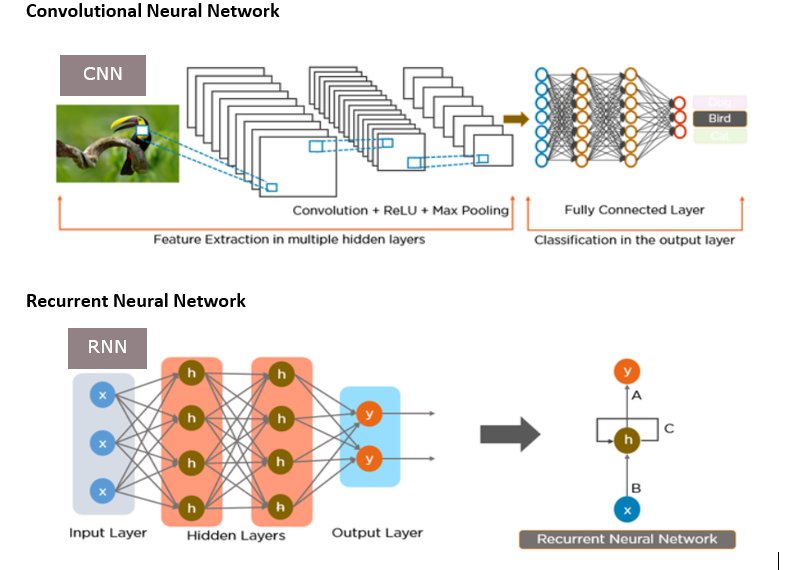
CNNs are like pattern detectors for images. They are designed to recognize shapes, edges, textures and higher-level patterns inside pictures. Instead of looking at the whole image at once, a CNN slides small filters across the image, focusing on local details first and then building up to the bigger picture.
Best for: Images, video frames, medical scans, object recognition.
Why: They are really good at handling spatial information, meaning they understand how pixels are arranged in space.
Example: A CNN can look at a cat picture and first notice edges, then whiskers, then ears, and finally recognize the whole cat.
Recurrent Neural Networks (RNNs)
RNNs are like memory keepers for sequences. Instead of treating every input as independent, they remember what came before and use that context for what comes next. This makes them perfect for sequential data where order matters.
Best for: Text, speech, music, time series data.
Why: They process one step at a time while carrying forward some information from the past, just like how you read a sentence word by word and keep the meaning in your head.
Example: An RNN reading “I love mango flavoured ice…” will expect the next word might be “cream” instead of something random like “masala dosa” because it remembers the context.
CNN vs RNN
CNNs handle space. They care about how data is arranged in two dimensions, like pixels in an image.
RNNs handle time. They care about how data flows step by step, like words in a sentence or stock prices over days.
CNNs are faster to train and scale well with large image datasets.
RNNs are slower and harder to train, but they are strong when sequence and context matter.
Quick Recap:
Use CNN when you want to process images or anything with spatial patterns.
Use RNN when you want to process text, audio, or any data that comes in sequences.
Both are building blocks of deep learning, and in real projects they are often combined with other techniques for even more powerful results.
The secret to life is to stay curious. Learn a new skill, get into Russian literature, start gardening, cultivate a niche interest. We live in a beautiful and fascinating world; do not let routine and problems and to-do lists destroy your sense of wonder.