Comparaison du taux de 🏭CO2 en g/kWh pour la production ⚡️électrique en 🇪🇺Europe durant les 12 derniers mois (du 03/06/25 au 02/06/26) en fonction du taux de sources 🌻bas carbone et du taux d'☀️ENR.
Données @ElectricityMaps#stats
@mzjacobson So the data are in. Higher % of renewable generation = higher electricity prices.
Not counting the cost of having blackouts from Portugal to France, or the cost of disposing of all of those non-recyclable turbine blades. Etc. etc. etc. etc.
The world burns through over 100 MILLION barrels of oil every single day. 🛢️🌍
🇺🇸 The U.S. alone consumes more oil than the next 3 countries combined.
🇨🇳 China continues rapid industrial growth.
🇮🇳 India is rising fast as energy demand surges.
Top 10 oil-consuming nations ranked 👇
BY IPCC AR6, RECENT GLOBAL WARMING ON WORST SSP5-8.5
Recent accelerated global warming temperature increases (2023-3025) are on the worst-case scenatio SSP5-8.5,
by IPCC AR6, WG1, SPM.
https://t.co/JkbW97j0JE
#globalwarming#climatechange
Fully phasing out fossil fuels by 2050 requires 1.6-1.8x more power generation than a standard 1.5°C pathway. And it’s not just more solar and wind: it means a much bigger role for nuclear and green hydrogen, too. Defossilization is a different beast than decarbonization.
Pays-Bas : en mai 2026 (5 semaines), les renouvelables ont couvert ... 65% des besoins électriques (dont deux semaines à 77%) : 👏
🔸photovoltaïque : 36,0%
🔸éolien terrestre : 12,1%
🔸éolien en mer : 11,1%
🔸biomasse : 6,0%
(en 2025, la part des EnR a été de ~60%)
@GBNEWS If we eat less meat, where will we get the energy to cycle more?
P.S. Net Zero is unattainable and irrelevant in a nation producing >1% of global CO₂ emissions.
The US is expected to retain its status as the world's largest economy this year, with projected GDP exceeding that of China, Germany, and India combined
The oil supply shock is now moving through the entire world economy
Asia is hit the hardest by the closure of the Strait of Hormuz. It is the largest oil importer globally, and ~84% of LNG and oil flows from the Strait were previously directed to Asia... that flow is now disrupted.
This has massive global implications.
Asia is also the world’s largest refining hub, accounting for ~40% of global refining capacity and ~50% of global fuel exports... both now under pressure.
No oil = no fuel = no exports
China, the largest fuel exporter, has already started restricting exports to protect domestic supply. As the shock persists, more countries will follow, extending restrictions beyond fuel to a wide range of critical goods.
Asia depends on oil/gas to sustain production
- ~60% of global plastic exports
- ~30% of fertilizer production
- ~20% of drug production
If this supply disruption persists, expect the world to go through a severe lockdown.
🚨The world generated 31,779 terawatt hours of electricity in 2025.
57% came from fossil fuels.
Global electricity generation mix:
🔴 Coal: 33%
🔴 Natural gas: 22%
💧 Hydro: 14%
☢️ Nuclear: 8.9%
☀️ Solar: 8.7%
💨 Wind: 8.5%
🔴 Other fossil: 2.7%
🔵 Other clean: 2.5%
Natural gas at 22% is the bridge fuel holding the grid together and AI is about to make it bigger (as i wrote in my previous article link in the comments).
44.9 GW of new US gas capacity is in the pipeline.
Meta is building 10 gas plants in Louisiana.
Google just contracted 1.5 GW in Missouri.
The 22% is heading higher before it heads lower.
The EU calls on member states to fast-track cohesion funds, including €34.6bn reallocated, to tackle surging energy costs affecting communities and businesses. https://t.co/raoiVl5ehf
Renewables overtook coal in global power generation in 2025. Coal's share dropped to LESS THAN A THIRD of global electricity for the first time 📉
Coal generation fell most in China and India, while the US saw coal rise to replace gas-fired electricity.
https://t.co/XqRiIMKgf4
By 2050, electricity is expected to represent around 58–61% of Europe’s final energy demand, up from roughly 23% today.
That means more than half of the European economy will be powered directly by electricity — electricity that can be produced almost entirely inside Europe.
Norway already exports gas volumes equivalent to more than 30% of total EU + UK gas consumption. In 2025, it was the EU’s largest supplier of pipeline gas, accounting for over 50% of EU gaseous gas imports.
If European domestic electricity production is scaled aggressively, and stable Norwegian energy supplies are included as part of the wider European energy space, Europe can move toward +75% energy independence from non-European sources by 2050.
That would be a historic shift. Europe would no longer be structurally dependent on Russian gas, Middle Eastern oil, American LNG or Chinese-controlled supply chains for its core energy security.
That is why pan-European coordination is critical to achieving this project.
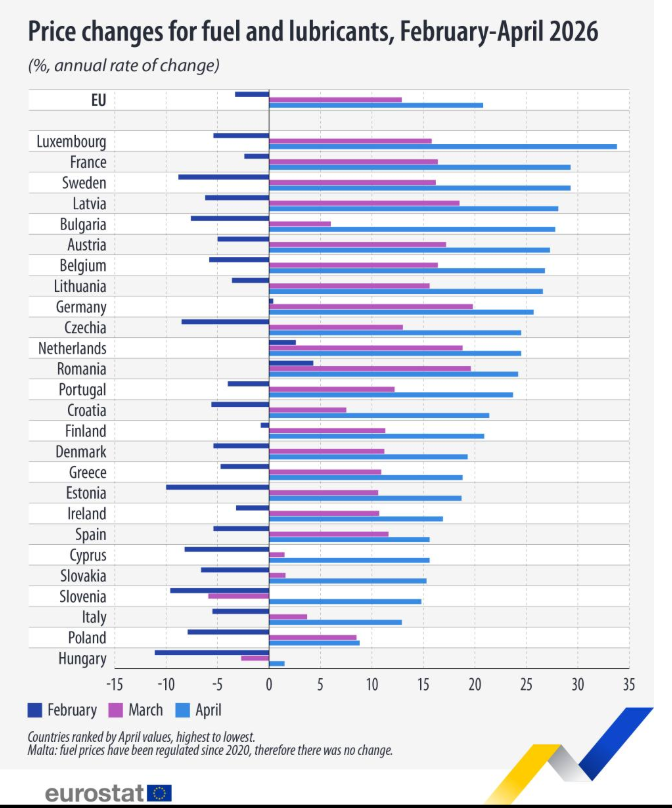
Strong increase in fuel prices continued in April 2026
In April 2026, fuel and lubricant prices for personal transport in the EU rose by 20.8% compared to April 2025, following a 12.9% increase in March 2026 compared to the same month.
Source: @EU_Eurostat
Something to keep an eye on next week--these are the forecasted max high temps for the next 7 days in Europe.
Note the chances for repeated record highs in top EU winter #wheat producer France (mostly dry over this span as well). #oatt#agwx
Source: Commodity Weather Group