Your real competition isn’t other people
It’s
-Your ego
-Your procrastination
-Your lack of discipline
-Your distractions
-Your bad habits
-Your self-doubt
-The knowledge you neglect to learn
-The unhealthy food you consume
Now go and defeat your real competition!
Barry Silbert, billionaire OG crypto entrepreneur is bullish on $TAO as the future of crypto.
Jason Calacanis, millionaire tradfi tech and AI investor is bullish on $TAO as the future of AI.
In THIS coming cycle, $TAO will be the biggest crypto of ALL time as the top AI leader.
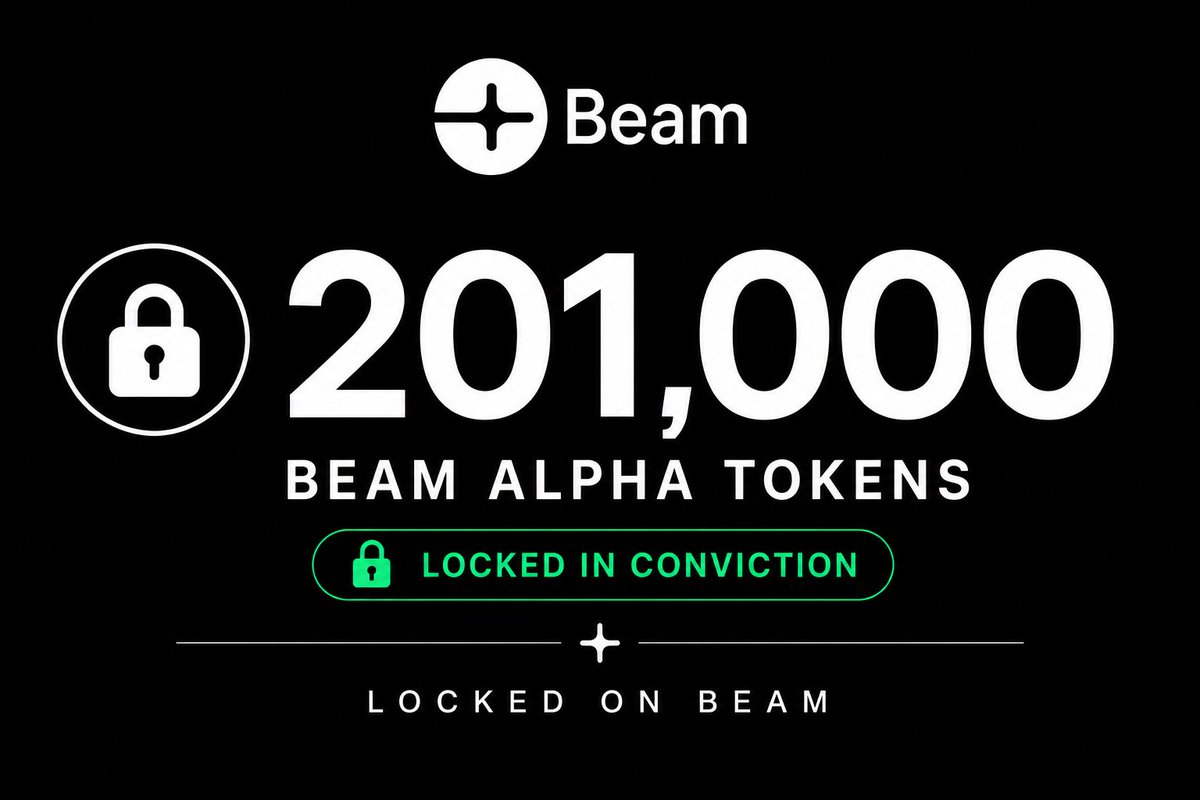
201,000 Beam Alpha committed in conviction. 🔒
This commitment extends beyond the Beam team.
We’re building decentralized bandwidth infrastructure with a clear objective: turn bandwidth into a programmable network that powers real products, real usage, and ultimately, real revenue.
Thank you to everyone who continues to support what we’re building. ⚡️
Jacob Steeves @const_reborn is back to building, and today he’s giving us a look at what he’s working on with @affine_io.
The Bittensor co-founder and former Opentensor Foundation CEO is joining @twistartups created by @Jason to talk about Affine, building AI on Bittensor, and where things are heading.
Tune in at 12 PM Central. This is one you won’t want to miss. 👀
Discounted price on frontier models on @say_gm_
Cheap uncensored models coming up next.
Cheaper because you get free inference just by holding GM alpha.
GM!
https://t.co/owum6mesaK
We're LIVE in one hour with @const_reborn, co-founder of @bittensor .
Jacob recently stepped down as CEO of the Opentensor Foundation and immediately went back to building. Now he runs @affine_io, a subnet designed to build the best AI model.
See you at 12 PM central!
𝟭𝟮𝟱,𝟬𝟬𝟬 𝗔𝗹𝗽𝗵𝗮. Locked perpetually.
We just increased our conviction lock on SN23.
We were already holding close to 100,000 Alpha under a decaying lock. We added another 25,000 and converted the entire position into a perpetual lock, with no decay, no unlock schedule, and no end date.
125,000 Alpha is now locked for good.
We are doing this for one reason. We are building the control layer for AI, and we intend to be here for every part of it.
While everything in Bittensor keeps shifting, we are doubling down with full commitment and no exit plan.
On-chain proof below.
����: https://t.co/c7IZsGFfSq
🔒: https://t.co/B7Xi2E97Q0
one of the reasons bittensor is so valuable is the unrestricted worldwide access to contributors which positions the protocol perfectly to benefit most from race to the bottom economics.
Affine’s new incentive mechanism introduces a novel ‘reason-distillation’ strategy.
Traditional distillation runs into performance degradation as smaller models struggle to accurately reproduce the complex reasoning trajectories of larger ‘teacher’ models.
Both the teacher and the student model are given a diverse set of coding scenarios. The teacher works through its own reasoning process and determines the ideal next step or action for each coding situation.
These coding scenarios, together with the teacher’s decision making, form the reference trajectories which Affine miner models are evaluated against. Miners commit challenger models, which compete against the current Affine champion on the same set of coding situations.
Affine's approach rewards reasoning that makes the teacher more confident in the next action it has chosen itself instead of reasoning that aims to exactly reproduce the path the teacher took to get to that decision. This high-parameter teacher model serves as a reasoning anchor. Affine’s S* v2 scoring algorithm then measures how much the challenger’s reasoning increases the frozen teacher’s probability of its own chosen action.
A miner challenger’s score depends on the change in the teacher’s confidence in its own reasoning after reading the challenger’s submission. The more the teacher��s confidence increases, the stronger the challenger is considered to be, regardless of the exact approach of reasoning.
This gives miner models freedom to discover alternative reasoning paths that may be shorter, more efficient, or better suited to their own parameter limitations. They do not need to reproduce the teacher’s exact reasoning trajectory; they need to produce reasoning that meaningfully strengthens the teacher’s chosen conclusion.
What's being evaluated is the final decision on the next step of action within the larger task and not the final solution to a problem.
A student does not have to replicate the exact way Einstein’s mind draws connections. Instead, the student reasons through a problem Einstein has already considered and explains an alternative path to the conclusion. The student succeeds when, after reading that explanation, Einstein becomes more confident in the conclusion he originally reached. We grade the effect of the student’s reasoning on Einstein’s confidence, rather than how closely the student imitates Einstein’s own thought process.
Latency update, first results.
Four production-ready models live on SN44 right now:
CRIME: 5MB, 70-80ms, ~75% accuracy
FIRE: 9.8MB, 60-70ms, ~90% accuracy
CARWASH: 9.7MB, 60-70ms, ~75% accuracy
ROADSIGN: 9.8MB, 70-80ms, ~85% accuracy
Read those numbers again 👇
Under 10MB. Under 80ms. Production-grade accuracy.
Small enough to run on a camera, a gateway, an embedded board...
That's the frontier we're optimizing: accuracy per byte, per millisecond.
The latency loop enforces it, and miners are converging faster than we expected.
More elements coming.
The goal was never another LLM. It was never even "an LLM that happens to train decentralized."
The goal is a sovereign, open-source platform for the whole model lifecycle: build it, serve it, fine-tune it, own it. Always available, to everyone, forever, borderless.
That is what Parallax and Chutes are for.
while other cloud providers are giving all their GPUs to the mega AI corps, lium has hundreds of GPUs available through leveraging a global network of providers.
you can rent anything from B300s to H200s to 5090s.
start your next AI training run now.
The names buying $TAO right now would surprise most of the market.
Retail is still debating whether Bittensor is real. The wallets already answered.
Barry Silbert holds roughly $100M in TAO through DCG and built Yuma, an entire incubator dedicated to Bittensor startups. He has compared its potential to early Bitcoin.
Jason Calacanis, the early Uber investor, is now a consulting partner at Stillcore Capital, a US hedge fund built exclusively around TAO and subnet tokens. His public call was a potential 200x from a $2.5B market cap.
Grant Cardone and Brian Dixon just disclosed TAO buys this week.
Chris Miglino’s DNA Fund committed around $50M in compute to mining Bittensor subnets and called decentralized AI possibly bigger than Bitcoin.
Polychain and dao5 were positioned years before any of them. Grayscale has already filed for a spot TAO ETF.
Now stack what they are actually buying:
21M hard cap, identical to Bitcoin. First halving complete, daily issuance cut from 7,200 to 3,600 TAO. Over 100 live subnets producing real AI services.
So who wins here? The people who treated Bittensor like infrastructure and positioned before the ETF decision.
Who thinks they win? Everyone calling decentralised AI a fad while billionaires quietly build entire funds around one token.
The people who read the docs always buy before the people who read the price.
Shoutout @WhatSayLew@JesusMartinez for the excellent breakdown.