Alpenglow is live on mainnet-beta ⛰️ 🎉
Solana’s new consensus protocol: finality reduced from 12.8 seconds to 150 milliseconds, built by Anza.
Why this is important 🧵
I remember the first time I see this tech , 1999, lockhead Martin was testing out new missle defense technology and the MKV was born , now our cars have that same propulsion technology
What a time to be alive
Today we're standing up XBOX LABS (https://t.co/dJSufI1vni). Here is the note that I sent to the team:
Team,
The first video games emerged some 75 years ago. In the time since, there have been booms and busts, but every year there are more great games to play, more devices to play them, and best of all, more people than ever playing. That growth helped make XBOX what it is today, and we've helped shape the industry in return, from bringing hard drives to consoles and online gaming through Xbox Live to Game Pass and cloud gaming, alongside franchises that have brought millions of people together.
In recent weeks, we've seen games rapidly decompiled and rebuilt to run on hardware they were never originally designed to support. Windows PC builds have been translated to run on Apple Silicon or ported to run inside a browser through WebAssembly and WebGPU, the latter now approaching 90% global browser support. Perhaps more surprisingly, we've seen many of the biggest games in the world have been remixed into the source code of another.
These experiments challenge long-held assumptions about our industry: the tether between software and hardware, the boundary between creation and play, and how people discover and experience games. While it is hard to predict the future of gaming, it is easy to see the possibilities in making great games easier to access, giving old games new life and allowing more players to become creators and co-creators. These are unmistakably good outcomes for players, even when (and sometimes because) they challenge our existing business models.
To explore these possibilities, I’ve asked Scott to stand-up XBOX LABS, a small group of game makers, engineers and scientists whose job is to turn emerging ideas into things our players and developers can experience. We'll build in the open, learn from what people do, and measure success by whether more people are playing and creating.
I think XBOX has an important role to play here. Coding became the first major workload for agents because they can write, run, and test software. Games share many of those same properties, and people spend more than 72 billion hours a year playing XBOX games, roughly five times the estimated time spent writing code worldwide. We've spent 25 years learning how to make great games, and I want our game makers to help shape what these new technologies make possible. As we learn, we’ll share the tools we build with developers across the industry, just as we always have.
Our priorities aren't changing. We remain committed to the 4Cs, to making great games, to our hardware and to being responsible stewards of IP and the communities built around it. LABS gives us a way to explore new technology that is game design led without abandoning the work already underway.
Asha
Ledger theft, day two. Since yesterday the thief has pushed ether through Tornado Cash three times, and each time on into Zcash's shielded pool. We followed every lot out the far side. Here is how, step by step.
1. THE SAME BUILD, THREE TIMES
An ether wallet pays a fresh splitter. The splitter pays four fresh wallets. The four drop it into Tornado Cash's 100, 10 and 1 ETH pools. Minutes, every time.
Run 1, yesterday 15:17: 1,254 ETH. Run 2, today 09:42: 1,291 ETH. Run 3, today 11:56: 450 ETH from 0xfa4EaBB840A33C156E600311433AE261CBfCb0e2, in the pools by 12:15.
2. OUT OF TORNADO CASH
The mixer breaks the link between a deposit and a withdrawal. We do not need the link. Our tooling fingerprints the withdrawal transactions themselves: how each one is constructed, who constructs it, and when.
Yesterday's 65 withdrawals (1,084 ETH) and today's 96 (1,726 ETH) all carry the same signature. The six other withdrawals from those pools in today's windows do not. Run 3 came out from 12:18 into 0x0d697aa182801566d87adc86e68e95fd3b2f5f82 (213 ETH) and 0x676b16cc18542f37d202a1a79ac05463395496a4 (122 ETH), and 195 ETH of it was inside a cross-chain swap service by 12:38. Forty-two minutes, end to end.
3. INTO ZCASH, AND OUT AGAIN
The swap service turns the ether into shielded ZEC, where sender, amount and recipient vanish. But the service's own shielding of each lot is public, and from it we derive a value signature for that lot's exit, then scan every transparent exit from the pool. 108 of 108 exits across both days match their lot to the zatoshi. Not one other exit from the pool does.
First lot today: in at 10:18:18, out at 11:06:16 in block 3512847 (8d26a9b095d4d28373527f7a6eb81a3be7f906d1e2190960c0512ff64f369418 and 738c6d1261e79766e4dd16bdbd38dced91b8e3a86ce41dcda83eda1f19208fbf), straight into a ZEC to USDC order.
Today so far: 20 lots ordered (2,379 ZEC, $2.9m), 14 out, 5 inside the pool, 1 still settling. Every exit feeds a ZEC to USDC order paying two wallets born at 11:11, 22 of the 28 paid by 12:43:
0x816D5Ee17DB1495d1409F135b98FF3edc5F3cDf8: 940,561 USDC
0xBA736A4b616e79867B6d586293966b552883f3F3: 852,258 USDC
1.79m USDC, unspent. @Circle can freeze it.
(1/2) 🧵⤵️
SIMD-0525 mission accomplished: 200ms slots are now live on mainnet-beta.
Blocks land twice as often as they did at genesis. An epoch now takes about a day instead of two.
IBRL
We’re rolling out monthly Claude Platform API credits for Max and Team plans:
Max 5x: $100
Max 20x: $200
Team: up to $500, pooled
Works on any model, including Haiku 5.5, in your code or third-party harnesses.
How it works and full terms: https://t.co/qmWL6xVGwr
One more thing: we’re halving the price of cache reads on Claude Sonnet 5.5, to $0.10 per million tokens. That makes Sonnet 5.5 around 20% cheaper to run on most long-running work.
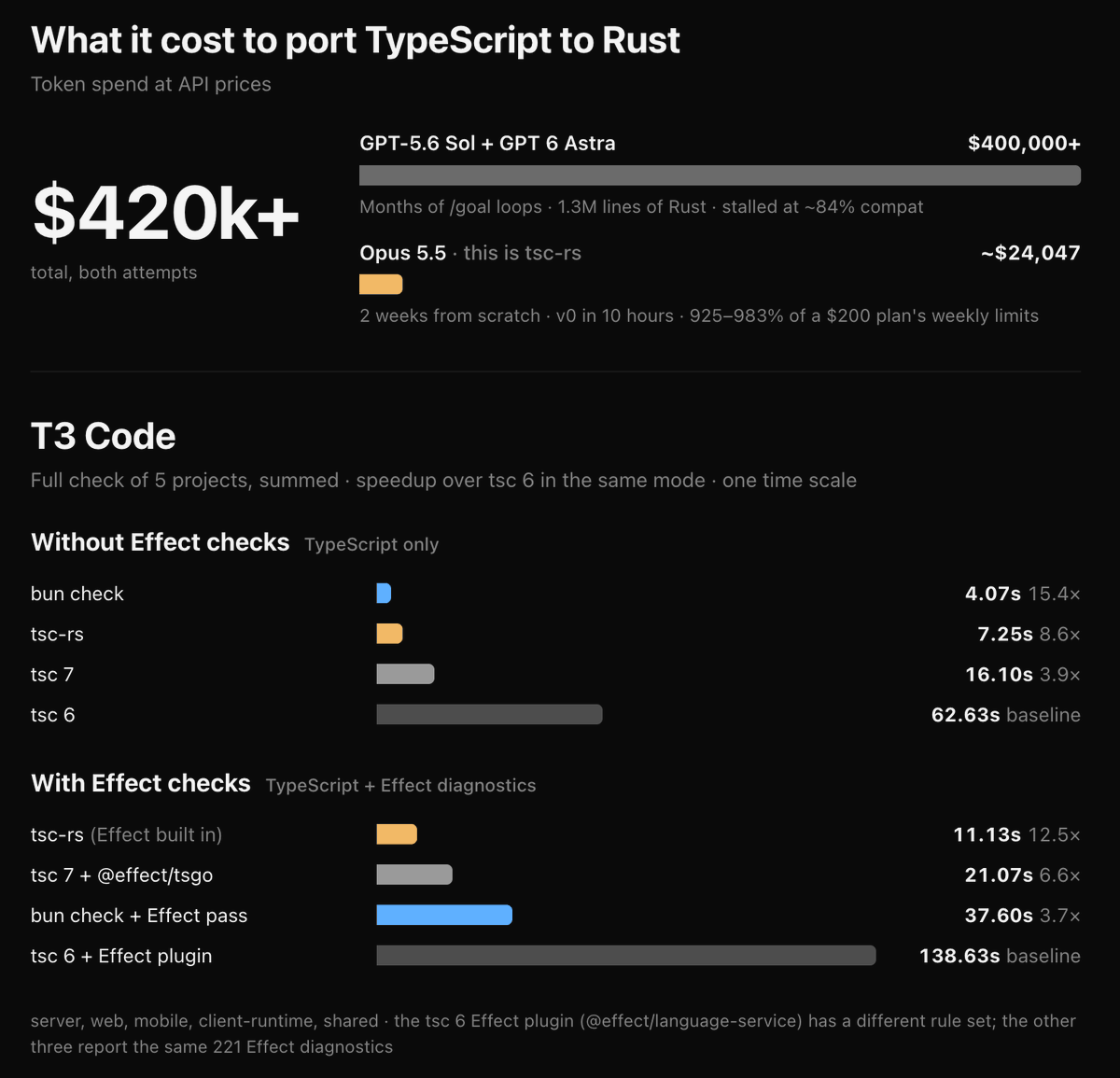
Announcing tsc-rs (aka ts-rust), my complete rewrite of the Typescript compiler, type checker, and LSP, all in Rust.
This is a project I've had agents working on for 5 months now. I burned ~$400k of Codex tokens and got nowhere. Burned ~$20k of Opus and got there in 2 weeks.
I have not read a single line of the code.
tsc-rs is an open source drop-in replacement for tsc, and it's available now.