A useful rule for evaluating new AI tools 🛠️: if the workflow becomes harder to explain after adding the tool, the tool may be creating complexity instead of reducing it ⚠️.
Large language models are changing search behavior 🔍. Instead of hunting for information across ten websites, people increasingly expect answers to arrive already synthesized and contextualized 📚.
The best automation is often invisible 👀. Nobody celebrates a workflow that quietly saves five minutes a day, yet those small gains compound into hundreds of hours over a year ⏳.
Software developers spent decades standardizing how applications talk to each other 🔄. AI agents are now facing the same challenge, and MCP is emerging as one of the strongest attempts to solve it 🏗️.
Not long ago, software was built to answer questions. Today, AI systems are increasingly expected to ask the right questions before producing an answer 🤖❓. That shift may be more important than the models themselves.
Startups are like dandelions - they spread quickly, adapt to their environment, and are tougher than they appear. Don't underestimate the power of a small seed with the right conditions.
Before MCP, every AI application needed its own way to access files, databases, and APIs 🔌. MCP introduces a shared language that makes tools easier to discover, connect, and use 🤝.
Machine learning models can identify patterns across millions of records 🔍. The challenge isn't finding patterns anymore. It's deciding which patterns are actually worth acting on 🎯.
MCP is doing for AI agents what HTTP did for the web 🌐. Instead of building custom integrations for every tool, agents can connect through a common protocol and focus on getting work done ⚙️.
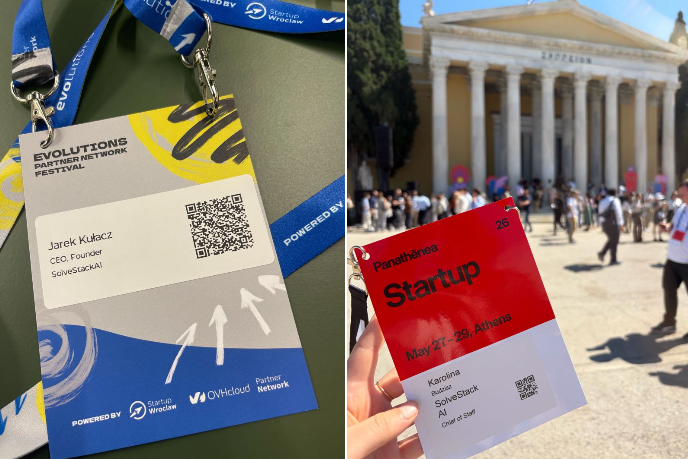
Just wrapped 2 events in 2 very different hotspots of Europe: EVOLUTIONS in Wrocław and Panathenea in Athens.
There's still a gap to be democratized. Large solutions are being adopted but smaller entrepreneurs innovate at an extreme pace. Founders have a lot to say.
Software used to be deterministic ⚙️. You clicked a button and got a predictable result. AI systems introduce probabilities, uncertainty, and judgment calls, which changes how applications must be tested and monitored 🔍.
One more reason to broaden your AI competences: for many families, the child is the more capable user. This creates a dynamic that is easy to miss. Parents who feel less competent with a tool are less likely to engage with it critically. Happy Children's Day, everyone ;)
AI agents are forcing companies to rethink software design 🤖. Instead of building screens for humans, teams are increasingly building workflows that machines can navigate and execute autonomously 🔄.
Every breakthrough in AI starts with better data 📊, not bigger models. A mediocre model trained on clean, relevant data will often outperform a sophisticated model fed with noisy information 🧹.
The companies gaining the most value from AI are rarely the ones making the loudest announcements 📢. They are usually the ones integrating small, reliable automations into workflows that employees already use every day 🔄.
Startups often overestimate the value of building new features 🏗️ and underestimate the value of simplifying operations. The best systems usually feel invisible because they quietly remove friction from daily work ⚙️.
AI tools are starting to resemble junior teammates 👨💻 more than traditional software. They can generate ideas, write drafts, and solve problems quickly, but they still require supervision, direction, and quality control 🎯.
The productivity gain from AI often comes from reducing decision fatigue 🧠 rather than saving raw time ⏳. Removing small repetitive mental tasks can dramatically improve focus during deep technical work.