Math isn't hard—it's hilarious. Your daily dose of fast math tricks, calculus guides, and geometry paradoxes. Let's solve for Z. Can your logic survive?
The intercept form y = mx + b offers a linear trajectory on an integer coordinate lattice.
Yet, this rational rise-over-run heuristic fails under irrational limits.
What analytical logic preserves plotting precision when m belongs to an irrational domain?
Most profiles blindly get confused by emotional variables instead of trusting pure algebraic reduction.
Look closely at this system of equations.
Why does modeling a complex human dynamic via linear matrices always trigger a logic crisis?
Most profiles blindly memorize the unit circle instead of using quick spatial shortcuts.
Save this math cheat sheet before the comments prove your arithmetic speed is safe but slow.
Which exact angle here triggers an undefined mathematical singularity?
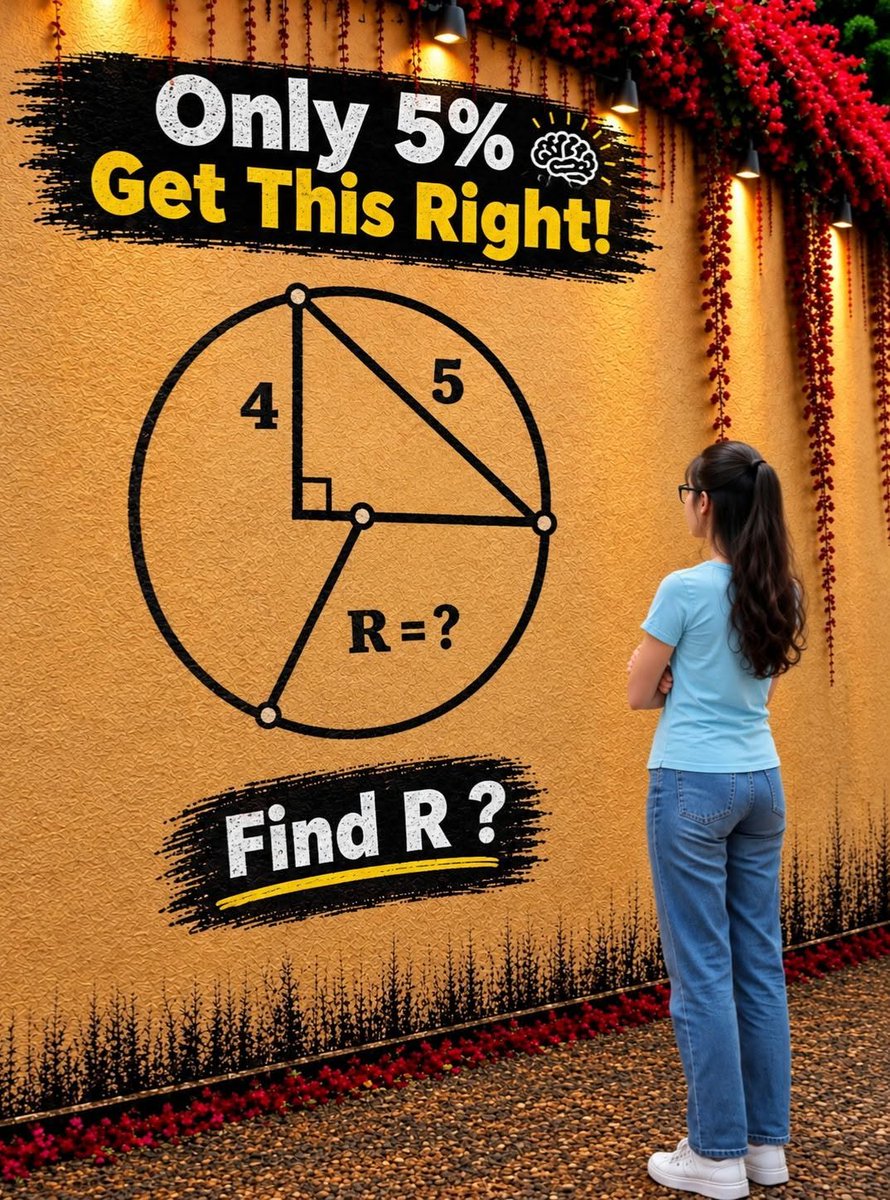
The baseline circle diagram caught the majority of engineering profiles off guard.
The exact solution is A (R = 4). The parameter of length 4 originates from the center to the boundary, defining a radius.
Did your mathematical logic survive this test?
Only 5% get this right because simple high school geometry layout easily triggers overthinking.
Look closely at the vector constraints and orthogonal points.
What is the exact value of R without falling for the visual triangle trap? Comment your answer 👇
This viral shortcut collapses across standard integer domains.
The answer is B (Pure numerical coincidence). Digit-summing only works for a few edge cases like 196, 289, and 125, violating basic number theory.
Did your logic spot the flaw?
This radical root shortcut looks like magic, but it is a massive numerical trap.
Most profiles blindly trust these patterns without checking formal arithmetic limits.
Which exact number immediately proves this digit-sum rule is completely fake?
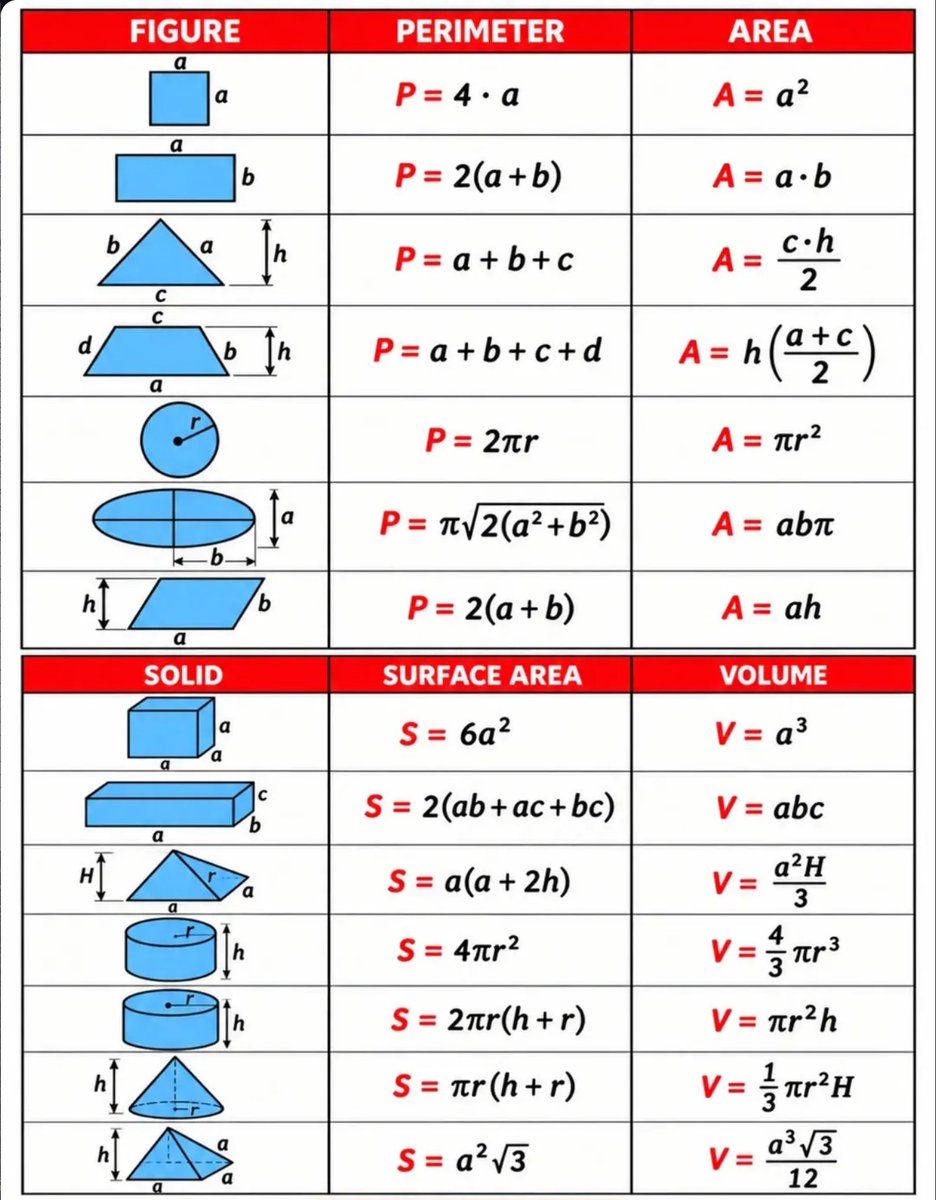
Most profiles blindly memorize equations but fail to see the geometric logic behind them.
Save this visual guide before comments prove your intuition is safe but shallow.
Which function mapping here forms the baseline for all advanced calculus?
The trap hides within utilizing elementary Euler approximations for the elliptic perimeter instead of actual complete elliptic integrals.
Plane math masks this boundary singularity on paper.
How do you enforce absolute rigor in structural reference models?
The trap hides within treating arithmetic functions as independent layers.
From cryptographic algorithms to deep neural networks, the entire digital field is bound by strict topological axioms.
Does mathematical logic possess an absolute ceiling?
Most profiles overthink this baseline exponent reduction.
The correct answer is A (25). Subtracting the exponents yields (x + 1) - (x - 1) = 2. Therefore, 5² evaluates strictly to 25.
Did your mathematical reasoning survive this layout?
Math Test: Most people rush this calculation and fall straight into a simple exponent trap.
Can your basic arithmetic logic resolve this algebraic division in under 5 seconds?
What exact operational step prevents this fraction from collapsing into zero?
If your immediate reflex was to apply the Pythagorean theorem and reply with 3, you officially let the visual diagram deceive you.
Save this geometry test to challenge your peers before the comments prove your intuition wrong. ✍
Cast your vote below to verify your spatial intuition:
A) R = 4
B) R = 3
C) R = 5
D) Impossible geometry constraints
Which path did your logic take first?
Try applying this exact digit-sum logic to the square root of 144 or 100.
Save this video to challenge your peers before the comments prove you wrong.
Why do these coincidental anomalies deceive so many smart profiles?
Cast your vote below to challenge your arithmetic logic:
A) It works for all numbers
B) Pure numerical coincidence
C) Only works for square roots
D) Valid algebraic theorem
What did your mathematical intuition select first?
If your immediate intuition led you to 1 or 5²ˣ, you officially let the algebraic variables confuse you.
Save this logic test to challenge your peers before the comments prove you wrong.
Why do you think variables cause so many profiles to fail this basic rule?
Most people blindly avoid formal calculus because simple high school algebra feels safe.
Why does defining a basic slope via derivatives trigger an immediate cognitive crisis for students?