Today we bring the answer to a question that we constantly receive based on the above: Why is a blockchain secure?
A blockchain is considered extremely secure and resistant to hacking for several reasons:
Decentralization: A blockchain is distributed across thousands of nodes around the world. This means there is no single point of failure. To hack a blockchain, an attacker would have to compromise a majority of nodes simultaneously, which is extremely difficult to achieve.
Robust cryptography: Information stored on a blockchain is protected by advanced cryptographic algorithms. Each transaction and block is securely linked using cryptographic hash functions, making it extremely difficult to alter information without detection.
Distributed Consensus: To add new blocks to a blockchain, a majority of nodes in the network must agree. This is achieved through consensus algorithms, such as Proof of Work (PoW) or Proof of Stake (PoS). These algorithms require a large amount of computational resources or a significant amount of financial involvement to conduct a successful attack.
Immutability: Once a block is added to the blockchain, it is virtually impossible to modify it without the consensus of the majority of the network. Any attempt to alter an existing block would change its hash and require modification of all subsequent blocks, which is extremely expensive and impractical.
Transparency and auditing: The information in a blockchain is transparent and accessible to all network participants. This means that any attempt to alter the data would be immediately detected by honest nodes on the network during verification of the blockchain.
In short, the combination of decentralization, robust cryptography, distributed consensus, immutability, and transparency makes a blockchain extremely difficult to hack. Although not impossible, successful attacks against well-established blockchains are extremely rare and require a significant amount of resources and coordination.
#Web3 #BlockchainEducation #CryptoCuriosities #DecentralizedLearning #Web3Wonders #BlockchainFacts #CryptoEducation #TechTrivia #DistributedLearning #CryptoFunFacts #Web3Exploration #BlockchainInsights #EducationalTech #CryptoKnowledge #Web3Discoveries
Today we have a new question: What can be done on a blockchain?
Blockchain technology is used for a variety of purposes, including:
Cryptocurrencies: The best-known application of blockchain is in the creation and management of cryptocurrencies such as Bitcoin and Ethereum. Cryptocurrency blockchains allow secure and decentralized transfers of value without the need for intermediaries such as banks.
Smart Contracts: Blockchains such as Ethereum allow the execution of smart contracts, which are autonomous computer programs that execute automatically when certain predefined conditions are met. This has applications in a wide range of industries, from finance to logistics.
Supply chain management: Blockchain is used to track and manage the flow of goods throughout a supply chain, providing transparency and traceability at every stage.
Voting and governance: Some blockchains are used to conduct voting and make government decisions in a decentralized and transparent manner, eliminating the possibility of electoral fraud.
Identity management: Blockchain can be used to create decentralized and secure digital identity systems, where users have full control over their personal information and can selectively share with third parties when necessary.
#Web3 #blockchain #BlockchainEducation
Starting this section of news and education about web3, we start with the most frequently asked question: What is a blockchain?
A blockchain is a distributed ledger technology that allows multiple participants to share data securely and transparently without the need for a centralized intermediary. In essence, it is a chain of blocks of information that is constantly updated and secured using cryptography.
Each block in a blockchain contains data and a hash of the previous block, creating an immutable chain of information. This structure ensures that data cannot be altered retroactively without changing all subsequent blocks, making the blockchain resistant to tampering and forgery.
#Web3 #BlockchainEducation #BlockchainInnovation
Desde el equipo de SorosChain queremos generar un entorno nuevo en @X donde podamos contar curiosidades sobre el mundo web3! Tambien queremos generar un entorno educativo asi todos pueden comprender que es SorosChain y no quedarse atras en el gran futuro que vamos a generar!
$SOR contract has been audited! 📄
https://t.co/hK9Wbjdu7e
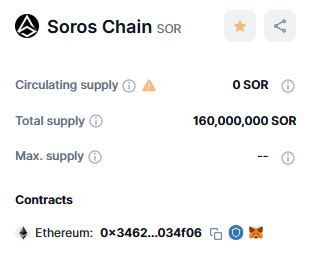
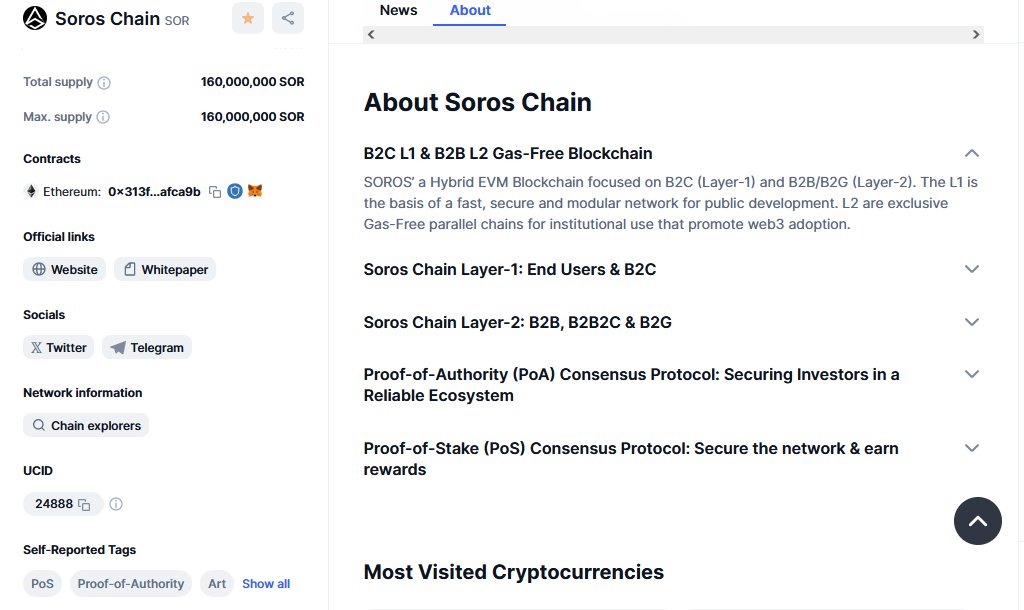
The information has also been updated on @CoinGecko & @CryptoRank_io. We are waiting for the validation of @Etherscan and @CoinMarketCap. On the other hand, next week we will also have the #KYC.
We are in the final stretch before launching the XSRS token (ERC-20) to the market and we want to submit to the voice, debate and vote of the community the modality in which we will carry out the pre-sale:
👉 Should we do whitelist or public sale?
Join https://t.co/L2nQtepsv5
We start the week in the best way! 💣
@Etherscan has verified and customized our page in the browser, giving us a giant difference compared to many other proposals on the market 🚀
Check for yourself:
https://t.co/hzBukLhxuP
♻ RT & FAV ♥
We have updated our website, Astronauts!
🌐 https://t.co/1ESloVKL86
We invite you to read the full message and join the $XSRS family at https://t.co/qNYTZzhlKM
@synthetix@CoinMarketCap@CoinMarketCap, we would like to register two https://t.co/Pm8dSuHkVG emails to manage Soros Chain's self-reporting dashboard on CoinMarketCap.
Congratulations to the winners! We deeply appreciate your contributions, as well as the participation of everyone. Stay tuned for our upcoming meme contest
https://t.co/Sl0yPwnmtH
https://t.co/7RQOgtxGip
https://t.co/FlXLvkAoZ1
https://t.co/awj5wrq9CT
https://t.co/oiOkC0vbFc