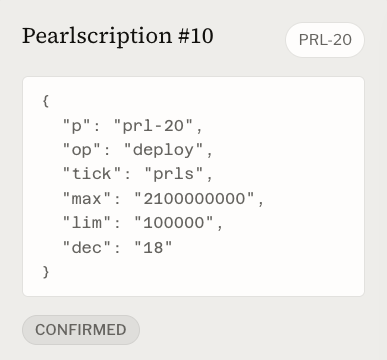
Pearlscriptions indexer v1.2.1 is live. 🦪
Updated for the Pearl MoE hard fork.
What’s new:
• checkpoint verification
• API / worker split
• faster incremental sync
• safer chunked rebuilds
• stronger registry checks
Run your own indexer, keep it synced, and help verify Pearlscriptions independently.
Pearl Genesis Explorer update:
The Minting Leaderboard is now live.
Track inscription activity, active wallets, trending movement, and real-time on-chain signals within the Pearl ecosystem.
Every inscription is an early signal.
Every wallet tells part of the story.
Pearl is still early.
We will continue building.
Built on Pearl.
Built for Pearl.
PRLS refunds are live. 🦪
If your PRLS mint commit went through during launch but the reveal never completed, you can now recover the locked PRL from your original wallet.
Open the same wallet and use:
https://t.co/tBiWbUysu4
Will Fast Matrix Multiplication ever be practical?
Strassen’s 1986 discovery of fast matrix multiplication (FMM) – asserting that the product of two 𝑛×𝑛 matrices can be computed in sub-cubic time 𝑛^𝜔 ∼ 𝑛²·⁸⁷ ≪ 𝑛³ – had a profound impact on theoretical computer science and algorithm design.
Since then, mathematicians improved on Strassen’s algorithm, and some experts believe that, eventually, it will be shown that 𝜔 ≈ 2, which would mean that the time to compute AxB is essentially the time it takes to merely read the inputs: ~O(𝑛²) (!) Needless to say, such result would have a major impact on the AI compute age we’re entering…
Unfortunately, FMM algorithms only work for enormous matrices--on the order of the number of atoms in the universe (“galactic algorithms" [1])--and it is currently hard to imagine them being practical on any imaginable hardware. Besides their asymptotic runtime, a core practical issue with FMM algorithms is that they all inherently rely on recursive divide-and-conquer, which creates memory and IO-bottlenecks, and is numerically unstable; This is likely the reason why the largest hardware manufacturers in the world are not developing chips for FMM. Even Strassen’s original algorithm, which gives nontrivial FLOP speedup for relatively small matrices, struggles to beat the sheer parallelism of naiive MatMul on GPUs or TPUs.
Some interesting progress on practical FMM seems underway [2] and would be interesting to follow, but it remains to be seen whether divide-and-conquer can be implemented in both silicon and memory to deliver wall-clock speedups for realistic dimensions of matrices in LLMs.
What is means for @prlnet. That’s the reason we designed the Pearl proof-of-work protocol (cuPOW) with the underlying baseline being “naiive” matrix multiplication O(𝑛³), which is what NVIDIA, AMD, Cerebras and all other AI hardware accelerators implement today.
Nevertheless, it is important to stress that Pearl’s protocol doesn't rely on naiive MatMul remaining SoTA -- if FMM becomes practical some day, Pearl's protocol can easily adapt to the 𝑛^𝜔 baseline (since the next version of cuPoW will only verify the output AB).
In fact, one of the intriguing aspect of @prlnet is that it creates incentives (for both humans and machines) to develop faster MatMul algorithms and hardware (as had happened in Bitcoin with SHA256). Of course, without proper modification, such breakthrough would break the security assumption of Pearl-GEMM, so such algorithmic breakthrough would better be public.
FMM and FFT. Our recent paper [3] shows that it is possible to achieve fast matrix multiplication without using Strassen-like divide-and-conquer, using only the Fast Fourier Transform, which is omnipresent in countless industry-scale applications. This paper presents a simple algorithm running in 𝑂(𝑛²·⁸⁹) time, which only sums a few convolutions in 𝕫ₖᵐ, using FFT (see figure below for illustration of the algorithm).
Despite being highly parallel (no recursion), this FFT algorithm for MatMul remains asymptotic, as it still requires many parallel repetitions on submatrices in order to obtain noticeable speedup over naiive MatMul (𝑛³). Whether FFT can lead to subcubic time MatMul
for reasonably-sized matrices is a fascinating question!
I believe FFTs are the most promising tool in this direction...
[1] Lipton, Richard J., and Kenneth W. Regan. “David Johnson: Galactic Algorithms.” In People, Problems, and Proofs, 109–112. Springer, 2013. https://t.co/X6N6ViYYai.
[2] Karstadt, Elaye, and Oded Schwartz. “Matrix Multiplication, a Little Faster.” Journal of the ACM 67, no. 1 (2020): 1:1–1:31. https://t.co/VnfiWVLdKK.
[3] Uffenheimer, Yahel, and Omri Weinstein. “Improved Sparse Recovery for Approximate Matrix Multiplication.” arXiv:2602.04386, 2026..
I’ll forever be bullish on crypto.
I think we overestimated how quickly crypto would become the next major computing paradigm. A lot of people were searching for the next platform shift and assumed it would be crypto, but in many ways that ended up being AI.
Over the past decade, ton of capital flowed into crypto, and much of it went toward overbuilding. Instead of focusing on a handful of narrow sectors where crypto had a clear advantage, the industry tried to reinvent everything all at once. What we’re seeing now is a natural pullback and consolidation after that period of excess
I don’t think the core thesis is broken by any means. Crypto’s biggest success may not be apps first (even though we have a few), but rails first. As stablecoins, wallets, tokenized stocks and onchain financial infra via neobanks reach every human and eventually every AI agent, crypto becomes the default settlement layer of the internet.
Once those rails are everywhere, many of the ideas that arrived too early like DAOs, decentralized marketplaces, machine to machine payments, and the ideas Vitalik wrote about in the early days of Ethereum may finally have the distribution needed to get it off the ground.
@pearlgenesislab Looking forward to the addition of a real-time leaderboard monitoring trending Inscription minting activity, displaying the number of wallets involved.
Mining is only one part of $PRL
There is still much more to explore, build, and unlock within the Pearl ecosystem.
Share the post and drop your $PRL address below.
A surprise might be coming.
@HunterFor2028 I am not endorsing any coins but if you’re a man of your word please donate to Shatterproof. They do great work and help a lot of people. There’s plenty of others. Bu


![WeinsteinOmri's tweet photo. Will Fast Matrix Multiplication ever be practical?
Strassen’s 1986 discovery of fast matrix multiplication (FMM) – asserting that the product of two 𝑛×𝑛 matrices can be computed in sub-cubic time 𝑛^𝜔 ∼ 𝑛²·⁸⁷ ≪ 𝑛³ – had a profound impact on theoretical computer science and algorithm design.
Since then, mathematicians improved on Strassen’s algorithm, and some experts believe that, eventually, it will be shown that 𝜔 ≈ 2, which would mean that the time to compute AxB is essentially the time it takes to merely read the inputs: ~O(𝑛²) (!) Needless to say, such result would have a major impact on the AI compute age we’re entering…
Unfortunately, FMM algorithms only work for enormous matrices--on the order of the number of atoms in the universe (“galactic algorithms" [1])--and it is currently hard to imagine them being practical on any imaginable hardware. Besides their asymptotic runtime, a core practical issue with FMM algorithms is that they all inherently rely on recursive divide-and-conquer, which creates memory and IO-bottlenecks, and is numerically unstable; This is likely the reason why the largest hardware manufacturers in the world are not developing chips for FMM. Even Strassen’s original algorithm, which gives nontrivial FLOP speedup for relatively small matrices, struggles to beat the sheer parallelism of naiive MatMul on GPUs or TPUs.
Some interesting progress on practical FMM seems underway [2] and would be interesting to follow, but it remains to be seen whether divide-and-conquer can be implemented in both silicon and memory to deliver wall-clock speedups for realistic dimensions of matrices in LLMs.
What is means for @prlnet. That’s the reason we designed the Pearl proof-of-work protocol (cuPOW) with the underlying baseline being “naiive” matrix multiplication O(𝑛³), which is what NVIDIA, AMD, Cerebras and all other AI hardware accelerators implement today.
Nevertheless, it is important to stress that Pearl’s protocol doesn't rely on naiive MatMul remaining SoTA -- if FMM becomes practical some day, Pearl's protocol can easily adapt to the 𝑛^𝜔 baseline (since the next version of cuPoW will only verify the output AB).
In fact, one of the intriguing aspect of @prlnet is that it creates incentives (for both humans and machines) to develop faster MatMul algorithms and hardware (as had happened in Bitcoin with SHA256). Of course, without proper modification, such breakthrough would break the security assumption of Pearl-GEMM, so such algorithmic breakthrough would better be public.
FMM and FFT. Our recent paper [3] shows that it is possible to achieve fast matrix multiplication without using Strassen-like divide-and-conquer, using only the Fast Fourier Transform, which is omnipresent in countless industry-scale applications. This paper presents a simple algorithm running in 𝑂(𝑛²·⁸⁹) time, which only sums a few convolutions in 𝕫ₖᵐ, using FFT (see figure below for illustration of the algorithm).
Despite being highly parallel (no recursion), this FFT algorithm for MatMul remains asymptotic, as it still requires many parallel repetitions on submatrices in order to obtain noticeable speedup over naiive MatMul (𝑛³). Whether FFT can lead to subcubic time MatMul
for reasonably-sized matrices is a fascinating question!
I believe FFTs are the most promising tool in this direction...
[1] Lipton, Richard J., and Kenneth W. Regan. “David Johnson: Galactic Algorithms.” In People, Problems, and Proofs, 109–112. Springer, 2013. https://t.co/X6N6ViYYai.
[2] Karstadt, Elaye, and Oded Schwartz. “Matrix Multiplication, a Little Faster.” Journal of the ACM 67, no. 1 (2020): 1:1–1:31. https://t.co/VnfiWVLdKK.
[3] Uffenheimer, Yahel, and Omri Weinstein. “Improved Sparse Recovery for Approximate Matrix Multiplication.” arXiv:2602.04386, 2026..](https://pbs.twimg.com/media/HI9zlMBbwAAKqsp.png)