Nuestro colega, Guillermo Francos, se unió a @davizsierra para discutir por qué los hackers buscan atacar teléfonos móviles actualmente y qué puedes hacer para protegerte en estos casos.
#RNEAudio | Este domingo en 'Cruce de cables', programa conducido por @davizsierra, hablamos de la ciberseguridad en nuestros teléfonos:
🎧Móviles blindados, revolución o burbuja de la IA y un viaje a 'Mundo Anillo': https://t.co/AlYkSjl4ND
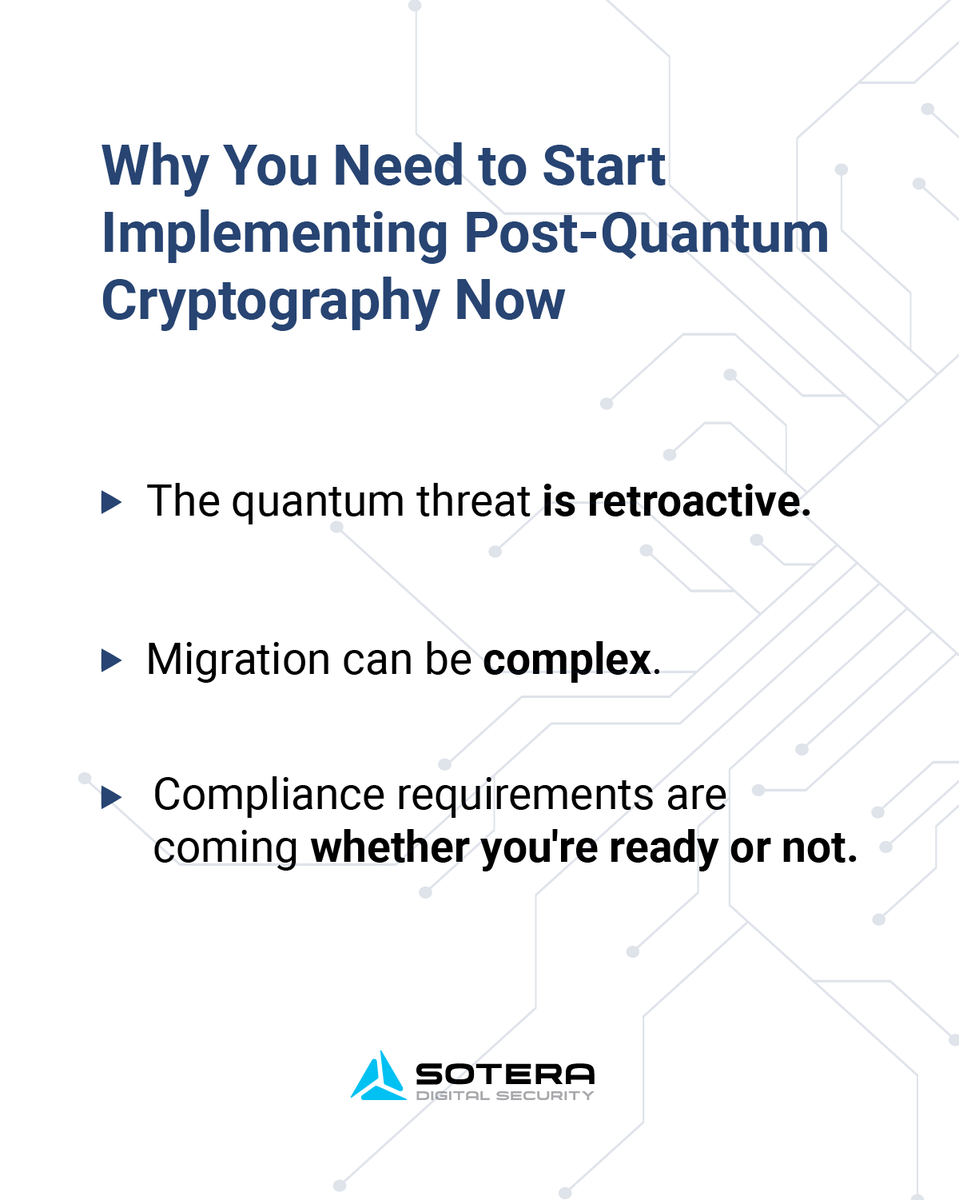
Although quantum computers are not readily available yet, post-quantum cryptography is already being rolled out to protect organizations from Harvest Now, Decrypt Later attacks.
Conoce más sobre SecureShield, nuestra solución con tecnología resistente a la cuántica que protege datos, aplicaciones y comunicaciones VoIP.
Esto es lo que está programado a hacer para proteger información sensible:
Q-Day is the moment a quantum computer will gain enough resources and stability to crack traditional cryptography. Experts are already warning organizations about the work needed to prepare for Q-Day. Read more:
https://t.co/U0Xd161OCh
Cuando agencias como la NSA, el NIST y la CISA establecen plazos urgentes para la migración post-cuántica, es una señal de que es una amenaza real. Cada año que una empresa u organización pasa sin seguridad móvil resistente a la cuántica es un año de datos posiblemente interceptado. Accede al eBook gratuito para conocer más sobre esta amenaza: https://t.co/7Fcj3FANbs
El cifrado de las aplicaciones de mensajería no es suficiente si la capa de red está expuesta. Los metadatos que dejan las conversaciones ejecutivas se han convertido en el punto ciego para las empresas en la era de la computación cuántica.
Las reglas para el cifrado están cambiando y la NIST ya exige regulaciones Lee nuestro eBook y conoce 3 pasos para enfrentarte a estos retos. https://t.co/cawbRcMQD4
Adoptar una política de Bring Your Own Device (BYOD) puede aumentar la flexibilidad y productividad, pero también introduce riesgos críticos si no se maneja correctamente.
Lee más en nuestra guía: https://t.co/5Vrf1rqgtA
#ciberseguridad#BYOD
64% of organizations now factor geopolitically motivated cyberattacks — including espionage — into their cyber risk strategies.
That number should be higher. But more importantly, most organizations aren't asking the right follow-up question: if nation-state espionage is in your threat model, is your mobile security strategy actually built for it?
Standard mobile security tools weren't designed to defend against sophisticated state-sponsored surveillance.
The threat is geopolitical. The solution has to match it.
Los adversarions no esperan a que la computación cuántica sea masiva, ya están robando datos cifrados para descifrarlos en el futuro. ¿Tu estrategia de seguridad móvil? Descubre el impacto en tus comunicaciones en en nuestro análisis. https://t.co/bAfmcV91ZR
re your network defenses relying on an obsolete playbook? For years, IP blocklists have been a staple of network security, but a massive shift in threat actor tactics has fundamentally changed the game. https://t.co/RCTWqXChSo
A recent Citizen Lab investigation titled "Bad Connection" reveals how state and non-state actors are tracking targets through global carrier infrastructure, zero clicks required: https://t.co/McehJvlFnf
Quantum computing is not a distant threat—it is already shaping today’s cybersecurity landscape. “Harvest Now, Decrypt Later” attacks are silently capturing encrypted communications now, with the intent to decrypt them when quantum capabilities mature. Mobile devices are especially exposed, as network-layer metadata and behavioral patterns remain vulnerable.
Is your organization prepared for the post-quantum era? Discover why strategic action is needed before the window closes and how to address the mobile security gap.
Read the full analysis on our website for insights that every executive and security leader should know.
https://t.co/ic6ScW6lSW
On April 23, 2026, two major cybersecurity investigations dropped on the same day — independently.
One from the UK's NCSC, co-signed by 15 countries including the US, Spain, Germany, and Japan. One from the Citizen Lab at the University of Toronto.
They weren't coordinated. But they described the same problem from two different angles.
The finding that should stop you cold: you don't need to click anything. No malicious link. No app installed. Just a phone on a carrier network — and a surveillance actor who knows how the global telecom signaling system actually works.
The Citizen Lab documented a four-hour operation in which a target was tracked across eleven carrier identities in nine countries. The attacker switched protocols every time a defensive layer blocked their path.
This isn't theoretical. These reports are addressed to organizations with the most to lose: governments, defense agencies, and critical infrastructure operators.
We broke down what both reports found and what they mean for high-risk organizations.
https://t.co/kb9sH0P9lH
Quantum computing isn't coming. It's here — and adversaries are already using it against your mobile communications.
This video explains exactly how the Harvest Now, Decrypt Later attack works.
Watch it. Then ask your security team what's protecting your network layer.
Not all "secure phones" are equal — and the gap between them is where attacks live.
Hardening a commercial OS is like reinforcing a glass door. Better than nothing. Not the same as a vault.
The Sotera SecurePhone runs a purpose-built secure OS — designed with zero tolerance for the attack surface that off-the-shelf systems accept as normal.
If the OS isn't secure by design, the phone isn't either.
Adversaries don't need a quantum computer to attack your encrypted data. They just need to store it until one exists.
This is called Harvest Now, Decrypt Later — and it's already underway.
Here's what your executives, legal teams, and deal teams need to know before the window closes: https://t.co/8a5R6OHUs4
Google just accelerate its post-quantum cryptography migration deadline to 2029. The "Harvest Now, Decrypt Later" threat is no longer theoretical. At Sotera, we're already implementing quantum-resistant encryption to stay ahead of it. https://t.co/cgC7PkOpMt
Hablar de seguridad móvil es hablar de protección total del dispositivo. Sotera Digital Security piensa en lo que los teléfonos inteligentes estándar no hacen. Los flujos de voz y los mensajes de texto entre dos dispositivos Sotera SecurePhone no pueden ser interceptados ni descifrados.
Are you looking for a security solution that allows you to use your everyday phone but hides your identity online? Sotera Digital Security offers the SecureShield SDN. Here's how it works:
En nuestro análisis más reciente, exploramos la evolución de amenazas como Pegasus, Predator y la aparición de Graphite. La realidad para gobiernos, directivos y personas de alto riesgo es preocupante. Lee más: https://t.co/4Aa3hg48wn