Anyone in the XRP community building around stablecoins, I wrote this essay on stablecoins that provides some insight into the significance of stablecoins and the potential impacts that they can have.
I’m learning about @RippleXDev with @EasyA_App on my #60DaysOfXRPL!
Learning the history of the #XRPL and how it was purpose-built for payments. It’s easy to forget blockchain’s killer use-case has always been exactly that.
The #XRP Ledger is making the transfer of value as cheap as the transfer of information.
So many nuances to XLS-66 (Lending Protocol). Reading the implementation on Github is essential to understanding it. I've read it and XLS-65 (Vaults) over once already and I am still not entirely comfortable with it.
More often than not I don’t know what I am signing on the XRPL. I usually just trust the app that I am on is not malicious. Is anyone working on making transaction signing more transparent?
I don't think there's a workaround here. Humans will always make mistakes. The good news is that this sort of thing happens all the time and it's generally not too big of a problem.
IE the bank isn't going to liquidate you on your last mortgage payment because you haven't paid the last $10 of your mortgage.
You get a few more attempts to collect before things start escalating.
I think we've figured out ways to notify borrowers of their obligations, and lenders understand that things happen and it is necessary to be a little flexible with timing in certain cases, especially if the amount is so small.
The interesting part for me is how do you design the protocol to work for agents and humans at the same time when humans are far more error prone than agents, and when agents are transacting with each other? Especially if off-chain legal and collateralization move on-chain.
Essentially; Will human and agentic borrowing share the same method of financing? Will there be two different standards to hold borrowers by? Discrimination? Can the lender be sued for unfair lending?
Haha partly joking but these are the questions of our times! And wow there is a lot of work to be done.
The XRP Ledger Foundation has completed the attestation of the XRP Ledger against the Global Layer One (GL1) Market Infrastructure Toolkit.
It is the first public, permissionless layer-1 blockchain to have the toolkit's Architecture and Resiliency principles independently verified.
GL1 is a multilateral initiative between global financial institutions and policymakers to foster an ecosystem of compatible financial infrastructures upon which tokenised assets can be transacted seamlessly across borders.
The toolkit assesses networks for tokenised assets across ten principles, built on international standards such as the Principles for Financial Market Infrastructures (PFMI) and emerging industry best practices.
For banks and asset managers, it is a standards-based reference for their own due diligence on the XRP Ledger.
More details:
https://t.co/EvLH2kTHa3
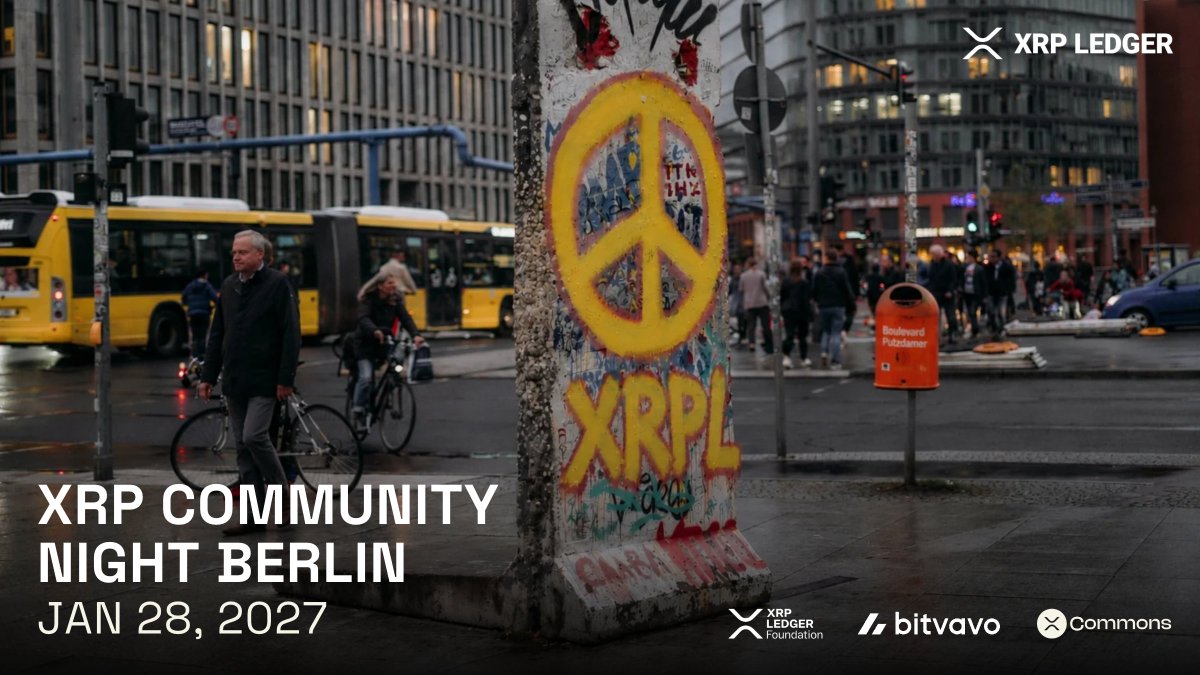
Own XRP? Come see what you can actually do with it.
Discover new projects, try out real applications, meet the teams behind them and find opportunities to get involved, become an early user or help shape what's next.
Your next opportunity might start in Berlin.
An XRPL Commons event, supported by @XRPLF and @bitvavocom.
Space is limited: https://t.co/nMElMHaklm
36 hours. 179 hackers. 70 submissions.
At the XRP Ledger Hackathon, developers used Mastercard Agent Pay for machines to explore new possibilities for micropayments and autonomous commerce, including how AI agents can transact within defined spending limits and with verified merchants.
See what we learned about the future of agentic commerce: https://t.co/S4NwQxxuRi
#AgenticCommerce #DigitalAssets #AI
@krisdangerfield The NFT idea is really cool!
I might be more inclined to buy a few if some of the revenue went towards as a prize pool and you could setup some sort of tournament or game where NFT holders could compete and learn.