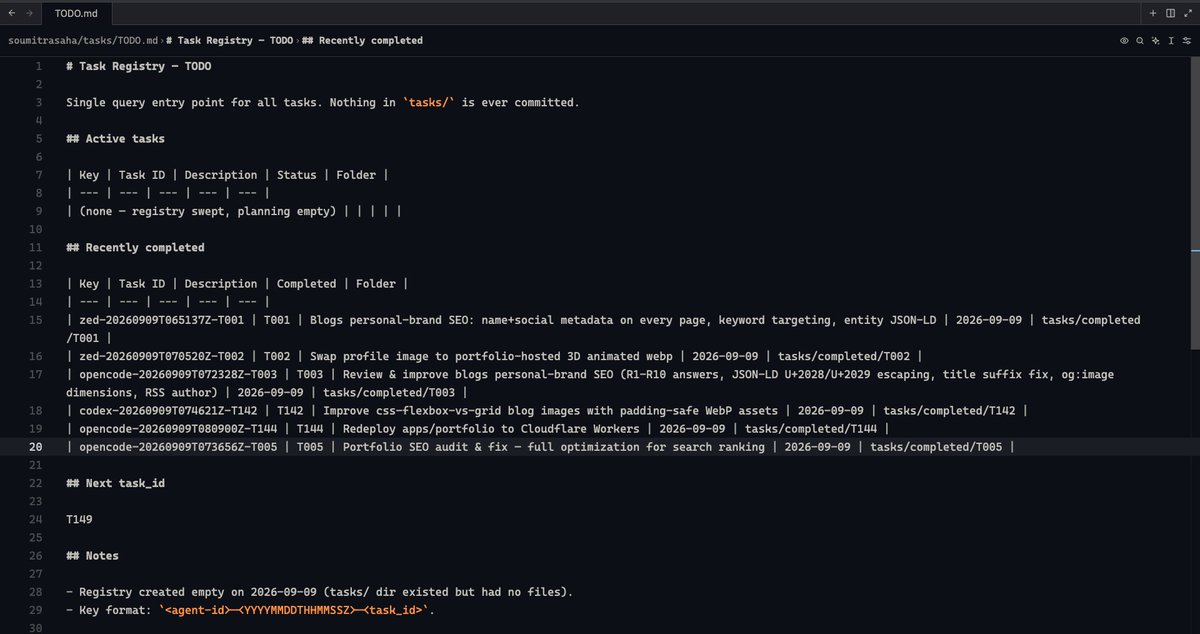
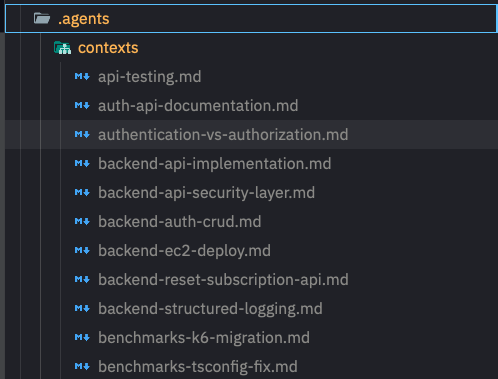
I work on multiple features at once with a swarm of coding agents.
At first it was chaos — several agents updating the same file at the same time. Constant headaches.
Then I stopped treating them like geniuses and started treating them like a team.
The system 🧵
Is anyone else seeing this issue with the @Zai_org Coding Plan?
For the last 3–4 days, GLM-5.3-Flash has been almost unusable at around ~4–5 tokens/s, while GLM-5.3 is giving around ~10 - 14 tokens/s. I am on the Pro plan.
I would genuinely rather consume 2–3x more tokens and get consistent, usable speed. At these speeds, it is extremely difficult to use GLM for serious coding work.
Today it became frustrating enough that I had to post about it. @Zai_org , please look into this.
I would actually be pretty sad to see Plan mode go.
One thing I really like about Claude's flow is being able to see the plan first, make sure it understands what I am trying to do, and then switch to Accept Edits and just let it execute. For bigger tasks, that saves me from constantly guiding the agent halfway through or correcting it in a loop.
To me, that's a different problem from effort levels. Effort controls how much the model thinks; Plan mode gives me visibility into what it's about to do before it starts changing things.
I would rather see Plan mode improved than removed. Even something like a clearer step-by-step plan, dependencies between steps, or optional Mermaid/flow diagrams (Markdown) for more complex tasks would make it way more useful.
we’re thinking of killing plan mode and using the shift+tab hotkey to adjust effort levels
I don’t think the models need plan mode anymore, but if you’re a plan mode diehard would love to get your feedback on why
A practical product flow could stay very simple: the customer opens a dashboard, enters basic business details once, uploads documents if needed, and the system builds a persistent business and risk profile.
From there, the flow becomes Dashboard → API → workflow engine → customer/risk state → policy guardrails → model router → carrier/CRM/document tools → response back to the dashboard.
For scale and cost efficiency,
- Jev can handle high-volume bounded decisions such as classify, route, continue, or escalate.
- A small, low-cost LLM can handle extraction, follow-ups, and routine conversations.
- A stronger LLM can be reserved for ambiguous reasoning or complex explanations,
- while a licensed human handles low-confidence, unusual, or consequential decisions.
RAG can support this by retrieving approved carrier appetite, coverage rules, policy documents, and customer context, while hard compliance and authority rules remain deterministic.
This seems like a practical way to implement the paper’s idea of bounded autonomy: keep routine work cheap and automated, and reserve expensive model or human attention for the cases that truly require it.
Read the paper end-to-end. My understanding is that the core problem isn’t lack of need — it’s that many small-business accounts generate too little commission to economically support continuous human attention.
The AI-native model changes that only if demonstrated routine work can run autonomously within explicit limits, without requiring human review on every transaction.
Licensed professionals then govern those limits and handle unfamiliar, high-risk, or consequential exceptions, while the brokerage remains accountable for the outcome.
So, in short:
- proven routine workflow → AI executes within defined limits
- unfamiliar/consequential case → qualified human
Is that an accurate interpretation of the thesis?
@thdxr the "true provider" part is what makes this interesting to me.
routing is useful. owning the inference layer is how you go from sitting in the stack to becoming part of the stack everyone depends on.
@BatsouElef I treat technical debt like interest: don't pay off everything, pay off the stuff that keeps making every future change more expensive.
If it's ugly but stable, I leave it alone. If the team keeps tripping over it, it moves to the top.
@thdxr I think people are reading a market-mix shift as a market decline.
Open-weight can win more workloads while frontier demand still grows where the extra capability is worth paying for.
Both can be true at once.
@alexisbchz Omarchy feels less like “trying another distro” and more like skipping the 20 hours of turning Arch + Hyprland into something you actually want to use.
Opinionated defaults are underrated.
@NanouuSymeon Yep. The code is rarely the scary part — it’s the uncertainty around it.
Hidden edge cases, production bugs, and "this should take 5 minutes" turning into 5 hours.
Experience doesn't remove the anxiety. It just gives you better debugging instincts.
Actually, this is exactly why I’m building this:
https://t.co/XUagtuYlJe
I wanted to test Flutter properly in a real production environment, not just through small demos or side-by-side comparisons.
So I’m building this as a side project in my free time, with the goal of having it production-ready by December 31, 2026 and launching on January 1, 2027.
For me, this is basically a real-world experiment: build it, ship it, maintain it, integrate the things production apps actually need, and then see how Flutter holds up over time.
If you have any genuine suggestions, feedback, or things you think I should test while building it, drop a comment below or feel free to DM me.
Would genuinely appreciate input from people who’ve already shipped Flutter apps in production.
2+ years of React Native taught me one thing:
The app was never the hard part. The ecosystem was.
What my last two years actually looked like:
→ New Expo SDK every 4-6 months = 2-3 days of migration pain each time.
Expo is genuinely easy to maintain in the beginning, especially while your app stays within the managed ecosystem.
But as the app grows, requirements get more complex, and you inevitably start touching native modules, custom configurations, and platform-specific code.
That's when upgrades stop feeling simple and start becoming a nightmare.
→ Outdated packages everywhere. I've written so many patches just to keep things alive, I basically became a patch-package maintainer. Not by choice.
→ Every new Android/iOS release → mystery bugs appear out of nowhere.
→ Same component, different behaviour on Android vs iOS.
→ Third-party native SDK integrations were the worst — especially payment gateways.
Try integrating 2-3 different payment gateway SDKs into the same React Native app and keeping both Android and iOS happy.
The native Android and iOS SDKs are often maintained by completely different teams, with different APIs, docs, edge cases, and release cycles.
One works perfectly on Android and breaks on iOS. Fix iOS, upgrade the SDK, and suddenly Android has a new problem.
If you've done this in production, you know exactly what I mean.
→ And the one I hated most:
Platform.OS === 'android' or Platform.OS === 'ios'
My "single codebase" components were 400-800 lines of platform branches.
That's not cross-platform. That's two apps in a trench coat.
So I finally gave Flutter a fair shot.
Honest confession: as a TypeScript dev for 4+ years, Dart styling felt completely wrong at first. Unlearning my React instincts was the hardest part.
But once I got past it?
The UI is genuinely sorted. And package management is stupidly easy compared to RN.
One caveat: I haven't shipped a Flutter app to production yet. And production is where the real truth comes out.
So if you've actually moved from React Native to Flutter — or moved back from Flutter to RN — what was your real production experience?
Did Flutter actually solve these ecosystem and native integration problems, or did you just trade them for a different set of problems?
Would love to hear what happened after you shipped. 👇
cc @reactnative@FlutterDev@expo
#ReactNative #Flutter #Development
Just in case it is useful, here is my portfolio: https://t.co/mIH8g3I9Nf
I am also building BetterTUI, a Rust-based terminal UI framework from scratch, similar to OpenTUI. Your examples have actually been one of my benchmarks. I have already launched v0.1.1 and am now building my own agent harness around it. I tried OpenTUI first, but it did not fit what I was looking for, so I decided to build the TUI layer myself. https://t.co/NypKzXMZZE
I would genuinely love to explore this opportunity. I have first-hand experience with OpenCode v1 and have been building custom features around it, including sharing videos of what I have built. I am not sure whether my experience matches what you are looking for, but I will definitely send an email. I would really like to hear from you.
@thdxr This is the kind of work nobody notices until it doesn't get done 😄
Half of IT is basically making sure everyone else can work… and then getting asked what you do all day.
Pretty simple guardrail: give agents spending limits the same way models have token limits — per transaction + daily/weekly/monthly caps.
If an agent goes rogue, it can only burn through a small allowance before you revoke access. Basically, don't give your AI a a no-limit card 😄
I've had a very similar experience using DeepSeek alongside OpenAI/Anthropic in actual builds. The 150–200+ tok/s is great, but the bigger deal is the cost — you stop being afraid of retries, parallel agents, verifier passes, and longer workflows.
That's where the open-weight advantage gets serious. It's not just cheaper inference; it changes what you can afford to build.
This is really helpful context. I'm currently around $100–150/month across Codex ($100), Claude Code ($20), a few Chinese providers, and Bedrock/Vertex when I need extra capacity.
Might try Cursor next month and see if it can simplify the stack and bring that cost down — possibly replacing Claude Code. Thanks for sharing the numbers.
@thomasgauvin Git was built for a world where code changes were relatively scarce.
AI flips that — now the scarce resource is human attention to review and reconcile all those changes. That feels like the real thing that has to be redesigned.
@thdxr This must be such a weird adjustment 😂
You go to sleep with one version of the company and wake up to a slightly different one. Does it feel freeing, or does it make you want to check Slack the second you wake up?