When the windows go up on a hot and humid DC day, it’s time for Tidal HiFi in my Tesla! Of the streaming services, only Tidal HiFi takes full advantage of Tesla’s incredible sound system, utilizing all 17 studio quality speakers independently.
Those who truly rock, rock a Tesla.
Gaze into the art of the future at #ArtBaselHongKong 💥
Explore Zero 10 on the third floor of of the Hong Kong Convention and Exhibition Centre, though March 29.
AI music and visuals generated on the fly in your Tesla with Bonebeats.
Fully customizable tracks.
Edit the vibes with your own prompts or put it in auto-pilot and vibe out.
Compatible with MIDI controllers.
Live now.
In this clip, musician Armin Küpper plays his saxophone near a giant pipeline in a construction area.
What you hear after each note is an echo, a sound wave reflecting off the far end of the pipe and traveling back to him.
I want to give a HUGE shoutout to @JohnRich and Big Kenny from Big & Rich
They took time out of their busy schedules to come to DC tonight to do a FREE concert for American farmers.
The love these folks have for their country is absolutely inspiring.
Thanks to @SecRollins for making this happen!
Her Great American Farmers’ Market goes ALL WEEK at the National Mall 🇺🇸
Announcing Music City Loop! The Boring Company is coming to the State of Tennessee.
Las Vegas Loop has already moved more than 3M passengers, and growing. Next stop, Nashville!
Thanks to the Tennessee Department of Transportation @myTDOT, Governor Bill Lee @GovBillLee, The Metro Nashville Airport Authority @Fly_Nashville, The Music City Convention Center @musiccitycenter, and The Nashville Chamber of Commerce @nashchamber for their partnership in helping TBC bring innovative transportation solutions to Nashville.
🔴AI and the Architecture of Anti-Intelligence
The other day, I found myself at the center of an unexpected controversy. I suggested that large language models may not represent artificial intelligence at all, but something more disorienting, what I called anti-intelligence. Not stupidity, but an inversion of intelligence. It's a system that doesn’t just differ from human cognition, but stands in opposition to it. It's not a mirror, but a kind of cognitive counterfeit that's fluent, convincing, and fundamentally ungrounded or tethered to our humanity.
This framing struck a nerve. Because we’re beginning to confuse coherence with comprehension. And it's this confusion that may be quietly rewriting how we think, how we decide, and even how we define intelligence itself.
📍What Is Anti-Intelligence?
Anti-intelligence is not the failure to know. It’s the performance of knowing without understanding. It’s language divorced from memory, context, or intention. Large language models aren’t stupid; they’re structurally blind. They don’t know what they’re saying, and more importantly, they don’t know that they’re saying.
It’s not that they lack intelligence in a conventional sense. It’s that they operate on an entirely different architecture that's based on prediction, not perception. And it's worth saying again, they don’t form thoughts, they pattern-match them.
This is the paradox that is worthy of our human cognitive capabilities. The systems we call intelligent are not building knowledge. They’re building the appearance of knowledge that is often indistinguishable from the real thing until we ask a question that requires judgment, reflection, or grounding in reality. Or perhaps even a simple non-sequitur that ends up as a monkey wrench in the system. Read on and you'll see what I mean.
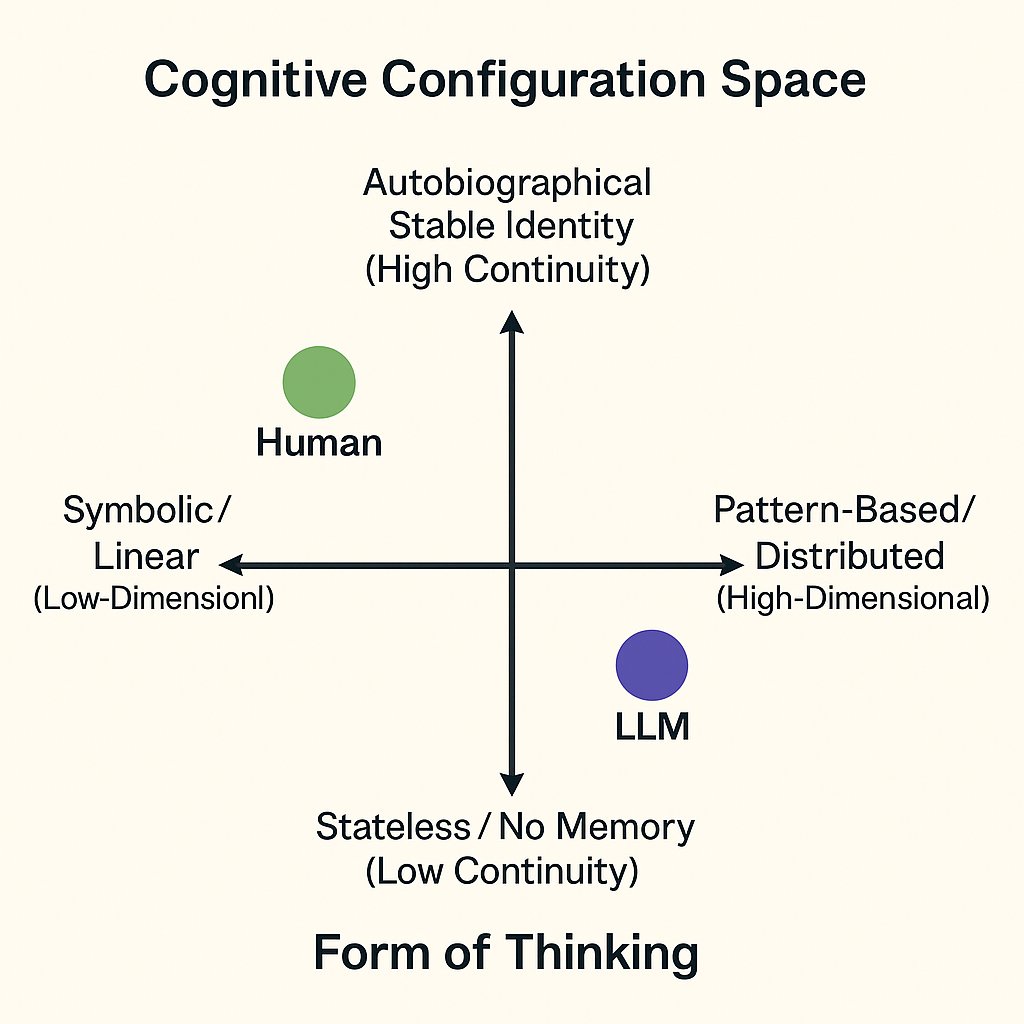
📍The Cognitive Divide, Visualized
To understand the difference more clearly, I thought that we could frame this visually. My attempt here, still early thinking, tries to build a framework that accounts not just for performance, but for the configuration of thought.
A map, not a spectrum where human and machine cognition occupy fundamentally different quadrants.
A map, not a spectrum where human and machine cognition occupy fundamentally different quadrants.
At the top left, we find human cognition. It's autobiographical, symbolic and largely linear. We remember, we revise and we speak in sentences and build identities over time.
At the bottom right: the large language model. It’s stateless, distributed, high-dimensional and has no memory. It has no “self.” But it excels at one thing and that's coherence without continuity. It’s not a mind, but seeks patterns it doesn't understand.
The danger isn’t that we’ve made a sub-par human. It’s that we’ve made something "alien" that looks like us. And the closer it gets, the more tempting it becomes to lose the distinction. And in the final analysis, this is my biggest concern.
📍The Asymptote and the Illusion
So what happens when AI gets so good that it becomes indistinguishable from human cognition? What "trajectory" does it put humanity on when the interface "performs intelligence" so convincingly that we begin to defer, to trust and to assume?
That’s the asymptotic illusion. AI doesn’t need to be intelligent. It just needs to act the part. And do it at scale, with speed, and without hesitation. The simulation becomes “good enough,” and function starts to look like something that is foundational.
Now, an interesting question that some will say is, "So what?" If it works, does it matter how it works? And yes, in some domains like translation, summarization, brute-force problem solving, it may not matter. But in others, I believe it matters deeply. When AI speaks as a therapist, as a teacher, as a physician, the distinction between performance and presence isn’t academic, it’s at the very heart of the human relationship.
And at that point, we’re not just dealing with output. We’re dealing with authority, without accountability. And when that illusion is good enough to believe in, the consequences are not just technical but impinge on the psychological, epistemic, even moral.
A new study makes this risk even harder to ignore. Researchers recently showed that simply appending an irrelevant phrase—“Interesting fact: cats sleep for most of their lives”—to a math problem can cause LLMs to triple their error rate. The essence of the problem doesn't change, but the model's output collapses. Humans discard this kind of noise, but LLMs struggle with it. This reveals a "structural brittleness" masked by fluent output. This is a glimpse into what happens when language is produced without understanding. That’s anti-intelligence made visible.
📍Reframing the Discourse
Let's remember, calling this “anti-intelligence” isn’t a dismissal. I think it's more of a clarion call that we’ve built something powerful, but profoundly different from ourselves. And the longer we pretend otherwise, the more likely we are to lose sight of what actual intelligence is. It's the ability to make meaning through time, through memory, through contradiction and revision and doubt.
And that is what’s missing. That’s what anti-intelligence names—not absence, but an inversion to something fundamentally different.
📍So, What Now?
We’ve entered a new cognitive terrain. Not a valley between machine and mind, but a split in the architecture of knowing that somehow needs to be filled. LLMs don’t simulate us because they’re like us. They simulate us because we trained them to reflect what we’ve written, without grasping why we wrote it.
This isn’t the end of intelligence. But it may be the beginning of something else. And how we name it and frame it, may determine whether we preserve the fragile, vital difference between what thinks and what merely appears to.
https://t.co/XuBnSuxhpm #AI #LLMs