Qubic smart contracts are about to be upgraded.
Our latest Tech on Deck AMA broke down Outsourced Computation: the system that lets smart contracts send authorized instructions off-chain and act on Bitcoin, Ethereum, or any external system.
451 of 676 computors must sign before anything leaves the chain.
Testnet mock: June 17
Mainnet mock: July 1
Go live: July 29
Energy was never meant to be wasted.
Qubic turns proof-of-work into the work itself: computation that trains AI with purpose.
No staking. No idle burn. Just useful work.
This is not mining as you know it. It's Qubic.
Watch.
In the 1960s, the US and Soviet Union both launched rockets. Both burned the same fuel. Both pushed the limits of human engineering.
One program put a man on the moon. The other proved it could.
Bitcoin mining is the rocket that proved it could. Qubic is the one going somewhere.
On Qubic, the computors aren’t racing to stamp out a number. They’re training an AI.
The proof of work and the work itself are the same thing.
Every cycle goes into building something that didn’t exist before, something that actually matters.
That something has a name. Aigarth, an AI the network has been growing from scratch for four years.
And it’s about to get even faster and more coordinated.
A protocol upgrade called the Anthill is coming.
Until now, every miner searched for answers on their own, thousands of people digging random holes hoping to find gold.
Once the Anthill lands, each miner builds on where the others left off, the way ants reinforce each other’s trails until the whole colony moves as one.
The work of one starts making the work of everyone else better.
Same energy bill, yet a completely different destination.
⚡️⚡️Question for the @VivancosDavid / @josesanchezhb team 🧠
I've been running creatures in Neuraxon GoL Live - tuning brain params, watching how each one lives, dies, and what behaviors emerge.
Did a series of 5 runs and saved the configuration that performed best (longest-lived, most mates, stable foraging).
My question: is this kind of community data actually useful to you? Like - do saved configs / observed behaviors from people just playing around feed back into the research at all? Or is the useful data already coming from your own structured runs + the datasets? Happy to share the config + what I observed if it helps 🙏
#Qubic
In 1904, psychologist Charles Spearman found that children who scored well in one subject scored well in almost everything.
He called the underlying factor “g”, general intelligence.
120 years later, g remains one of the most replicated findings in behavioral science.
And yet, when researchers run the same psychometric analyses on large language models… the g factor structure doesn’t show up.
LLM performance across domains doesn’t correlate the way human cognition does.
It tracks training data density, not genuine cognitive generality.
So what would it take to actually evolve g in an artificial system?
That’s the question behind Neuraxon’s latest experiment.
Artificial creatures growing their own modular brains, selected not for mastering any single task, but for the shared cognitive thread across many.
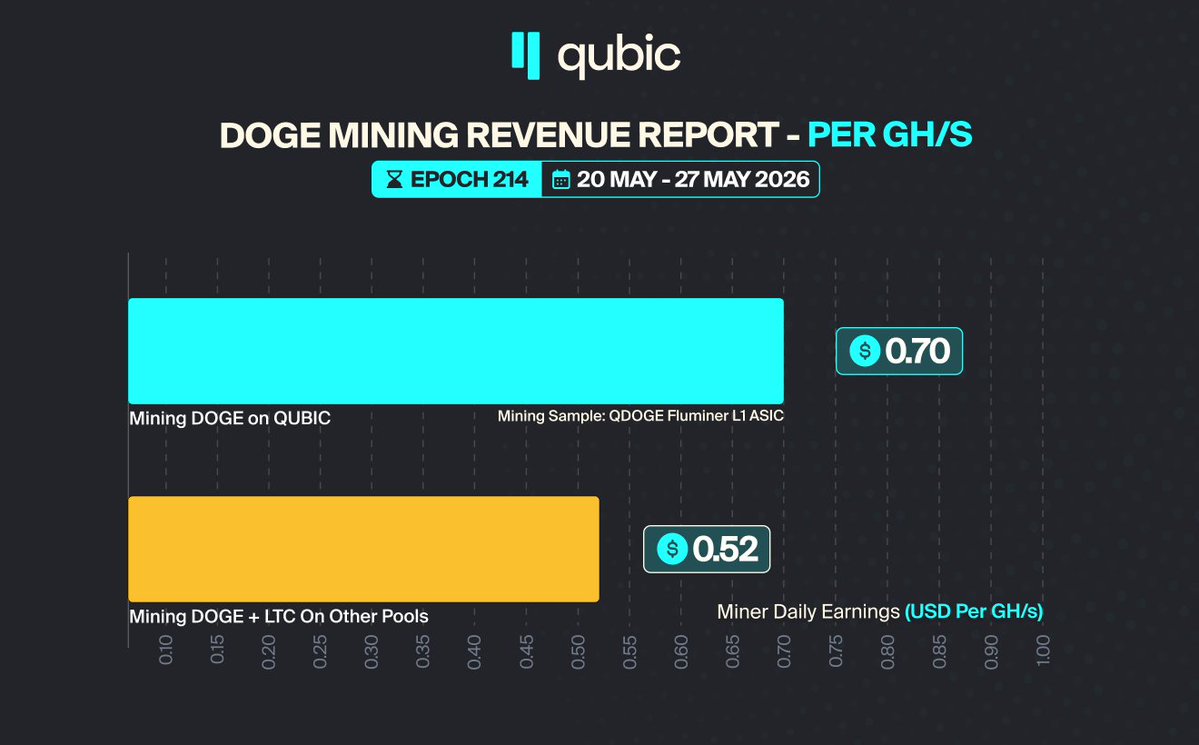
Doge Mining Revenue Report | Epoch 214
Mining Sample: QDOGE's Fluminer L1 (5.7 GH/s)
Revenue per GH/s per day:
Mining DOGE via Qubic
→ $0.70 / GH/s
Mining LTC + DOGE on traditional pools
→ $0.52 / GH/s
That's +$0.18/day per GH/s. 35% more revenue on the same hardware.
Note: These are revenue figures. Actual profitability depends on your own operating costs, including electricity.
Last week the Qubic science team let you watch artificial creatures evolve in your browser. That version reset every time you loaded it.
This one does not.
NeuraxonLive is a single world that runs around the clock and keeps running. The creatures in it forage, mate, sing, and die on their own.
None of it is scripted. When one dies it stays dead, and there is a permanent ranking of every creature that has ever lived in the world.
Each creature carries a brain built on the general-intelligence design from last week's release. So you are not watching a replay. You are watching selection actually shape these things in real time, and if you zoom in, you can hear them.
You can drop your own creature in. The first season is live now, capped at 500 creatures with 100 custom slots. Whether your line survives or dies out is decided by the world, not by you.
It is fully open source, so you can also run your own world on your own machine.
GPU Mining Revenue Report | Qubic vs. The Field
Setup: 6x RTX 3080 Ti | ~1.57B it/s
Daily revenue:
Qubic AI Training → $5.82/day
Karlsen → $4.67/day
Evrmore → $2.72/day
Kerigan → $2.70/day
Quai → $2.44/day
Zano → $2.30/day
Qubic leads the field. Not by a little.
And that's just the data. Here's the bigger picture.
Qubic started by dominating CPU mining during the XMR and Tari phases.
Then came DOGE ASIC integration, which turned Qubic into the most profitable way to mine DOGE, consistently outperforming traditional pools epoch after epoch.
Now GPUs are entering the story, and Qubic is sitting at the top of that table too.
CPU. ASIC. GPU. Very few projects have integrated all three. Almost none are leading profitability in two of those three sectors at the same time.
Epoch 215 and a new algo are coming. Curious to see where this goes next.
Note: These are revenue figures. Electricity and operating costs are not factored in.
This is not theoretical.
Neuraxon v2.0 just won Best Paper and Best Presentation at an evening session at IEEE co-sponsored conference in Berlin.
The CUDA port is live.
The code is open source.
The research is published.
The photograph doesn’t win awards.
The living tree just did.
→ https://t.co/lMxYvCOWiw
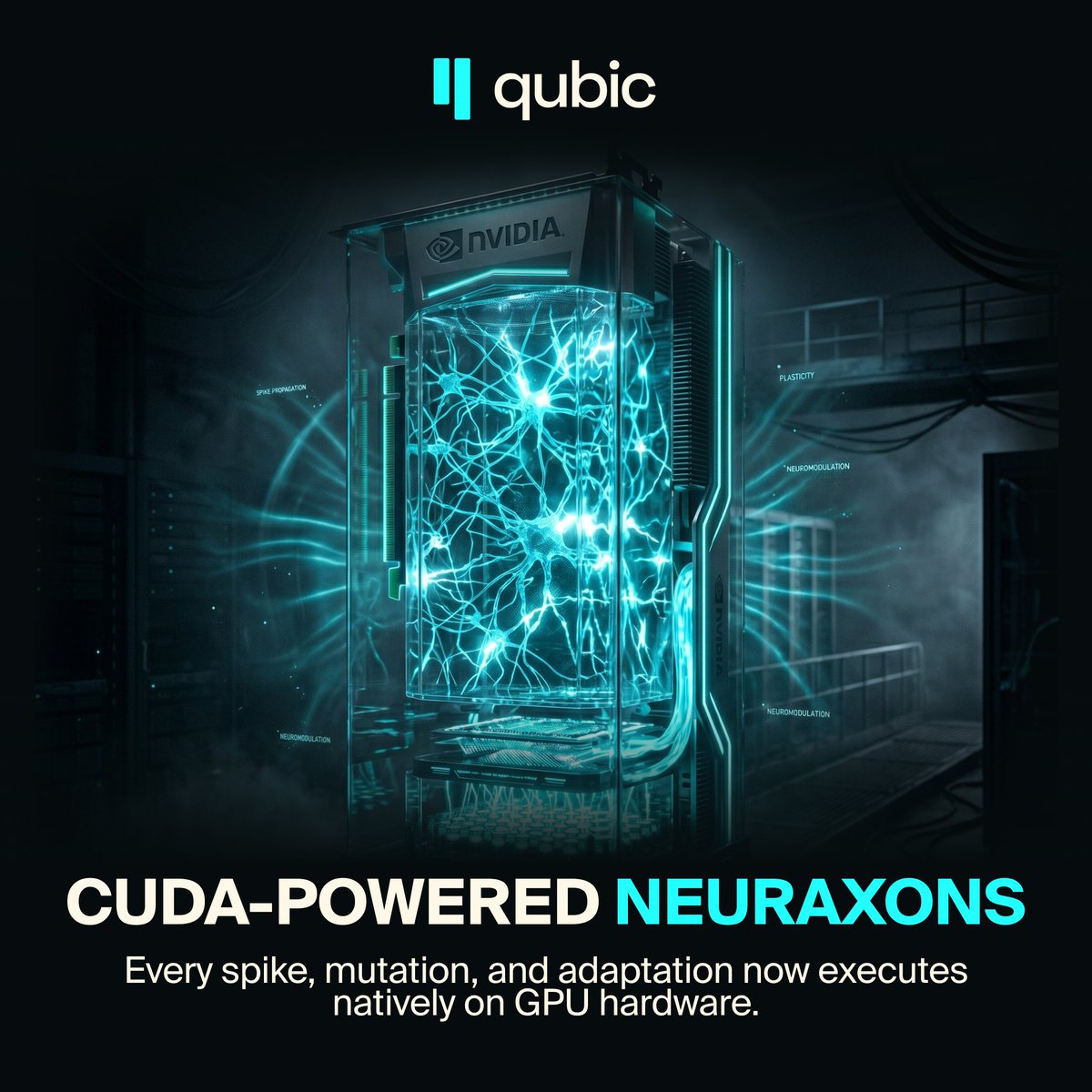
Qubic Science has released CuNxon.
Full Neuraxon computation ported to NVIDIA CUDA kernels. Every operation a Neuraxon can perform, from spike propagation to plasticity to neuromodulation, now runs natively on NVIDIA GPUs.
Previously, Neuraxon research ran on CPUs. That was fine for the Game of Life simulator and the early parameter sweeps. It is not fine for what comes next.
There are roughly five million CUDA developers worldwide. Most of them work in machine learning and AI. As of this release, every one of them can build with, test, and extend Neuraxon using the same GPU toolchain they already know.
The practical path this opens: when the Aigarth evolutionary layer gets ported into the Qubic network, miners and Computors will be able to train and evolve Neuraxon populations using GPU compute, not just CPUs.
A single $100 GPU. Or a billion-dollar cluster. The library does not care. The code is open source.
Yes... Looks Like #Neuraxon just started....
@josesanchezhb & @VivancosDavid are very proud to communicate that our paper #MultiNeuraxon follow-up to the just presented and awarded at ICMLT Neuraxon 2.0 in #Berlin for@_Qubic_ #OpenScience evolving @c___f___b #Aigarth to new heights...
This time has been accepted for poster presentation a the 19th #AGI Conference, so to #SanFrancisco @SFSU and beyond...
What is intelligence? can it emerge in a machine? These are questions we ask at our #MultiNeuraxon#TrueAI#aigarth exploration journey for @_Qubic_#OpenScience , @josesanchezhb & @VivancosDavid
We are very glad to release today the Multi-Neuraxon Game of Life Lite 5.0 with a first exploration of the g intelligence theory (General Factor Theory) in the Nxers, A follow up NIA article will dig into the details.
Lite Version is already @huggingface
https://t.co/9ehfZUpoKk
And research version is at @github
https://t.co/SJuYIL0BOA
🧠Why does it matter? For the first time, you can watch artificial creatures evolve brains built on the CHC model of human cognition — six functional spheres selected directly for the g-factor itself — letting psychometrics, neuroscience, and artificial life finally collide in real time, right in your browser.
Qubic Ecosystem Update (May 24, 2026) The latest network brief is out, highlighting a shift toward a triple-revenue mining model. Here are the core technical & ecosystem takeaways:
🔹 Triple Mining Executed: Epoch 214 data shows Qubic miners are successfully generating external income from DOGE & LTC blocks, alongside AI training via Useful Proof of Work (UPoW).
🔹 Protocol Upgrades: The network just deployed a 4x transaction capacity increase (4,096 per tick), with a doubled data payload upgrade scheduled for June 10.
🔹 Solana Bridge: Mainnet launch is currently targeted for July 27, marking a key interoperability milestone.
🔹 Ecosystem Utility: 18.6% of the token supply is currently locked in Qearn, while dApps like qMine and Qraffles are showing active smart contract usage.
Read the full intelligence brief here: https://t.co/czCs8EF9Q3
$QUBIC ⚕️
First successful context verification test with LLM as preparation for Aigarth integration.
Today I completed the first full test using a Large Language Model for deep context analysis, semantic verification, and real-time inconsistency detection. This test represents a significant milestone on the path toward integrating Aigarth, the advanced decentralized artificial intelligence architecture that I intend to adopt as the main replacement for the current LLM.
The transition to Aigarth will require an extremely robust infrastructure. For this reason, I have already begun rigorous stress testing, load testing, and high-concurrency benchmarks to ensure the system can support massive user scale while maintaining low latency and high stability.
This strategic preparation has been underway for several months. For security and business intelligence reasons, I have been advancing discreetly, implementing architectural optimizations and scalability mechanisms that are not yet common in current market solutions. The goal is to be technically ready to integrate Aigarth as soon as it becomes available, while maintaining a strong competitive advantage.
The incorporation of Qubic is a fundamental pillar of this strategy. I have already secured a relevant position in QUBIC specifically to enable testing and future large-scale operation of the Aigarth architecture.
All of this is grounded in the scientific vision presented in the Neuraxon paper by David Vivancos and Jose Sanches. Neuraxon proposes the first true decentralized artificial intelligence architecture, introducing a "golden rule" still absent in current LLMs: the explicit definition of the three fundamental states (TRUE, FALSE, and UNKNOWN) as the foundation of AGI reasoning.
Unlike traditional binary models, Neuraxon employs ternary logic, bio-inspired mechanisms (including neurotransmitter modeling and small-world connectivity), and is designed to operate natively in distributed computing environments, exactly what Qubic provides.
I am positioning my tool to be among the first to integrate this new generation of decentralized artificial intelligence. This is just the beginning of a deep technical journey.
#aigarth #qubic
Most people in crypto hear "51% attack" and assume every chain has the same threshold.
Qubic does not.
Finality on Qubic requires 451 of 676 Computors. That is 66.7%. Not 51%.
To push a malicious state change through, an attacker needs 451 nodes. Simultaneously. All independently signing.
If 226 Computors behave maliciously or go offline, the network halts.
It does not process bad transactions.
It stops.
That is a safety mechanism, not a vulnerability.
Three more things working in the background:
• No single entity may control more than 225 Computor slots. It is written into the protocol.
• Network guardians monitor Computor behavior in real time, independent nodes embedded inside the core network itself. Divergence is visible immediately.
• Every Computor must align with full network consensus to keep operating.
The core tech team estimates 10 distinct operators currently run the 676 slots.
That number sounds low until you consider: these are technically deep operators running infrastructure that must be online continuously.
No single entity controls the network and that is the signal that matters.
The numbers are stronger than most chains.
Monitoring is real time.
And the system doesn't need anyone to behave.
It assumes they won't.
Your brain sits at a frontier between order and chaos, and a single number determines which side it falls on.
The branching ratio (σ) measures how neural activity propagates. Too low, signals die. Too high, you would have seizures. But right around σ ≈ 1, something remarkable happens: sensitivity, memory, information capacity, and complexity all peak at once.
In NIA Vol. 8, the Qubic scientific team breaks down how this principle from statistical physics and neuroscience became a core design constraint in Neuraxon, and why the "edge of chaos" matters for building brain-inspired AI that actually works.