If the next 6–12 months include:
Continued easing of geopolitical tensions,
Clearer U.S. crypto regulation (CLARITY ACT),
One or more Fed rate cuts,
Gradual liquidity expansion,
then the environment would be considerably more favorable than today.
A rough estimate of the relative importance might look like:
Liquidity expansion: 40–50% of the macro tailwind.
Rate cuts: 25–35%.
Regulatory clarity (such as the CLARITY Act): 15–25%.
Geopolitical stabilization: 5–15%.
These aren’t precise measurements, but they reflect how markets have tended to react historically.
What that could mean for the market
If all of these align while the economy avoids a severe recession, a plausible sequence would be:
Bitcoin continues to attract institutional inflows.
Ethereum begins outperforming later.
Capital rotates into large-cap altcoins.
Smaller-cap projects, AI tokens, and meme coins often experience the largest percentage gains during the later stages of the cycle.
Historically this combination of macro and regulatory conditions has been associated with stronger performance across the crypto market than any one catalyst on its own.
bitcoin:native
Thread about the JaredFromSubway MEV bot exploit
1/ Insane exploit on one of Ethereum’s most notorious MEV bots.
JaredFromSubway.eth — the sandwich attack bot that has extracted tens of millions from traders since 2023 — just got drained for ~$7.5M+ in one of the cleanest and most sophisticated attacks I’ve seen.
No contract vulnerability. No phishing. The bot essentially approved its own robbery.
2/ Here’s exactly how it happened:
The attacker didn’t hack the bot’s code. Instead, they weaponized the bot’s own logic against it.
They deployed:
* Fake wrapper tokens (fWETH, fUSDC, fUSDT)
* Fake liquidity pools on DEXes that looked highly profitable for arbitrage/sandwich opportunities
3/ The bot, constantly scanning for MEV opportunities, spotted these fake pools and thought it had found a juicy trade.
As part of its normal automated process, it granted approval to attacker-controlled helper contracts to spend its tokens.
In early test transactions, these approvals were actually used (small amounts), so nothing looked suspicious.
4/ Then came the critical part:
In later transactions, the bot granted large approvals that were never consumed or revoked.
This gave the attacker unlimited spending power over the bot’s funds through those helper contracts.
5/ Once enough approvals were in place, the attacker executed the final drain using transferFrom.
They pulled large amounts of WETH, USDC, and USDT directly from the JaredFromSubway contract.
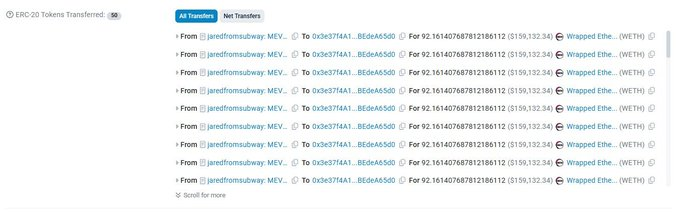
Example from on-chain data:
* Multiple transfers of ~92 WETH
* Multiple transfers of ~143k USDC
* Multiple transfers of ~149k USDT
All going to the attacker’s helper address: 0x3e37f4A10d771Ba9dE44b6d301410b1BEdeA65d0
6/ The bot’s address (for verification):
jaredfromsubway.eth → 0xae2fc483527b8ef99eb5d9b44875f005ba1fae13
Arkham Intelligence tracked the hit across 95 addresses. The bot’s balance reportedly dropped from ~$25M to ~$4.4M.
Some funds were later moved through Tornado Cash.
7/ Why this attack was so effective:
MEV bots are designed to act fast and trust opportunities that look profitable. This attacker created a fake opportunity that perfectly matched what the bot was programmed to chase.
The exploit turned the bot’s automation and lack of strict approval management into a liability.
8/ Key takeaway:
Even sophisticated MEV bots (and their operators) must be extremely careful with token approvals.
Always revoke unused approvals.
This applies to regular users and automated bots alike.
This attack is a masterclass in social engineering on-chain — no code was broken, only trust and automation were exploited.
The hunter became the hunted.
What are your thoughts on this exploit? Have you seen similar approval-based attacks before?
solana:HtTYHz1Kf3rrQo6AqDLmss7gq5WrkWAaXn3tupUZbonk just did a collaboration with Adidas
CA in bio
IP rights
Dog owner part of the team
Most viral dog in history