Cheers, Professor! Remembering Sumit Sarkar
In the History Department’s first-floor lecture room in North Campus, sometime in 1998, Sumit Sarkar walked in to introduce a course titled ‘Social History of Modern India’. I still have vivid memories of that class, which was an overview of what to expect over the coming weeks.
Of the many things he spoke about that day, I remember a few ideas and names that I was hearing for the first time.
Having come to the M.A. programme as a Physics graduate, I had never heard of Bernard S. Cohn, E.P. Thompson or C.A. Bayly. The second was the defining reading of the course: Prof. Sarkar’s own then newly published book, Writing Social History. Within the first week of his classes, I bought a copy. By the end of the year, everything that I saw around me, and experiences that one routinely encountered, seemed to acquire new meanings.
Why is the sweeper the sweeper? Why do we think the way we think? How do we come to learn the languages we learn, and in the manner that we do? It was an exhilarating journey of learning.
He is described as a Marxist historian. But that, I think, was too comfortable a chair for Sumit. He was a historian who embraced intellectual discomfort, with the resulting habit of questioning and revising positions he had once endorsed.
In @the_hindu
https://t.co/p4ozX8edHz
Left - Pop concentration of Muslims in West Bengal
Right - Concentration of deletions of 'under adjudication' voters
CLEAREST visualisation of mass deletion of Muslim voters.
This is the only real relevant data from this elections. Not voteshare / seatshare. & there's more🧵
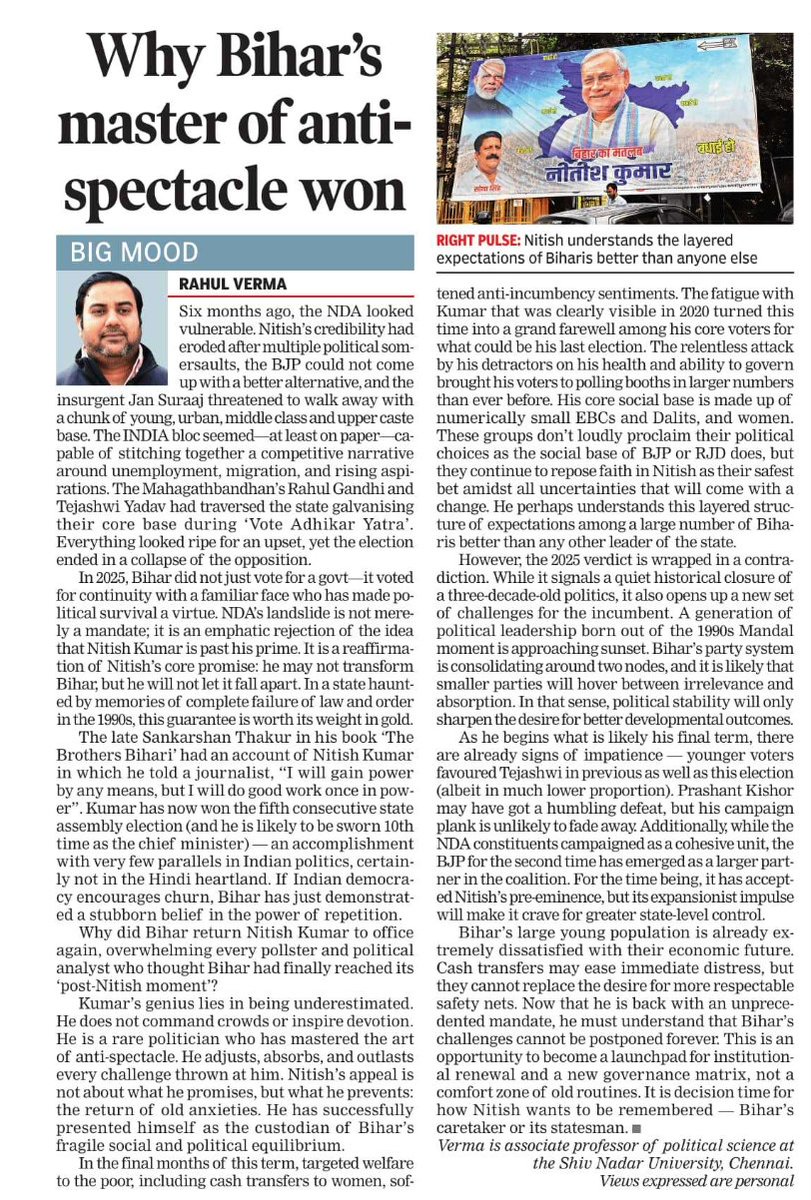
Why did Bihar return Nitish Kumar to office again?
my piece for Sunday TOI: https://t.co/IIznYqFq25
But now its decision time for how he wants to be remembered — Bihar’s caretaker or its statesman.
Sociologists, researchers, and students, this is for you! The Indian Sociological Society's website is an incredible treasure trove of resources. From academic journals & research archives to writing resources & open-access journals.
https://t.co/WPvosW46b4
The bureaucratic state, then, occupies “a managerial role in relation to urban infrastructures” but does little to dismantle the inherited “castes” of waste labour. Butt explains that waste recyclers in Lahore also navigate overlapping formal and informal sectors. Many people who were “unable to be absorbed into the ‘formal’ economy as waged laborers,” he writes, were “compelled to secure livelihoods in the ‘informal’ economy.”
Read @ankushpal2001's essay on Waste and labour in urban South Asia: https://t.co/2QIFH1t5qp
New open access article @CSSHJournal where I write about India's city improvement trusts of early 20th century and how they inaugurated a new language, technology, and rationality of urban governance.
- https://t.co/FfobGEMqOy