Pakistan’s merchandise exports grew by 10.84% to $8.43 bn in the first quarter of FY27. However, imports rose even faster, increasing by 13.21% to $19.22bn over the same period and further widening the country’s trade deficit.
Business representatives said Pakistani exporters operate on narrower profit margins than their regional competitors, face a heavier tax burden than other businesses, and often endure prolonged delays in tax refund payments without compensation. They added that arbitrary FBR deductions, liquidity pressures and high operating costs were further constraining the export sector.
https://t.co/VyMXkemvks
Pakistan’s Interior Minister Mohsin Naqvi has called for export-led growth alongside import substitution, arguing that Pakistan should reduce its dependence on imports through stronger domestic manufacturing. He cited Iran’s industrial development under decades of sanctions as an example.
At the same time, Naqvi offered a critical assessment of Pakistan’s governance system, saying that some federal departments and institutions have become obstacles to the country’s performance. Reviving his earlier call for a “system reset”, he said institutional reform would be necessary to improve economic performance and called for support from the business community
https://t.co/TJrQOAriM1
India’s manufacturing sector rebounded in September, with the HSBC Manufacturing PMI rising to 55.1 from 52.8 in August, its highest level since February. Stronger domestic and export demand boosted new orders, output and hiring, while business confidence rose to a four-month high.
https://t.co/t8rOVSh44x
Indian pilot Smit Machchhar is being praised for his heroic actions after his Omani co-pilot allegedly stabbed him mid-flight and attempted to crash a flydubai plane bound for Tel Aviv with 174 people on board. Despite being injured, the captain managed to open the cockpit door, allowing passengers and crew to restrain the co-pilot. A reserve flight crew then took control and landed the aircraft safely in Saudi Arabia.
https://t.co/204QZY6DP5
China has proposed upgrading Korala on the China-Nepal border into an international trading point, as both sides look for alternatives to increasingly unreliable cross-border routes.
Nepal currently relies on three main trade crossings with China, but all face recurring disruptions. Kerung-Rasuwagadhi was badly damaged by flooding, Tatopani has repeatedly been affected by floods and landslides, while Korala itself is constrained by heavy winter snowfall and higher logistics costs.
Nepali officials, however, say their immediate priority is to fully reopen Tatopani, which already has more developed customs, immigration and logistics infrastructure, rather than move too quickly to expand Korala.
https://t.co/ZehQ1dlkCO
India’s Special Intensive Revision (SIR) of electoral rolls is facing growing scrutiny. Since the exercise began in Bihar, more than 130 million names have been left out of draft voter rolls across 30 states and Union Territories.
In West Bengal, 2.716 million voters were deleted from the rolls after adjudication, but 2.221 million of them — around 82% — later appealed for reinstatement. Only 1,607 were restored in time to vote in the April state election. In Delhi, around 4.77 million names were left out of the draft roll, roughly one-third of the previous electorate, while more than 3.3 million voters were subsequently issued notices over “logical discrepancies” or other verification issues. The Supreme Court later said that some of these notices appeared to have been issued “mechanically” and asked the Election Commission whether additional filters were needed.
The scale of the exclusions, the slow appeals process and concerns over how voters are being flagged are increasingly eroding trust in the Election Commission and the Supreme Court, while feeding a broader debate over the credibility of India’s democratic institutions and the fairness of electoral competition under the BJP.
https://t.co/ba18UcPQSk
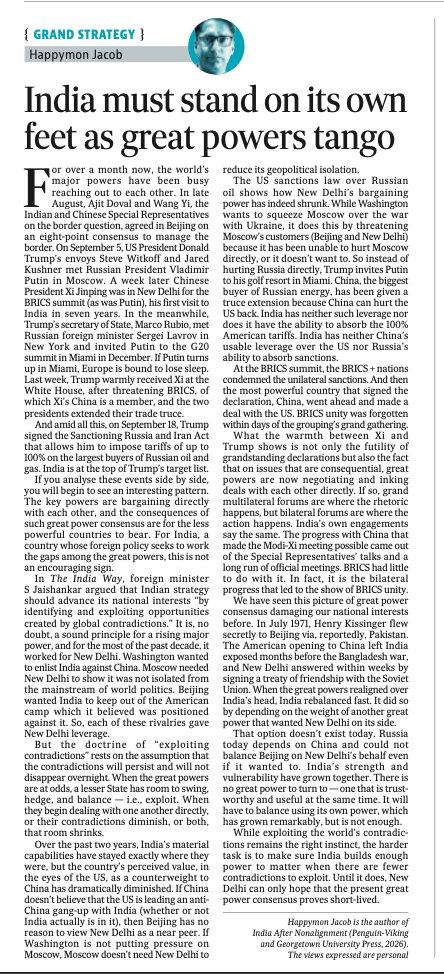
In my column for Hindustan Times, I argue that "While exploiting the world’s contradictions remains the right instinct, the harder task is to make sure India builds enough power to matter when there are fewer contradictions to exploit."
India's industrial output growth accelerated 8% in August, its second-fastest expansion in more than two years. Growth in manufacturing, which carries the largest weighting of about 76% in the index of industrial production, rose to its second-highest level in 29 months at 9% from a revised 8.2% in July, marking the third straight month in which the sector grew 8% or more.
Within the sector, 18 of the 23 industry groups at the two-digit level expanded compared with a year earlier. Electrical equipment led the gains with 30.9% growth. Other transport equipment followed with 25.3%, and motor vehicles, trailers and semi-trailers grew 25.2%. Rubber and plastics products (21.4%), computer, electronic and optical products (19.3%) and beverages (18.3%) also posted strong double-digit growth.
https://t.co/Lfa8SiyUDi
Mesabi Metallics, a Minnesota-based US steel and mining company backed by India’s Essar Group, is making a major new investment in the American steel industry.
Trump announced that Mesabi Metallics will build a $15 billion steel complex in Iowa, which he described as “the largest steel plant in American history.” The facility is expected to produce up to 10 million tonnes of steel annually from 2030.
The project is part of a broader roughly $18 billion US investment plan, including around $3 billion already committed to an iron ore mine and pelletising operation in Minnesota.
https://t.co/ZjtO4liFBY
The latest Trump-Xi meeting has triggered renewed anxiety among India’s strategic community.
One concern is the prospect of a US-China “G2” — two great powers managing the world between themselves and leaving others to adjust. For India, which aspires to play a larger global role while preserving sufficient external space for its own development, such a prospect is deeply unsettling.
Another source of frustration is Washington’s approach towards India. Many Indian analysts see a striking contrast between the caution the US shows towards China and what they view as a far more coercive approach towards India. For those who had long believed that close US-India ties rested on deep strategic trust, this has produced a palpable sense of disappointment.
Against this increasingly pessimistic backdrop, Jaishankar has now offered his clearest response yet to the prospect of a US-China G2:
“While they may have their points of convergence, overall they are in a competitive mode. There are limits to what the two of them can agree upon vis-à-vis the rest of the world. And that then leaves the rest of us and the rest of us are coming to terms today with a very different America, with the fact that there is also today a certain conversation taking place between America and China.”
India has not stopped engaging pragmatically with Washington. Foreign Secretary Vikram Misri has raised India’s concerns over the Sanctioning Russia and Iran Act with US lawmakers, while both sides are again trying to move forward negotiations on the Bilateral Trade Agreement. Meanwhile, Essar-backed Mesabi Metallics has unveiled an integrated US steel investment plan of around $18 billion.
Jaishankar also described the broader approach in these terms: “Each one of us is looking for our optimal solutions. How do we de-risk? How do we diversify? Which are the new partners? Where do we get more value out of an existing partnership?”
For India, both dynamics appear likely to continue: anxiety over possible US-China accommodation, alongside continued efforts to maintain and expand practical cooperation with Washington.
https://t.co/wXrfg2Niz4
India's "Hasina dilemma": Hasina risked her own domestic popularity to meet India's core national security demands. If India gives in to Dhaka's demands and extradites her to face the death penalty, it risks sending a dangerous signal to other neighbours that New Delhi may abandon even its closest partners. If India continues to shelter Hasina, however, her presence could remain a permanent source of anti-India sentiment within Bangladeshi civil society.
https://t.co/XTjoMZPDGj
Bangladesh is proposing a direct road link connecting Chattogram with Kunming, the capital of China’s Yunnan Province, through Myanmar, which could cut transport time between the two sides to around 24 hours.
The proposal is worth watching beyond the infrastructure itself. Yunnan has long been positioned as China’s gateway and regional hub towards South and Southeast Asia, and Bangladesh has increasingly become an important part of that outreach.
Bangladesh was the first South Asian country to come under Yunnan’s special trade facilitation policy. Under the initiative, a bonded warehouse, exhibition centre and customs-related facilities are being arranged for Bangladeshi products and are expected to become operational soon. Bilateral trade between Bangladesh and Yunnan exceeded RMB 1.3 billion in 2025.
The relationship also goes beyond trade. Bangladesh maintains a Consulate General in Kunming. Yunnan Governor Wang Yubo visited Bangladesh and met Muhammad Yunus in 2025, while Yunnan has also hosted training programmes for Bangladeshi officials. Former Chinese Ambassador to Bangladesh Li Jiming, who previously served in Yunnan’s CPPCC foreign affairs committee, also remains involved in Bangladesh-related exchanges in the province.
This may offer an interesting example of how China’s subnational governments can play a more direct role in external cooperation.
https://t.co/sNX1WNMUXN
At a meeting in the Philippines on September 21, RCEP ministers approved the establishment of an Ad Hoc Accession Working Group to advance the accession process for Bangladesh, alongside Chile, Hong Kong and Sri Lanka. Trade experts have suggested that Bangladesh should begin preparations early to facilitate a smoother accession process.
https://t.co/bA1fiRrSs8
AIIB plans to expand its financing for India’s water sector, including a broader pipeline of critical water infrastructure projects and policy-based loans that could support reforms in the sector.
India is already AIIB’s largest financing destination. The bank has approved around US$13.8 billion in financing for the country, but less than 7% has gone directly to water-related projects.
The push comes as India continues to face severe water stress. Despite rapid progress in expanding water infrastructure, nearly 30% of urban households still did not have access to safe and adequate drinking water through piped supply within their premises as of 2024. During periods of acute shortages, some cities remain heavily dependent on private water tankers, amid repeated controversy over illegal groundwater extraction and the so-called “water tanker mafia.”
These pressures are likely to intensify. Climate change is increasing the risks, while rapid urbanisation and industrial development are pushing up water demand. Agriculture still accounts for the bulk of freshwater use, making the allocation of limited water resources across farming, households and industry increasingly difficult.
For India, tackling water stress will require not only greater infrastructure investment, but also stronger water governance and more efficient resource allocation.
https://t.co/A24uMpEv5w
Xi Jinping said at the 2025 Virtual BRICS Summit: “It takes a good blacksmith to forge good steel. We can only cope with external challenges more effectively when we manage our own affairs well in the first place.”
"Our core problem, however, is dysfunctional domestic politics. As long as these impulses pull India in different directions, India will never be able to meet its objectives. The prescription of derisking and diversifying our foreign policy, therefore, should be preceded by internal balancing, domestic reforms, constructive politics at home and a ruthless pursuit of leverage. There is no other objective worth pursuing."👍
“India is not short of geology. It holds the world’s third-largest rare-earth reserves. The real constraint is midstream processing; cracking, chemical separation, metallisation, and alloying.”
https://t.co/4T6wwcHPTy
In European immigration debates, Indian migrants have historically had relatively low social and political visibility. On the one hand, the Indian migrant population in continental Europe was long comparatively small and concentrated among skilled professionals, international students and other highly qualified workers. On the other hand, Europe’s traditional immigration debates have tended to focus more on refugees, asylum seekers, and migrants from the Middle East and North Africa.
However, that is beginning to change. In Eurostat’s own words, “the stock of residence permits for Indian citizens increased noticeably” in recent years. By the end of 2025, Indian citizens held more than one million valid residence permits in the EU, the highest level recorded between 2021 and 2025. The shift has been particularly pronounced in some countries. In Portugal, for example, the Indian resident population has more than doubled since the early 2020s, rising from roughly 38,000 in 2021 to around 94,000 by 2025.
The growing size and social visibility of the Indian migrant population are coinciding with the rise of anti-immigration political forces across Europe. Against this backdrop, concerns among Indian migrants that they could increasingly become targets of Europe’s right-wing anti-immigration politics are not without basis.
Nepal PM Balendra Shah used his UNGA speech to call for climate justice and stronger international cooperation after Nepal’s recent deadly floods.
He also proposed a Nepal-India-China “Himalayan Climate Resilience Mechanism” focused on data sharing, glacier monitoring, early warning and cross-border disaster response.
https://t.co/DzD6z91SOe