Helping to trade wheat and corn and manage risk by proving accurate analysis of the Black Sea since 1991. Probably the best crop forecasters in the region.
The grain market isn’t calm and risks are building, from U.S. dryness to a possible fertilizer squeeze in EU and Ukraine. Want our near- and medium-term view on #wheat and #corn prices? Subscribe to our Free Note for analysis from SovEcon and @sizov_andre: https://t.co/zyTwGBzpGA
Stairs up. Elevator down. But this one has no brakes.
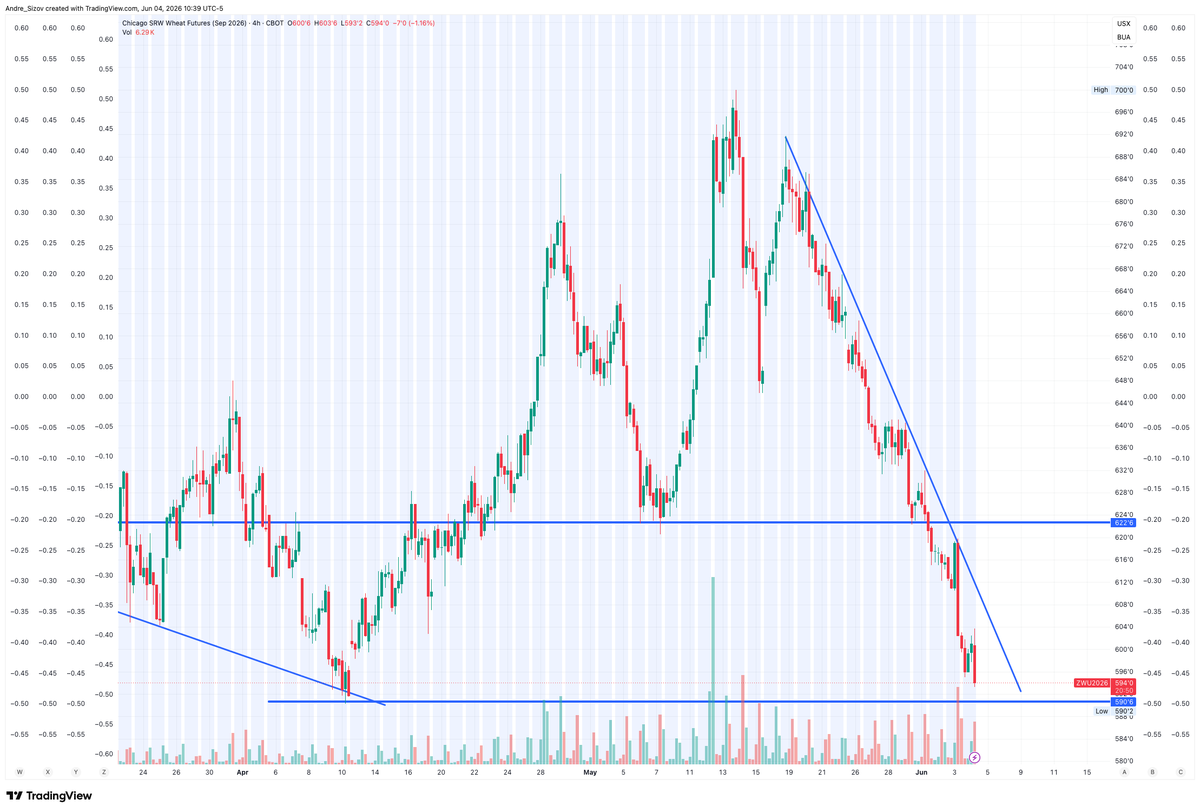
Sep CBOT #wheat is approaching its April low.
Shortly after the China commitments story, we flipped bearish - but we did not expect the sell-off to be this brutal. Nearly 15% down in two weeks.
The next question: when does this become a buying opportunity?
Our view:
https://t.co/aUa0DsUj8d
#oatt #agwx #sizovreport
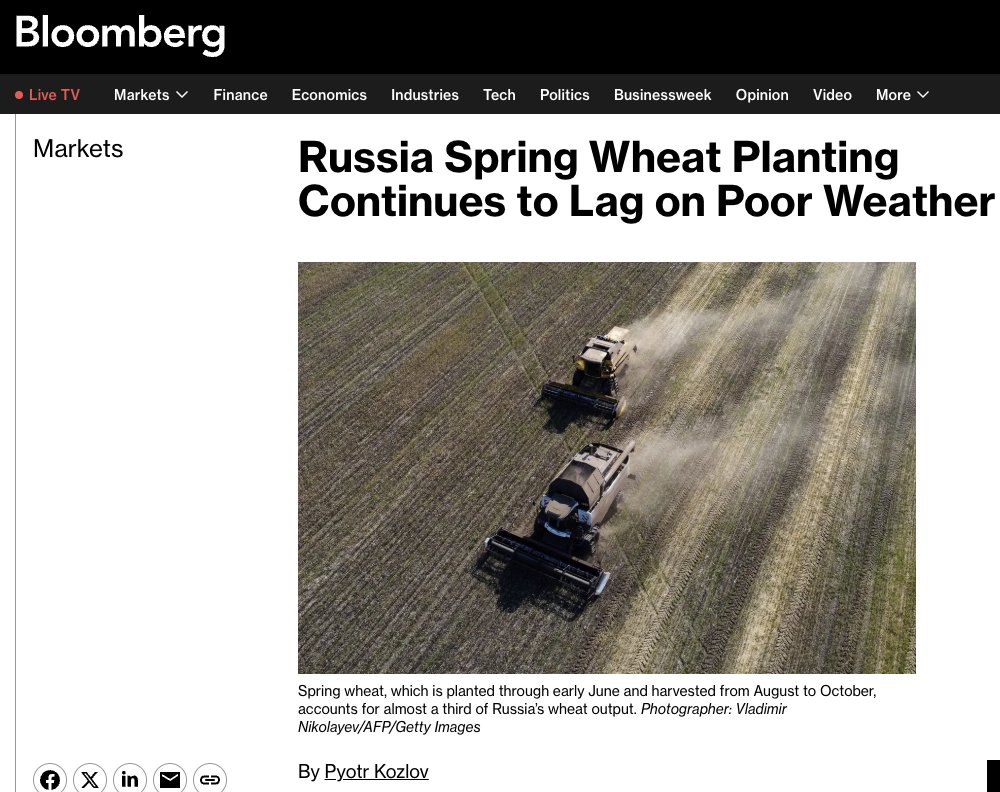
Exclusive: Russian spring wheat planting continues to face delays as persistent rain hinders growers, risking lower harvests. “This is the slowest planting pace since 2018,” @sizov_andre , head of consultancy SovEcon, said, with the largest delays in Volga and Siberian regions
ABARES sees the Australian #wheat crop at 26.7 mmt, down 26% y/y.
That is well below the USDA’s 30.0 mmt.
A more realistic number, in our view. But does the market care yet, or is this already priced in?
#oatt#sizovreport#australia
Russia’s spring #wheat area may be the smallest in decades.
As of late May, Russian spring wheat area was at its smallest level in many years.
The key reason is not just delayed planting. Farmers are shifting hard into crops with better economics, especially oilseeds.
Interestingly, even Siberia - where the climate is broadly similar to Canada - is trying to plant more sunflowers instead of wheat.
That is negative for the new wheat crop. In May, we (@SovEcon) forecast Russian spring wheat area at 10.5 mln ha, down 0.5 mln ha year on year, but that number now looks too optimistic.
Bloomberg: “This is the slowest planting pace since 2018,” Andrey Sizov, head of consultancy SovEcon, said by phone, with the largest delays in the Volga and Siberian regions. Spring wheat acreage could fall even lower.
#sizovreport #oatt #agwx
Funds keep selling #wheat.
The net short is now around 40-50K, up from 19K in the latest COT.
Two weeks ago, we called it:
“Neutral to bearish bias. The China deal gap should be filled soon. Funds want to sell wheat again.”
Since that report, CBOT wheat is down 8%
How far are we from the bottom?
Our view:
https://t.co/ju8pnUDJw6
#oatt #sizovreport
I keep getting asked: why is #wheat down so hard?
Valid question. The list of reasons is long - and so is the list of reasons why it should be up.
But that's the wrong question.
The #1 question: are funds really selling? If they are -play along while you figure out why.
If you're thinking about touching $WEAT again, keep that in mind.
#oatt
UK crop ratings have fallen after weeks of dry weather, with AHDB warning that the next fortnight could be critical for yield potential.
Winter #wheat is now rated 64% good or excellent, down from 74% in April, while winter barley has fallen from 70% to 62%.
#oatt#agwx
The team at @sovecon raises Russian #wheat production to 90.3 mmt and stating "no significant weather risks". There's a reason HRW futures are under pressure. HRW is the only global wheat class with production supply shock which makes HRW the residual supplier. Bearish US wheat
Australia’s #wheat crop likely has a meaningful downside.
But the main driver does not seem to be input shortages. Diesel imports are actually higher y/y. At this stage, the bigger issue is early-season weather.
Later on, fertilizer costs could still weigh on applications. And El Niño remains a clear risk, as it often brings below-average rainfall to Australia and weaker yields.
#Australia #oatt #agwx #sizovreport
Another #grains don't care about crude session.
We saw the same pattern at yesterday's open - flagged it as a bearish signal for clients. It played out.
What's next: https://t.co/dOJgWyzEhq
#oatt#sizovreport#wheat
ZW vs WTI
KC #wheat is getting obliterated.
Right after confirmation of the worst crop conditions in decades, with good/excellent at just 26%, the market is down another 2%.
That leaves KC wheat down 16% from the May high.
#Kansas#HRW#oatt#sizovreport
"The team at @sovecon raises Russian #wheat production to 90.3 mmt and stating "no significant weather risks". There's a reason HRW futures are under pressure."
#oatt#agwx
En la semana que finalizó el 20 de mayo, los precios de exportación del trigo ruso se situaron en 243 $/t. "No alcanza para compensar la fortaleza del rublo, por lo que los márgenes de exportación siguen siendo muy negativos. Las retenciones para el trigo se mantiene en cero".
Funds dumped almost 90K of #corn as per the latest COT.
Biggest weekly sale since May 2025.
The last time we saw this kind of selling, front-month corn dropped about 20% over the next two month.
Anyone else seeing the parallel?
#oatt#sizovreport
Good news if you are bullish on #wheat: Russian FOB hit a seasonal high last week at $247/mt.
Bad news: prices started declining right after.
FOB has been supported by elevated domestic prices, but the new crop is just around the corner.
Is the support story over? Our view is in this week’s report: https://t.co/bnLyWYRkmM
#oatt #blacksea #sizovreport
"Russia spring planting is a disaster."
Not anymore.
Siberia — ~4 mln ha, the biggest spring #wheat region (roughly the same area as all US spring wheat) — was cold and wet. Planting was running late.
Now it's catching up fast. The delay story is largely over.
The real question now: what does this mean for Russia's total crop and global prices?
Our view: https://t.co/ZiB7MsjoAC
#wheat #oatt #blacksea #Russia