Albrecht von Wallenstein was a true warrior-hero archetype.
In his palace he had himself depicted as god of war Mars.
Obtaining great glory in battle, asserting himself with vast ambition.
But ultimately his hubris led to his downfall - like a tragic hero of Antiquity.
When a garrison is occupying a city that does not support it in medieval times, the mistake has very often been made of leaving only a small detachment of soldiers behind while the rest of the garrison goes out to forage in the countryside.
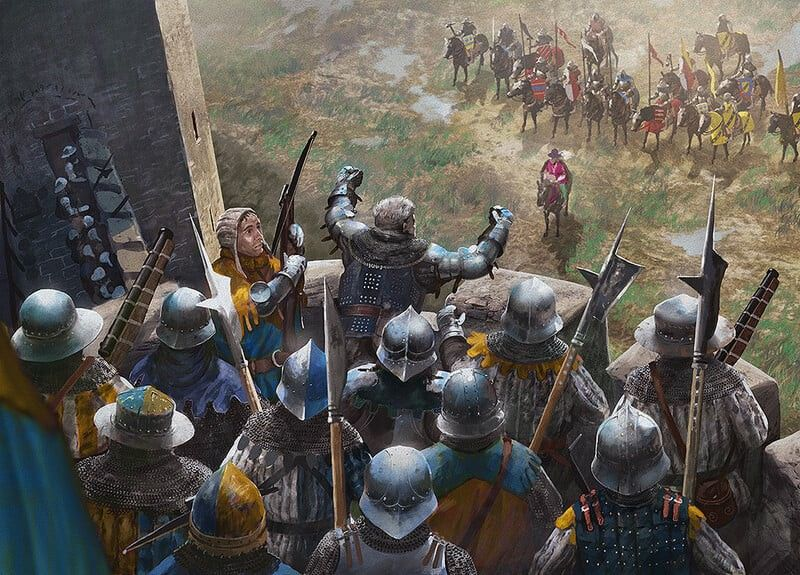
April 1430, Melun. An island fortress in the Seine that took Henry V four and a half months and more than 8,000 men to starve out in 1420. Its governor was now the burgundian Jean de Luxembourg, and his lieutenant Dreux de Humières who hold the castle. Then supplies ran out. The garrison sent almost every able-bodied man on a raid into the Gâtinais region, leaving only a handful of English soldiers in the city. News of Charles VII's approach was already spreading.
The townspeople rose up when the garison left, seized the gates and sent messengers to nearby royal French commanders. Their troops rushed in and surrounded the castle, where the English in state of great panic fled and had taken refuge.
When the burgundian garrison returned to the Bierre gate after foraging across the countryside, no drawbridge came down. A hail of arrows met them, and a fleur-de-lis banner flew over the walls was displayed. They turned back toward Corbeil town, still held by English.
Joan of Arc and her troops arriving from Sully-sur-Loire joined Melun and could pass over the Seine river few days after.
Non je ne donnerai pas de pourboire, vous n’aviez qu’à créer un syndicat pour exiger d’être payés par votre patron. C’est vous qui êtes ridicules en vivant de mendicité alors que vous travaillez pour une entreprise !