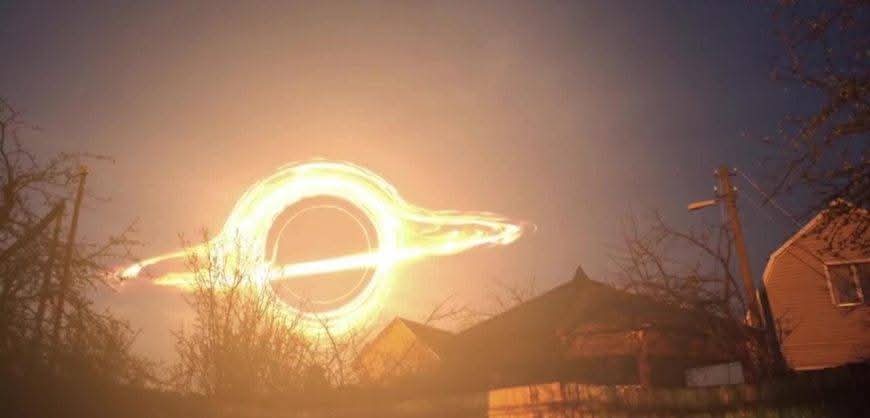
Meteor crashing into the Moon...
This is not a rare sight, through captured not very often.
The Moon is struck by roughly of meteoroid material daily, with around meteoroids the size of ping-pong balls hitting it every day. Because the Moon lacks an atmosphere, it is constantly bombarded by debris ranging from dust to larger, crater-forming rocks.
A galactic tango 💃
Two spiral galaxies in Arp 248 appear connected by a luminous bridge in this image observed by the Hubble Space Telescope. The stream is known as a tidal tail, full of stars and interstellar dust, and is formed by the gravitational attraction of both galaxies.
Credit: ESA/Hubble
Sobrero Galaxy 🌌
NASA has revealed a stunning image of the Sombrero Galaxy, located 30 million light-years away, captured by the James Webb Space Telescope. Taken with Webb’s Mid-Infrared Instrument, the photo showcases the galaxy’s glowing core and smooth inner disk, along with intricate dust structures in its outer ring—signs of emerging star-forming regions. In contrast to more active galaxies, the Sombrero Galaxy has a modest star formation rate and a relatively quiet supermassive black hole at its center.
The Red Rectangle Nebula, so called because of its red color and unique rectangular shape, is a protoplanetary nebula in the Monoceros constellation. Also known as HD 44179, the nebula was discovered in 1973
Journey through Caldwell 51, a faint galaxy about 2.3 million light-years away. Hubble captured ultraviolet, infrared, and visible-light observations of C51, in order to learn more about its chemical composition.
Since most elements in the universe are formed by stars and distributed into their galaxy when the stars die, this information can help researchers learn more about the evolution of the galaxy and its star formation history.
A stunning new time-lapse reveals the slow, dramatic evolution of Kepler’s Supernova Remnant, stitched together from over 25 years of observations by NASA’s Chandra X-ray Observatory.
This celestial wreckage traces back to a brilliant explosion witnessed on Earth in 1604 and later named after the legendary astronomer Johannes Kepler 🌌.
Today, scientists understand what really happened: a dense white dwarf star stole too much material from a nearby companion—or collided with another white dwarf—and crossed a fatal limit. The result was a Type Ia supernova, one of the universe’s most valuable tools for measuring how fast space itself is expanding 📏🌠.
What remains after such a blast is a supernova remnant—a vast, expanding cloud of debris glowing fiercely in X-rays. Heated to millions of degrees by the explosion, this material shines brightly, and because the remnant sits relatively close (about 17,000 light-years away within our own galaxy), Chandra can capture its fine details with incredible precision 🔥🛰️.
This newly released video combines X-ray data from 2000, 2004, 2006, 2014, and 2025, making it the longest time-spanning visualization Chandra has ever produced. A true testament to the observatory’s endurance and sharp vision ⏳👁️.
“The story of Kepler’s remnant is only now starting to reveal its deeper chapters,” said Jessye Gassel, a graduate student at George Mason University. “It’s astonishing that we can literally watch the shattered remains of a star slam into material it ejected long before.”
Instead of a straight shot, NASA is sending four astronauts on a “hybrid free-return trajectory.” They’ll whip around Earth to gain speed, then use the Moon’s gravity like a giant slingshot to hurl themselves back home. No engine burns for the return trip, just pure orbital mechanics and vibes. 🧑🚀
There is a massive black hole with millions of times more mass than our sun is plunging towards Earth and will one day annihilate life as we know it. This particular black hole is coming towards us at 110 kilometres per second and is at the center of the Great Andromeda Galaxy – the Milky Way’s closest and much larger neighbor. At the center of the most known galaxies, there exist a supermassive black hole which stars spin around and helps keep everything in formation.
But such is the powerful gravitational pull of the Milky Way and Andromeda that they are being drawn toward each other and will one day crash.
Fraser Cain, publisher of space website Universe Today, wrote for https://t.co/siOf3O6X3g: “There’s a black hole at the centre of the Milky Way. And not just any black hole, it’s a supermassive black hole with more than 4.1 million times the mass of the Sun. It’s right over there, in the direction of the Sagittarius constellation. Located just 26,000 light-years away. And as we speak, it’s in the process of tearing apart entire stars and star systems, occasionally consuming them, adding to its mass like a voracious shark.”
Due to the size of Andromeda however, there is only going to be one winner when it smashes into the Milky Way. But, as Andromeda is 2.5 million light years away, it will take over four billion years to reach us, so we are safe for now.
Mr Cain said: “Panic will happen when the Milky Way collides with Andromeda in about 4 billion years. Suddenly, you’ll have two whole clouds of stars interacting in all kinds of ways, like an unstable blended family. Stars that would have been safe will careen past other stars and be deflected down into the maw of either of the two supermassive black holes on hand. Andromeda’s black hole could be 100 million times the mass of the Sun, so it’s a bigger target for stars with a death wish.
The Ring Nebula 💍 🌌
Located about 2,300 light-years away in the constellation Lyra, the Ring Nebula (or M57) is a glowing shell of gas and dust, created from a star nearing the end of its life.
This nebula offers us a glimpse of what our own Sun might look like in a few billion years!