$APP $UI
AppLovin’s Ex Parte application.
Quick version: $APP is asking a San Francisco court for a TRO
Target: Unity’s Ad Quality SDK
Claim: it’s collecting data on ads AppLovin wins and serves through MAX
Ask: shut that collection down within 5 business days
I’m gonna share some important pages. Not gonna waste too much time on this, so if any1 wants to look for themselves here is the link:
https://t.co/yyN6TJEjQB
Let’s get into this.
$APP $U
I doubt most of y’all even know about this research.
A lot of people think AppLovin just started its e-com push, but it’s been running since 2024.
This August article has actual 12-month results versus other platforms across Triple Whale’s 755 e-com shops that spend on AppLovin. The attribution comparison is on those 755. The media-mix model is trained on about 6,300 e-com shops...the 755 plus a large contrast group of shops that weren’t spending on AppLovin.
This is better than a lot of sell-side or “expert” opinions, because it’s a real data-driven look across a big group of e-com shops.
I’m sharing this for the people who think e-com results are still something “that has to be proven.” I think these are pretty good early signs of success.
Probably the last post I’ll do on $APP until we get something new on the lawsuit or the Q3 print.
Full article: https://t.co/DSbEfAZMtQ
Read it for yourselves. If you don’t understand anything in those screenshots, use your favorite LLM and let it explain it to you.
I think this is a pretty promising direction. I knew about this research as soon as it came out, but I don’t think anyone on X shared it, even though I think it’s pretty significant.
$APP is pretty cheap here, considering there is a good reason to expect they will succeed in e-com, and that should show up in FCF compounding for this biz.
I can’t believe I have to explain this in ’26, but not every competitive market is a zero-sum game. $U growing doesn’t have to mean they are taking share from $APP. Is there zero pressure? Probably not either, but people on X are extremely oversimplifying everything. $U / $APP competitors: Google, Meta, Pangle/ByteDance, Mintegral, Moloco, InMobi, Liftoff/Vungle…...... you get what I mean.
So I’m constructive on $U, and I’m constructive on $APP with their e-com push too. I haven’t looked into $U as much as I have with $APP, but I might do it next.
Stay sharp, keep thinking independently through the headlines, and good luck.
@wealthmatica@KrisPatel99 That was just a temporary restraining order. The lawsuit is still ongoing. Denial of the TRO only shows the judge did not think an emergency freeze was justified. That is all it decides. Success on the TRO was unlikely.
@KrisPatel99 Most people are reading this wrong. Not a zero-sum game. Rather than explaining everything, I’d refer to this post below.
https://t.co/i9p2kYMz1y
I see a lot of noise around $APP. Let's pause for a second. What are the real risks?
1) Unity Vector taking market share from AppLovin
The mobile game UA market (what studios spend on ads to win new players) is estimated to be at $40–60B. AppLovin handles around $20B of that, so 35–50% share. From that it keeps around 40% as revenue (c.$8B).
Unity Vector is 6x smaller: around $3B of ad spend, c.6–8% share.
The other 42–59% is Meta, Google, Mintegral, Moloco and smaller networks. AppLovin has been taking share from them for years, and Vector started doing the same this year.
The market grows mid-single digits (c.5–6%), so $2–3.5B of new spend a year, roughly all of Vector's current business.
For Vector to take AppLovin's pie, AppLovin first has to stop gaining share, which isn't what's happening. But say AppLovin stays flat at c.42% (current midpoint), Vector climbs from 7% to 28% and the rest shrinks from c.51% to a hard floor of c.30% (Google, Meta and TikTok reach audiences in-game networks can't).
To get there, Vector's ad spend must grow c.+50% a year from 2026 to 2030, basically copying what AppLovin did in its best years. Only after that would it start taking from AppLovin.
2) AppLovin growing below 20% in FY27 (what hit $TTD)
Consensus expects +26% for 2027, and management targets 20–30% growth in gaming. For AppLovin to drop below 20%, it would have to stop gaining share in gaming entirely and grow only with the market plus e-commerce. That gets you 14–15%. Possible, but it means AXON stops winning, and there's no sign of that.
3) Could Apple kill AppLovin by cutting device signals?
Apple could restrict the signals (IP address, phone model) that ad networks rely on to measure which ad led to an install, but cutting them off completely is unlikely.
Yes, Apple did ATT in 2021 regardless of who got hurt. But this would hit its own wallet: games bring billions in App Store spending, Apple keeps 15–30%, and ads are a key way games find paying players. It would also hurt developers and invite more antitrust action. France, Italy and Germany have already acted against ATT.
And any cut-off would hit Meta, Unity and Google too.
Bottom line: the risks are real, but each one requires something that isn't happening today.
their chance of winning depends on the signed contracts, it’s a shame we don’t get to see those. But I’d assume they know for a fact Unity was breaching them, otherwise they wouldn’t sue. The easiest way to protect the protected output from MAX is with a contract. But there are other ways MAX can defend its output, which I think they might do after this incident. That’s why I’d disagree with them losing being a disaster.
I take expert calls with a grain of salt. Most of them are biased, they talk to 3 people and paint a picture like that’s what everyone thinks/does.
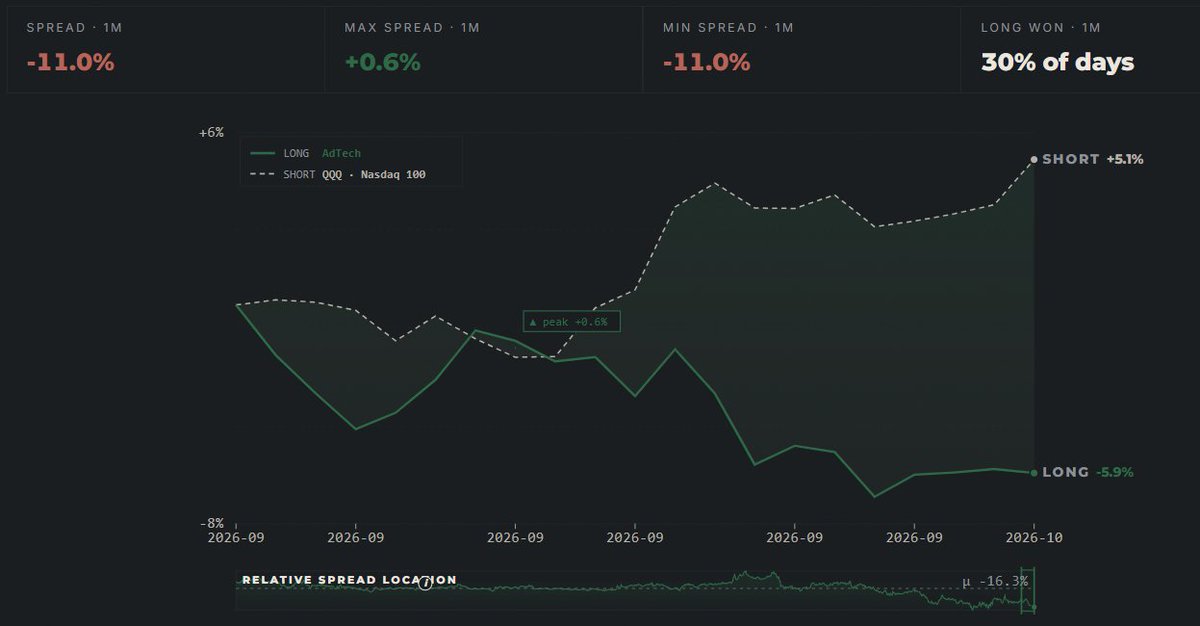
Yeah I think $U is not a bad company at all. But the R/R, especially with this lawsuit, is with $APP right now to me. Even though if someone’s running the long $U short $APP trade right now they’re printing haha.
Nah man. Don’t downplay AppLovin’s position in this. Worst case, they tighten up MAX so third-party SDKs can’t pull data or only get very limited access compared to now, and they just keep rolling. Those are moves they can and will make.
Third-party models end up with worse data, bid worse, and that’s how you protect a dominant position. Third party models trained on stolen data get significantly worse over time because the market is fluid and keeps changing. It’s really not that deep. And don’t forget… AppLovin knows how to play dirty better than anyone. How do you think they got on top?
If you wanna build an $APP position, now would be the time to pull the trigger if you believe the fears are overblown. 52w IV percentile is at 30%, so you can consider buying LEAPs too. How I’m playing this? I’ll hedge 50% of my $APP stock position with put spreads once AppLovin pumps a little higher. I’ll do that just to free up margin. I’m not too worried about downside from here. Good luck.
$APP
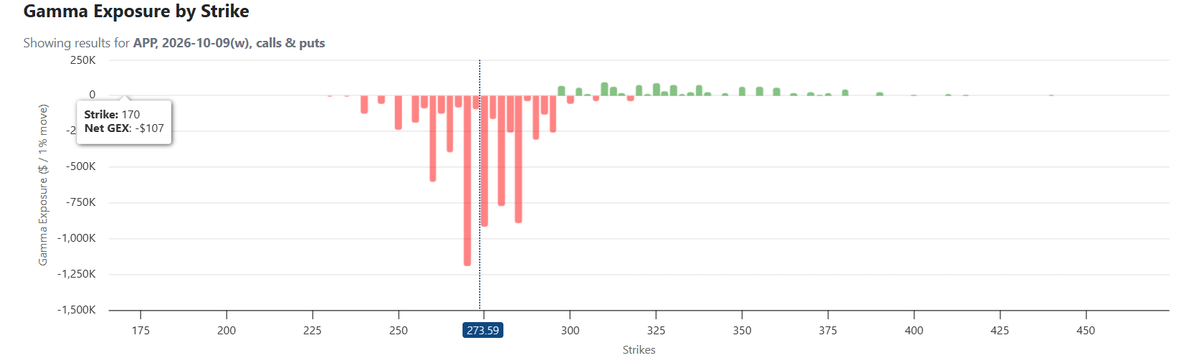
Looking at short-term positioning. These gamma put walls only add fuel to the fire to the downside if you’ve got a headline- or sentiment-driven tape. Dealers have to sell the lower it goes… add stop-losses and forced sellers and you’ve got a perfect recipe for a squeeze lower. The same mechanic works on the upside too (dealers have to buy the higher the stock goes), so it can squeeze higher as well.
$APP
Sentiment/headline-driven tape causing forced selling. I see a lot of people talking about these last few days’ decline and trying to connect it to fundamentals deteriorating. That’s a wrong read of the current tape. If you’re a $APP shareholder, enjoy the volatility. Nothing else to do.
He makes sense tho. Unity is going after AppLovin… he kinda underplays AppLovin’s position and the potential setback Unity can have from this lawsuit, cuz IF their edge was really stealing data from MAX and they lose it, they’re gonna have a harder time staying competitive. But one co ($U) is accelerating growth = multiple expansion… the other co ($APP) is decelerating = multiple compression… I’d still buy $APP over Unity as of today.
Markets are fluid. You need constant access to data, and if your main edge was training on competitors’ data and you lose that, I’d expect you to have a harder time staying competitive.
It comes down to what a third-party SDK can still get from MAX, and how MAX adjusts. They can probably make the in-memory read less useful…maybe by not leaving the protected output in memory, and by making the auction harder to read. Unity’s bids get worse, and if another bidder steps in, publishers optimizing for eCPM wouldn’t even feel that. In theory. But if the edge doesn’t come from Ad Quality, none of this matters.
$APP $U
Had some time to think about this drama. $APP will take steps: change MAX terms, stop sharing output on channels other SDKs can subscribe to, encrypt the mediation packet, kill the internal listener hooks, push pubs onto Ad Review instead of a rival kit, etc. They have plenty of options how to fight back.
On $U I’m way more careful tho. Because if these allegations are proven right, I’d expect they’re using Ad Quality to exploit not just AppLovin but every other demand source on that mediation. That would mean their ad rev growth is based off obtaining illegal information and using it against the competition. That is not durable at all. If these allegations are proven wrong, I’d judge Unity like any other adtech/gaming biz.
This is a negative development in my opinion.
One of $APP's key advantages is being the mediator with MAX. This gives them access to privileged information like each advertisers bid, which ads won, and how many ads were shown in an individual session.
Without this info, competitors are bidding blind.
This is a reason why competitors bids are structurally lower than $APP's.
However, as far as I know, there is no reason why other bidders can't receive this information too, it was just a technical reality of whoever mediates the auctions sees that data and of course they would keep it to themselves because it was a competitive advantage.
Now if there is a way for Unity's SDK to collect more data, I don't think the publisher would care. This makes auctions more competitve and should result in them getting more higher bids.
It is bad for $APP because a higher bid from $U, even if it isn't the winning bid, can compress the spread they take on their ads. (This was a key risk I flagged in my video a few months back).
Unity also owns a very popular game engine and has reportedly been using data from that to further tailor their models. After rebuilding their ad stack, publishers have reported improved ROAS, sometimes higher than $APP (which could also be a result of their CPMs being lower).
I also imagine though that $APP will figure out how to hide this data better so $U will not be able to take it in the future.
Nevertheless, the lawsuit corrborates claims we've heard that Unity has been improving relative to AppLovin. Now they are still far, far behind, but given the auction dynamics of how they make money, a 2nd tier competitor getting more competent could directly impact their revenues.
Will have more thoughts out when @Speedwell_LLC publishes the AppLovin report next week.
@DrewCohenMoney I think that too. But the ad market’s fluid like any other market. If your main edge was training on competitors’ data and you lose that, I’d figure you’re gonna have a harder time staying competitive.