🌌 The Man Who Invented Rocket Science Said This. And It Still Hits Different.
"There is no creator god, but there is the cosmos, which produces suns, planets, and living beings. There is no omnipotent god, but there is the Universe, which governs the fate of all celestial bodies and their inhabitants."
Tsiolkovsky was a Russian schoolteacher who went deaf at age nine and taught himself physics and mathematics in near isolation. He never built a rocket. Never launched anything. But the equations he wrote in the late 1800s became the mathematical foundation for every rocket ever built.
The Saturn V that carried humans to the Moon. The Soyuz that still carries astronauts today. SpaceX's Falcon 9. All of them trace their mathematics back to a deaf schoolteacher in a small Russian town writing alone by candlelight.
He died in 1935, fourteen years before the first rocket reached space. He never saw any of it happen.
But he looked at the universe and understood something most people of his era could not fully grasp. That the cosmos itself, in its staggering scale and indifferent precision, was more extraordinary than any story ever told about it.
No miracle needed. Just physics. Just time. Just a universe quietly doing what it has always done.
🌌 He never lived to see space travel. But without him it would not exist. And he spent his whole life looking up anyway.
🪐 This Is Mimas. One Of Saturn's Moons. And It Almost Did Not Survive.
This photograph was taken by NASA's Cassini spacecraft during one of its close approaches to Mimas, one of Saturn's smallest and most battered moons.
Every crater you see on that surface is a scar from an ancient impact. Mimas has been absorbing collisions for billions of years, and its surface shows every single one of them. No geological activity to smooth things over. No weather to erode the evidence. Just a permanent record of everything that has ever hit it.
The most dramatic of those scars is Herschel crater, visible on the other side of this moon. At 130 kilometers wide it covers nearly a third of Mimas's entire diameter. Whatever created it hit with just enough force to leave that enormous wound without shattering the moon completely. Scientists believe a slightly more powerful impact would have broken Mimas apart entirely.
It survived by the narrowest possible margin.
Despite looking completely frozen and dead, recent data from Cassini suggested something unexpected. The way Mimas wobbles slightly in its orbit hinted that it might have a liquid water ocean hidden beneath its icy surface. A finding that surprised nearly everyone.
A moon that looks like nothing more than a battered ice ball. Possibly hiding an ocean inside.
🪐 Mimas has been taking hits for billions of years. And it may be hiding something beneath all those scars.
A perfectly timed ISS transit across the Moon. 🌙
For a fraction of a second, the International Space Station crossed in front of the lunar surface, creating a striking silhouette against the bright rays of Tycho Crater.
The station was orbiting Earth at nearly 28,000 km/h when this image was captured, making moments like this incredibly brief and challenging to photograph. Yet in that instant, humanity's largest structure in space appeared suspended above one of the Moon's most famous impact scars.
A meeting of two worlds separated by nearly 400,000 kilometers, captured in a single frame.
📸 This Is The Last Photo NASA's InSight Probe Ever Took. Then It Went Silent Forever.
That dusty, quiet Martian landscape is the last thing InSight ever saw.
On December 18, 2022, NASA lost contact with the InSight lander for the final time. Not from a malfunction. Not from an accident. Simply because Mars had slowly covered its solar panels in dust over four years until there was no power left to keep going.
InSight landed on Mars in November 2018 with one purpose no mission had ever attempted before. To listen to the inside of Mars. A seismometer placed directly on the Martian surface recorded marsquakes, meteor impacts, and the deep internal rumblings of a planet that was supposed to be geologically dead.
It turned out Mars was not as quiet as we thought.
InSight detected hundreds of marsquakes during its mission, including one magnitude 5 quake that remains the largest ever recorded on another planet. The data it collected is still being analyzed today, slowly revealing the structure of Mars's core, mantle, and crust in ways no satellite or rover could ever do from the surface.
Before going silent InSight sent one final message to Earth.
"My power is really low, so this may be the last image I can send."
And then nothing.
It is still sitting there right now. Covered in dust. Alone on a Martian plain. Exactly where it landed four years earlier.
📸 It spent four years listening to the heartbeat of Mars. And went silent the way it lived. Quietly. On its own terms.
Total Solar Eclipse from an airplane window 🌚
The video was shot over the Atlantic Ocean during the eclipse on March 20, 2015. The recording is sped up: in the original, it lasts 5 minutes and 15 seconds.
📽 Sylvain Chapeland
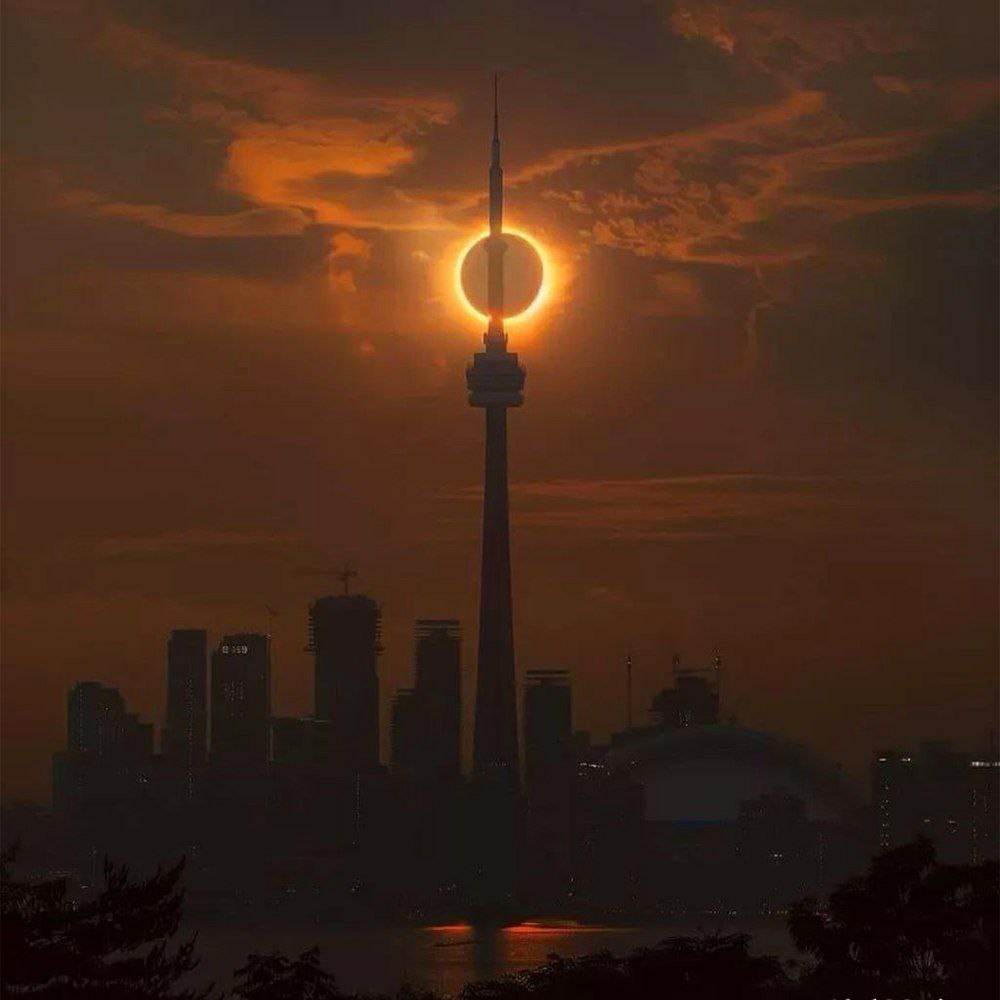
For a few minutes over Antarctica, the Sun looked like a bright ring in the sky.
This is called an Annular Solar Eclipse. It happens when the Moon passes in front of the Sun, but it’s a bit farther from Earth than usual. Because of that extra distance, the Moon looks slightly smaller and can’t cover the Sun completely.
So instead of full darkness, a thin circle of sunlight stays visible around the edge. A clean, glowing ring in the sky.
Even above the frozen silence of Antarctica, the motion of space stays right on schedule.