Challenging the narrative on mainstream mental health. We use precision analysis and strategic advocacy to elevate ethics above administrative convenience.
🔍 The Continuum of Control: Informal Coercion and Its Implications for Evidence-Based Mental Health Care
A Critical Analysis of Informal Coercion and the Relational Dynamics of Mental Health Services
https://t.co/kvuX7Axpu2
#MentalHealth#LivedExperience#IatrogenicHarm #PsychiatricCoercion
@hawkngradiation It's unbelievable how much evidence we have that these practices; forced treatment, coercive practices and forced hospitalization often do more harm than good, yet many people still believe it's helpful. Really good to see this discussion going.
Forced institutionalization is not the way to go.
Author and journalist Daniel Bergner opens up about the harms of coerced treatment. His brother’s experience on a psychiatric ward spurred a years-long investigation into the nature of our minds, the evolution of modern psychiatry and its overreliance on medication, and alternative approaches to mental health care.
#mentalhealth #disabilityrights #forcedtreatment
🤝 Relational Conditions for Recovery: Why Autonomy Is a Social Achievement and Why Mental Health Care Must be Built Around It 📜
"Mental health systems have often operated under a classical, individualist model of autonomy, one that treats self-determination as an internal cognitive property to be assessed and, when deemed insufficient, displaced by professional authority. This article argues that such a framework is philosophically incomplete and, when applied as a default orientation in mental health care, can be harmful to recovery. It builds upon a central thesis, that autonomy is not an intrinsic internal property, but a social accomplishment, thereby constituted and maintained through relational conditions. Authentic recovery involves an ecology of care, characterized by emotional safety, epistemic respect, supported decision-making, and non-paternalistic support...."
https://t.co/9MMaQ4Ey5o
#MentalHealth #SpadesUpAdvocacy #Autonomy #RelationalAutonomy #LivedExperience
👁️ Stigma in Mental Health 💎
Stigma in Mental Health: The Status and Future Direction (2025)
Mustafa Habeb, Adela Magdalena Ciobanu, Mena Al-Ani, Richard Mottershead
“…As for interpersonal stigmas related to mental health issues, it has been discovered that institutional policies and other societal factors distinguish individuals with mental health issues, causing them to be denied access to resources and opportunities [24]. In comparison to the general population, individuals with mental health disorders experience a lower quality of life in addition to a higher incidence of illness, different types of abuse, neglect, suicide, and death. The social stigma that shadows mental illness persists in patients despite the recent advances in acceptance and understanding of mental illness in the field. This is ultimately because society still lacks awareness of mental illness [25].”
https://t.co/pfyWdiTJtX
#MentalHealth #LivedExperience #EndStigma #PeerSupport
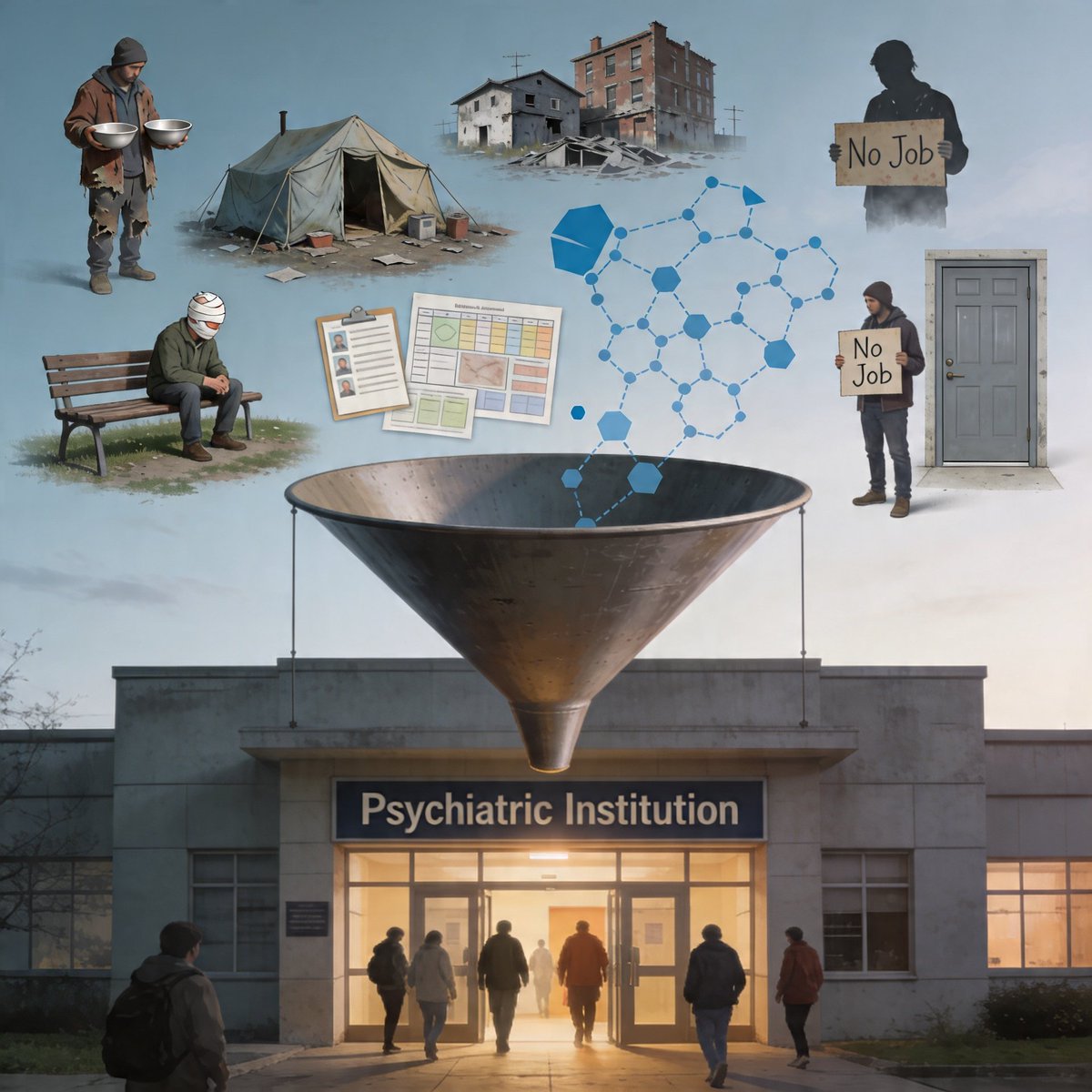
⚖️ The Failure Of The Psychiatric Institution and The Evolution Of Mental Health Care
This book outlines the deficiencies within the institutional model. It provides a brief history as well as a detailed analysis of some of the fundamental issues with the long-term psychiatric confinement framework. It provides several evidence based alternative treatment approaches.
This text is in relatively easy to understand vocabulary and grammar. As the push for psychiatric confinement expands, it's worth discussing some of issues outlined this text.
https://t.co/0DUDlHgpBG
#MentalHealth #SocialDeterminants #Context #LivedExperience #SystemicChange
U.S. nursing homes are fabricating schizophrenia diagnoses to hide their use of dangerous antipsychotic drugs to subdue dementia patients, a government watchdog report found.
The drugs increase the risk of falls, strokes and death. https://t.co/6SkzWxZfSz
💜 Spades Up Advocacy: Responding To Pressure 🔥
In the field of systemic advocacy, we often encounter significant pressure. Our current model of care can be quite resistant to change.
We will continue to define and articulate the deficiencies within our mental health system; with precision.
We will also continue to acknowledge our current model’s strengths; those who work within our system, see it's potential but are silenced from policy, procedure or bureaucracy.
Change always requires discomfort.
At Spades Up Advocacy we respond to pressure with passion.
No. We don't give up.
We overcome.
#SpadesUpAdvocacy #NeverGiveUp #WeHaveAVoice #SystemicChange
⚖️ The Failure Of The Psychiatric Institution and The Evolution Of Mental Health Care
This book outlines the deficiencies within the institutional model. It provides a brief history as well as a detailed analysis of some of the fundamental issues with the long-term psychiatric confinement framework. It provides several evidence based alternative treatment approaches.
This text is in relatively easy to understand vocabulary and grammar. As the push for psychiatric confinement expands, it's worth discussing some of issues outlined this text.
https://t.co/0DUDlHgpBG
#MentalHealth #SocialDeterminants #Context #LivedExperience #SystemicChange
📜 Selected Papers from Miranda Fricker
For those who have experienced iatrogenic harm from our mental health system and were invalidated, dismissed, and discredited; you may find the work of Miranda Fricker both empowering and healing. ❤️🩹
Defining the harm and our emotions surrounding those experiences can be profound and liberating. 📜
#MentalHealth #EpistemicInjustice #LivedExperience #Awareness
https://t.co/nY6ecHvxhd
🧠 Myth Buster 🔥
This article consolidates some very significant research. 💎
People With Mental Illness More Often Crime Victims
- Aaron Levin
“More than one-fourth of persons with severe mental illness are victims of violent crime in the course of a year, a rate 11 times higher than that of the general population, according to a study by researchers at Northwestern University.”
#MentalHealth #EndStigma #LivedExperience
https://t.co/CJfH3GCoGA
📜 Selected Papers from Miranda Fricker
For those who have experienced iatrogenic harm from our mental health system and were invalidated, dismissed, and discredited; you may find the work of Miranda Fricker both empowering and healing. ❤️🩹
Defining the harm and our emotions surrounding those experiences can be profound and liberating. 📜
#MentalHealth #EpistemicInjustice #LivedExperience #Awareness
https://t.co/nY6ecHvxhd
Strengthening autonomy in mental health care through a relational approach (2024) 🤝
Paola Buedo & Timothy Daly
“…The relational approach offers several advantages in the field of mental health. First, it emphasizes the status that a person needs in order to exercise autonomy. Second, it explains how different forms of social oppression, such as gender, ethnicity or the stigma associated with mental health diagnoses, can threaten this status and thereby interfere with the development or exercise of autonomy, even when other conditions for autonomous decision-making are met. All of these factors not only are acknowledged, but can be worked upon with the person concerned, while recognizing, respecting and even bolstering that person’s agency.”
https://t.co/FTgzRCUZp7
#MentalHealth #LivedExperience #RelationalAutonomy #DeepThought
💔 A “Borderline” Failed System 🔧
A Danger to Self and Others: Consequences of Involuntary Hospitalization (2025)
Natalia Emanuel, Pim Welle, and Valentin Bolotnyy
This report is very significant. 💎
“...We find that in these judgment call cases, involuntary hospitalization significantly increases the likelihood of harm to self or harm to others. In particular, for judgment call cases we find that the risk of a being charged with a violent crime in the three months following an evaluation is increased by 2.6 percentage points above a baseline of 3.3 percent (though the chart shows results for each month through the six months after evaluation). Likewise, for judgment call cases, involuntary hospitalization increases risk of dying from suicide or drug overdose death is increased by 1.0 percentage point above a baseline risk of 1.1 percent over a three-month period after evaluation for hospitalization.”
Our policy makers should be having a critical discussion regarding these findings. 🏛️
https://t.co/0F6FMH1cdE
#MentalHealth #LivedExperience #IatrogenicHarm #SystemicChange