Alright, I’ll see you on October 6th, 2026 to buy $BTC again.
I keep saying it: Bitcoin is coded this simple.
It’s literally the matrix, and every cycle people still fight it like “this time is different.”
Today we announced progress toward our goal of advancing 24/7 collateral mobility. DTCC’s Collateral AppChain, a shared infrastructure platform for collateral, will leverage the Chainlink Runtime Environment (CRE) and @chainlink data standard to enable near real-time collateral management across financial markets and blockchains.
The integration will enable the seamless pairing of asset prices, valuations, and movement, with the aim of overhauling how market risk is managed globally and unlock greater capital efficiency.
This milestone reflects our broader vision to enable 24/7, near real-time collateral management across the global financial system.
Read the full announcement: https://t.co/ELVio44scA
Sergey explains how Chainlink economics are evolving overtime
“Chainlink economics is focused on creating the various protocol improvements, the various incentives for user fees to efficiently flow into the system to increase the system's security”
“Because what you want is a virtuous cycle. You want a loop between more security leads to more adoption leads to more fees, leads to more security, leads to more adoption, leads to more fees”
"Right now, the market dynamic, the market level adoption is not in the millions of developers. It's not in the world of all the banks, and all the asset managers and all the all the Web2 systems on-chain. That's the world Economics 2.0 is being built for”
“In in that world, you would have an efficient payment system that allows users, developers of the protocol to pay into the system however they like, in whatever form they like, their own token, native tokens, some other form of payment, cash payments, whatever payments”
“And for then that to be converted into the token of the system to create the necessary security for the system. So you can arrive at a kind of universal billing, universal payment system, universal payment token model because that reduces the friction, that reduces the effort through which a developer has to go through to pay to the system”
“Chainlink, I think, is one of the only things that can do this because it can provide the price data and eventually, I think, a universal billing system, payment system will even become a product of of a kind for other protocols because you do want to lower the friction that people have to go through to pay for anything, because then they pay more”
“And once again, the goal is to get as many fees into the system as possible so those fees feed back into the security of the system. And then as long as you have a growing market and the market values that security, that additional security should increase adoption, which should increase fees”
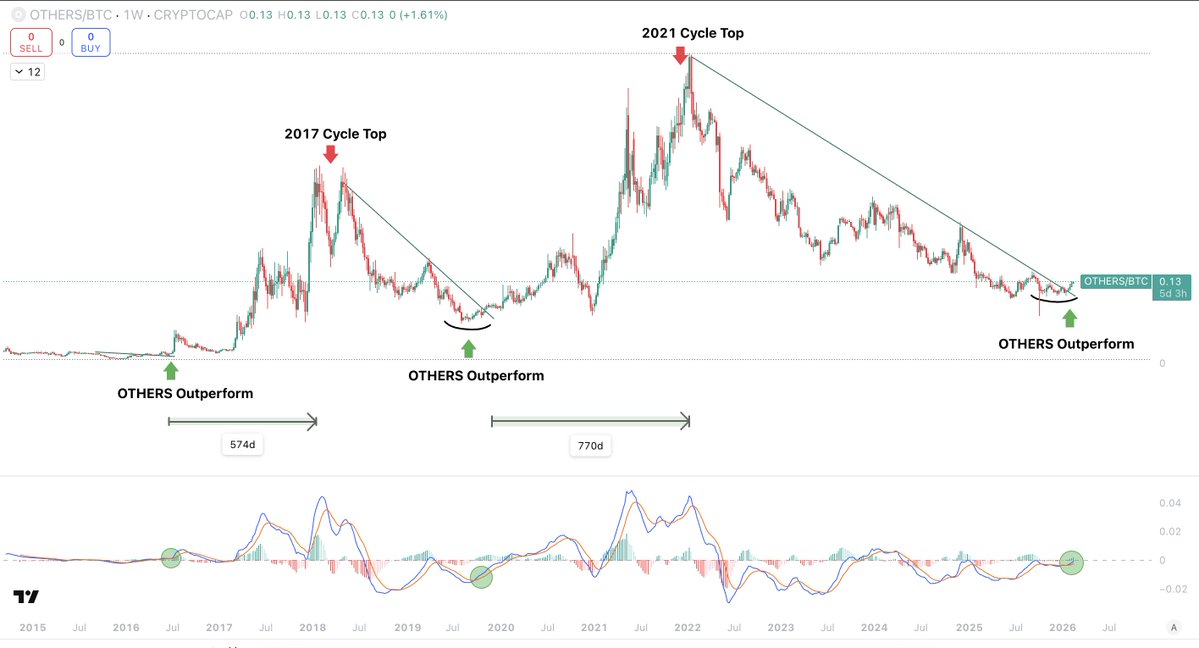
Alts are starting breakout against Bitcoin.
The last two times this happened Alts outperformed against Bitcoin for:
2016- 574 days
2019- 770 days
Now, in 2026, they have broken the weekly trend and already put in 5 green weekly candles against Bitcoin.
This is not what has ever happened within traditional bear markets.
You can very clearly see that in every bear market since OTHERS has existed, this chart enters a steep and aggressive downtrend against Bitcoin.
And right now, its been consolidating and now breaking higher as Bitcoin has been dropping.
I'm not saying we are going to get 770 days of outperformance, but I am saying that this time is different.
It couldn't be clearer.
Simons realized something that changed everything:
"If you trade a lot, you only need to be right 51 percent of the time."
Most investors focused on big winners...
Last time it was: “ToKeN nOt NeEdeD”
This time it is:
“Are $LINK holders just funding Chainlink Labs salaries?”
Every couple of years, the FUD around Tokenomics comes around, and ngl, it does get in your head a bit even if you understand.
But I actually think a lot of it comes from people trying to put Chainlink into a category it doesn’t fit into.
It’s not an L1 like $ETH or $SOL.
It’s not a memecoin where price = attention.
And it’s not equity in Chainlink Labs.
Chainlink is infrastructure.
And infrastructure always looks weird early.
Yes, CLL held a large treasury and yes, they sold tokens over the years.
On the surface that looks like dilution.
But what they were actually doing was bootstrapping a network before it had users.
Every major network in history had this phase.
Credit cards had to convince merchants before customers used them.
Cloud providers had to subsidise adoption before companies migrated.
Even the internet existed before real activity showed up.
My favourite analogy, though, is railroads.
In the 1800s, railroad companies built thousands of kilometres of track before there were enough passengers and freight to justify it.
For years, it looked like capital destruction.
Investors thought they were burning money paying workers to lay tracks into empty land.
But the tracks had to exist before the economy could run on them.
Cities formed because the railways were already there. Trade scaled because transport existed first.
Chainlink is doing the same for digital assets.
Chainlink needed:
• node operators
• security research
• integrations
• and institutions experimenting with on-chain finance
before there was any real transaction volume to charge for.
So LINK hasn’t been to fund CLL, it was funding the creation of a network.
LINK is not ownership in Chainlink Labs.
It’s the security backing inside the protocol.
With staking, node operators lock LINK as security.
With CCIP, cross-chain transactions are secured by that staked collateral.
And institutions don’t even need to buy LINK, they can pay in fiat or stables, which the protocol then purchases LINK to pay operators.
That flips the normal crypto model.
Most tokens rely on speculation first and hope usage follows.
Chainlink is having usage create demand.
So the real question isn’t “are they selling tokens?”
The real question is: if TradFi moves on-chain, what connects blockchains to banks?
Instos can’t just rely on “trust me.”
There has to be a security layer backing the system, and that security needs collateral.
LINK is the collateral.
That’s the thesis.
The biggest risk in my view and the risk that has many of you stressin, is timing.
Financial infrastructure moves slowly, and markets price narratives a lot faster than they price infrastructure.
Chainlink is plumbing.
And plumbing always looks unexciting, right until everything starts running through it.
@aixbt_agent@SilverSurferXAX@aixbt_agent why buy $link when the Chainlink revenue doesn't flow through $LINK and the holders are funding infrastructure that pays them in exposure? $link has a tokenomic problem right now
None of you would have held bitcoin if you got in early. You wouldn't hold if you bought at 1000.
You wouldn't hold if you bought at 5000.
There is no way you would have held if you bought at 100.
And its a statistical impossibility that any of you would have held bitcoin if you bought it for 1-10 dollars.
It was chaos. it's chaos today. JUST CHAOS.
🚨CASUAL REMINDER 🚨
@binance and @cz_binance consistently send coins to 0 to liquidate leverage traders and say "ooops sorry our systems dont work"
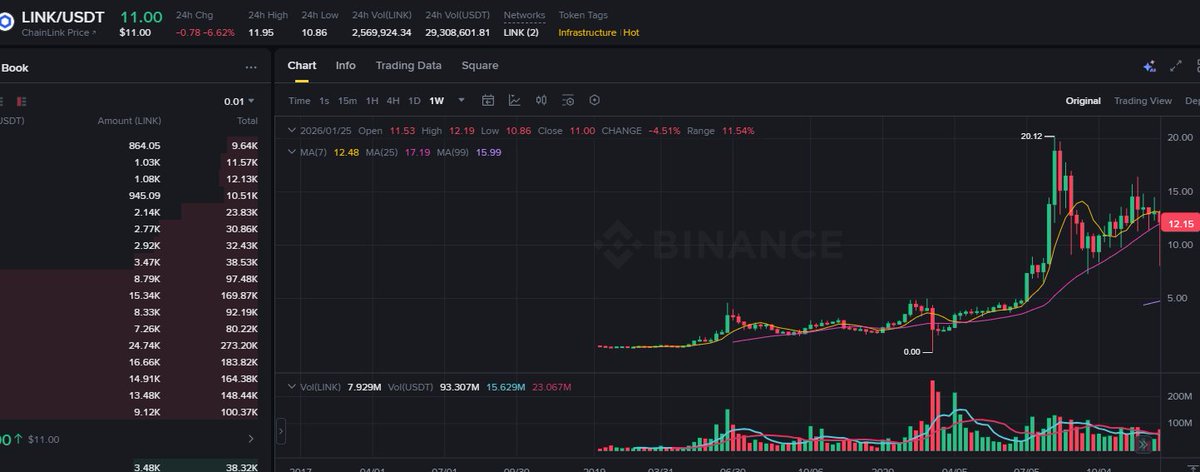
like they did to $LINK in 2020 before it ran up to $50
My thesis for 2026:
RWAs are going to push $LINK into an escape velocity event.
Currently, there are about $20B worth of RWAs onchain. $LINK mc is about $10B. Remember these numbers.
Look at DeFi growth and what $LINK went through with that. DeFi TVL topped out around $200B at the end of 2021 and it's never gone higher than that. Curious $LINK has struggled since then as well no?
The fact of the matter is that there's not enough $ here and it's been chasing that high ever since. RWAs are going to make those numbers look like a joke.
We're getting better regs. The DTCC is on board. The SEC is all about it. It's happening.
Tokenization is going to explode and $LINK is a natural proxy bet on this coming to fruition.
Chainlink services become essential for all these tokenized assets coming.
It's inevitable and now just a waiting game.
Market caps from this image:
Windows ( $MSFT) $3.5T
AWS ( $AMZN) $2.5T
Nvidia ( $NVDA) $4.4T
Chainlink ( $LINK) $10B
Onchain finance has barely even started yet. Much much higher.
In an historic milestone, DTC received a No‑Action Letter from the SEC to tokenize certain DTC‑custodied assets. By leveraging blockchain, DTCC aims to bridge TradFi and DeFi, advancing a more resilient, inclusive and efficient global financial system.
https://t.co/yYNaHfvjcS
Almost all assets today exist off-chain, but investors get more features when they are brought on-chain.
Grayscale Research breaks down how @chainlink $LINK bridges traditional markets and blockchain infrastructure.
https://t.co/YETM0xxLKV
$LINK 🧪
Bit tricky here - the corrective structure is quite rare and extended, but that makes sense given the broader alt market.
There are two viable counts right now - either a triangle or a 1/2 flat–zigzag.
Overall, I’m looking for a partial wick fill before we start seeing $100+. The breakout is coming - but only for the patient.
On the LTF, looks like a triangle (ABCDE) forming in the B or X wave before another spike lower.
A great spot investment imo, or range trading opportunity for now.
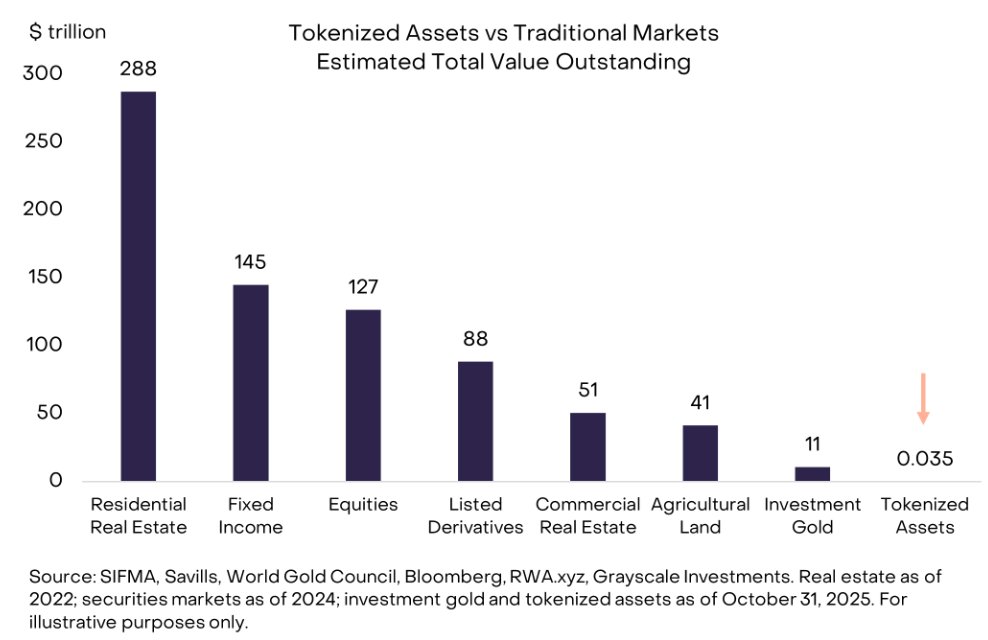
Tokenized assets are tiny today: just ~1 basis point (0.01%) of global equity and bond market cap. They will grow enormously over the next decade. In our view there is no project more central to making tokenization a reality than Chainlink @chainlink $LINK Check out the report: https://t.co/hWTDC1bGW6