Headlines fade. Business models evolve.
I analyze how companies make money, what changes next, and what the business may be worth. Scenario-based, not calls NFA
Anthropic is finally giving public markets a look inside. The numbers are striking—but the more important questions may be the ones behind them. https://t.co/O7DqSy6ZMa
JANA’s push for Fiserv $FISV to raise Project Elevate savings to roughly $1.25B–$1.3B is notable, but the more important point is its explicit recommendation to use Palantir to retire legacy systems, reduce vendor spend and make sure savings actually reach the P&L.
This may be the beginning of a new Palantir $PLTR distribution channel:
Activist / board → portfolio company → Palantir → measurable EBITDA / FCF improvement
This is not JANA’s first Palantir-related case.
At Mercury Systems, where JANA Managing Partner Scott Ostfeld sits on the board, the company brought in Palantir to improve factory operations, material planning and automation.
The emerging pattern is:
JANA identifies operational inefficiency → gains board influence → sets hard financial targets → uses Palantir as the execution/accountability layer.
$PLTR therefore becomes more than an AI vendor. It can function as the system that connects a restructuring thesis to actual operational results.
@Driesnails Yes — that’s basically my point too.
I don’t think ASTS needs to be “for sale.” A consortium/JV structure actually fits the neutral infrastructure thesis better: multiple MNOs can fund and use the network without letting any single carrier — or Starlink — control the D2D layer.
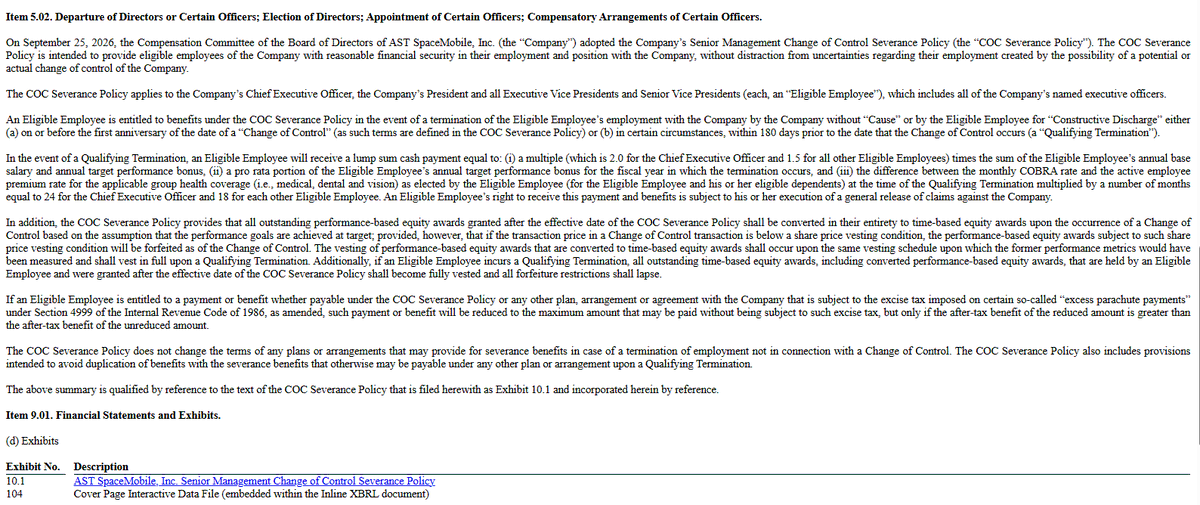
$ASTS just adopted a Change-of-Control Severance Policy, and the market immediately started speculating:
Is Verizon or AT&T getting ready to buy the company?
On the surface, the idea makes sense.
ASTS is no longer just a satellite company. Its Direct-to-Cell network is being built to work directly with carrier spectrum and carrier networks. In a way, ASTS is becoming an extension of the terrestrial mobile network into space.
But that also creates a problem:
ASTS may be too strategically important to be owned by just one carrier.
If Verizon bought ASTS, would AT&T still want to hand over its spectrum, customers and network integration to a platform controlled by Verizon?
Probably a much more complicated relationship.
Same thing the other way around.
That’s why ASTS may actually be more valuable as a neutral infrastructure provider.
ASTS runs the satellites and space network.
AT&T, Verizon, Vodafone and other carriers provide the spectrum, customers and terrestrial network.
That setup lets ASTS work with multiple carriers at the same time.
Vodafone’s JV with ASTS in Europe may be a better model for what happens long term: not necessarily buying the whole company, but using JVs, strategic investments and long-term contracts to lock in access.
So I wouldn’t read the new Change-of-Control policy as:
“ASTS is about to be sold.”
The more interesting takeaway is:
ASTS is becoming infrastructure that multiple carriers want access to, but may not want any single competitor to control.
$LULU
lululemon's own guidance assumes none of its turnaround efforts work.
That's the bar its new CEO walks in against.
Nike eliminated her job last year. Why Nike let her go, and why that's only half the story for lululemon. https://t.co/Afb4cbfIrP
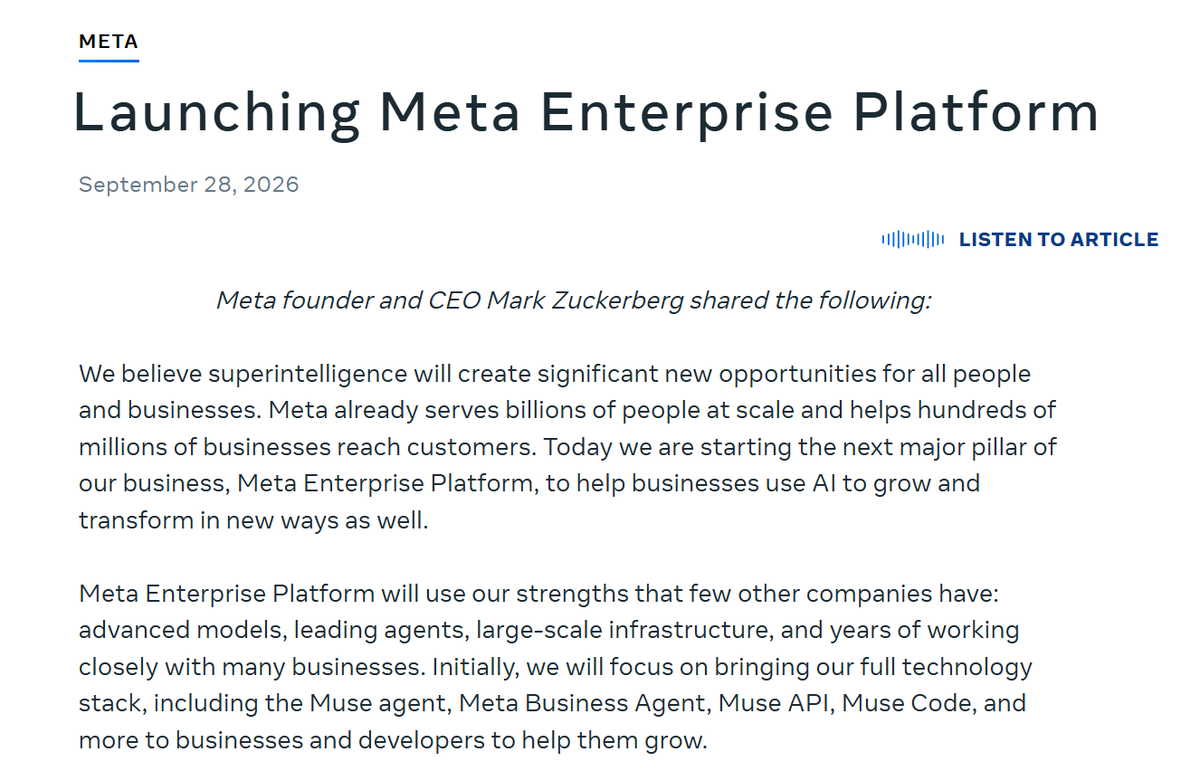
MongoDB CEO CJ Desai just stepped down effective immediately to join Meta.
This is bigger than a leadership shuffle.
For $MDB , the near-term issue is obvious: execution risk just went up. An abrupt CEO exit creates a governance discount, even if the company keeps guidance unchanged. The good news is that former CEO Dev Ittycheria is stepping back in, so this is not a leadership vacuum.
But the deeper signal is where Desai is going.
He’s not leaving MongoDB for another database company.
He’s going to Meta to lead enterprise AI.
That matters because AI value capture is moving up the stack.
The first phase was:
GPUs → models → infrastructure
The next phase is:
agents → workflows → distribution → enterprise customers
Meta already has the models, compute, consumer distribution and AI products.
What it has historically lacked is:
enterprise sales, pricing, security, CIO relationships, workflow integration and recurring software revenue.
That is exactly the background Desai brings from ServiceNow, Cloudflare and MongoDB.
So for $META, this hire is really about answering the biggest question behind its massive AI capex:
Can all that infrastructure create a second revenue engine beyond ads?
If Meta can turn Muse, APIs and agents into enterprise software, the story changes from:
Ads + AI improves engagement
to:
Ads + consumer AI + enterprise AI platform
For $MDB, the risk is the opposite.
MongoDB still benefits from AI workloads, but if more of the economics move toward agents, orchestration and workflow platforms, databases risk becoming a lower layer in the stack rather than the main value-capture layer.
That’s why this one personnel move is worth watching.
It may be a small preview of the next AI war:
not who has the best model — but who owns the enterprise customer.
Oracle's 2056 bonds now yield over 8%, and its credit default swaps are at a record high.
It sits one downgrade above junk. If that downgrade comes, about $120 billion of its bonds drop out of investment-grade indexes, and funds that can only hold IG have to sell.
I think the reason is in its own 10-Q, not in the headlines.
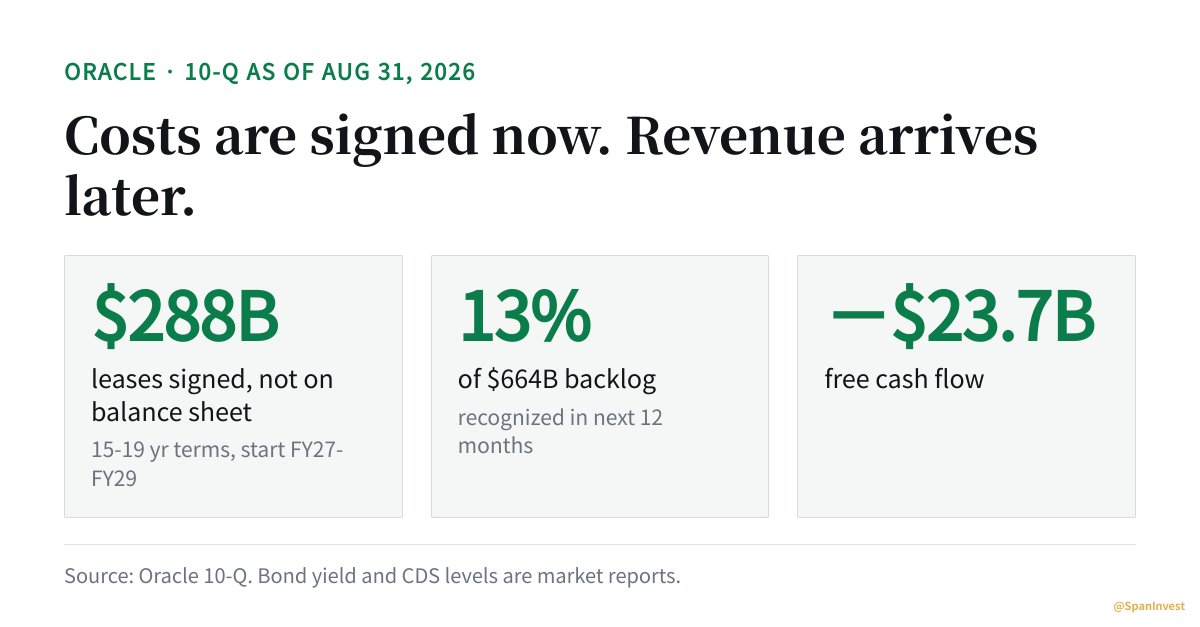
As of Aug 31, $ORCL had $288 billion of data center leases signed but not yet on the balance sheet. They start between fiscal 2027 and 2029 and run 15 to 19 years. Those payments are fixed.
The revenue side is slower. Of $664 billion in remaining performance obligations, about 13% is expected to be recognized in the next 12 months. Free cash flow is already around negative $23.7 billion.
So the costs are locked in early and the revenue arrives later, and bondholders fund the gap in between. How fast that backlog turns into cash depends on customers who are themselves still raising money.
CDS are rising at Google, Microsoft, Amazon, Meta and Nvidia too. Of the big builders I track, Oracle has the widest gap between what it has committed to pay and what it can count on collecting this year, so it is the one the market prices first.
For the spread to come back in, revenue recognition has to speed up faster than the leases start. That is the number I'd check in the next 10-Q.
I think the real story is Bitdeer pairing its own increasingly efficient ASICs with third-party low-cost power. If they can repeat this model, the economics become more than just “BTC goes up” — they start to include a real structural cost advantage from hardware efficiency and asset-light power sourcing.
@burrytracker When a guarantee actually gets triggered, whose balance sheet eats it first — the insurers holding the float, or the equity in the financing vehicles? Nobody in this thread has priced that order yet.
Bonds tied to Meta's data centers carry an A+ rating and are reportedly trading around 7.5%, a yield you'd expect from single-B credit.
I think this is the market putting a price on a number Meta has booked at zero.
When Meta moved its Louisiana data center into a joint venture in 2025, it kept a residual value guarantee: if Meta walks away at the end of the lease and the campus is worth less than about $28B, Meta pays the gap. A second venture in El Paso this July added another RVG of about $13B.
Meta's 10-Q on both: "RVG payments are not probable, and therefore no liability has been recorded to date."
So $41B of guarantees sit on the balance sheet at $0. Meta's maximum loss on the Louisiana venture alone is put at $46.03B.
That's the core of how I read Meta right now. The on-balance-sheet side is about as clean as big tech gets, with cash and securities above its $83.66B of notes. The off-balance-sheet side is the heaviest I've seen: $349.31B of purchase commitments and $278.99B of leases not yet commenced as of June, plus another $68B of data center leases signed in July.
A 7.5% yield on A+ paper says bondholders are pricing some chance that a data center built for one tenant is worth a lot less when that tenant leaves.
The single line I'm watching is that one: the day Meta changes "not probable" to anything else, those zeros turn into real liabilities at once.
Minecraft just passed 425 million copies. GTA V, a 2013 game, has sold more than half of that, about 230 million.
That second number is what $TTWO investors are really paying for, and it didn't come from launch week.
GTA V cost roughly $265 million to make and market. What turned it into one of the best-returning entertainment assets ever was GTA Online, which kept charging players for 13 years after a single purchase.
GTA VI arrives November 19. Rockstar calls it a single-player experience. On the earnings call, management declined to say whether an online version exists.
Development cost has gone up an estimated 5 to 7 times, to $1 to 2 billion. A strong launch can cover that. A 13-year tail is what would pay for the valuation, and that part isn't in the launch.
So I treat November as the smaller of two tests. The bigger one is whether an online mode gets announced, and when.
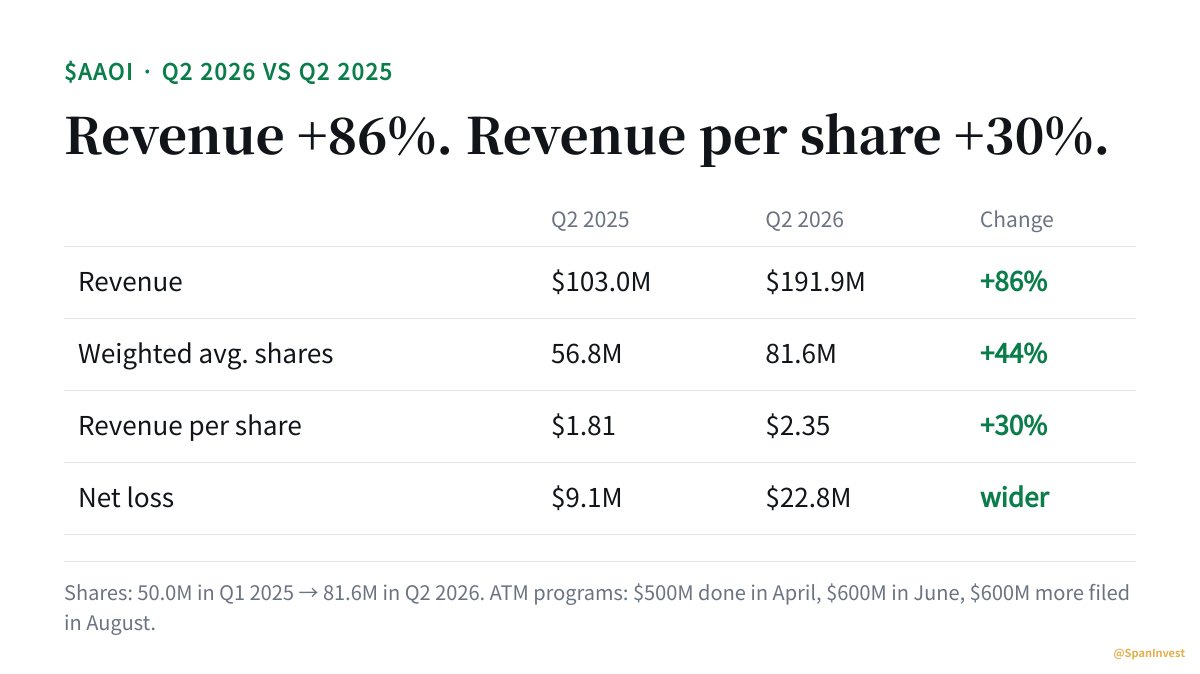
$AAOI revenue grew 86% in a year. Revenue per share grew about 30%.
Q2 2026 vs Q2 2025: revenue $191.9M vs $103.0M. Weighted average shares 81.6M vs 56.8M, up 44%. Net loss $22.8M vs $9.1M.
The gap is how the build-out is being paid for. Applied Opto has leaned on at-the-market stock sales: a $500M program finished in April, $600M in June, another $600M filed in August.
When a company funds growth with equity, I look at revenue per share before revenue. Demand for AI optics can stay strong while each share owns a smaller slice of it. And an ATM sells into strength, so new supply shows up right where buyers do.
There are cheaper ways to fund a ramp: customer prepayments, a strategic placement, a convert priced well above market. Each dilutes less per dollar raised.
My AAOI file is still a May HOLD, written while the company was losing money at the operating line. Nothing in this quarter changes that. Over five quarters, the share count went from 50.0M to 81.6M.
@burrytracker The Alphabet number holds up: $811B purchase commitments + $85.2B leases not yet started, per the June 10-Q. The nearer-term hit is the $122.8B of assets not yet in service. That starts depreciating well before 2028.
@burrytracker Worth adding: under the financing-component rule that $1.9B shows up as interest expense first. So revenue and operating margin look better, pretax income over the contract doesn't change much.
@RihardJarc Agree on distribution. The open question for me is whether those enterprise seats cover ~$190B of capex this year. Stock's up ~35% since the July 23 low, so a lot of that is already priced as a yes.
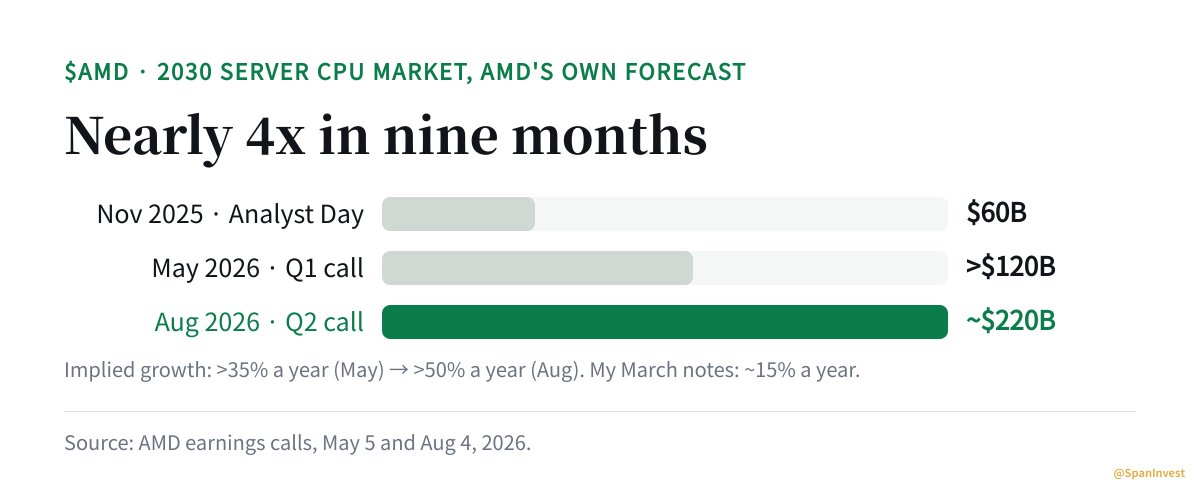
$AMD's own forecast for the 2030 server CPU market has nearly quadrupled in nine months.
- November 2025 Analyst Day: $60B.
- May 2026 earnings call: over $120B, growing more than 35% a year.
- August 2026 call: about $220B, growing more than 50% a year.
When I wrote up AMD in March, I treated server CPUs as the steady leg: roughly 15% annual market growth, with the upside sitting in GPUs. For AI accelerators I had penciled in about 50% a year. AMD now puts server CPUs at that growth rate.
The reason management gives is agents. An agent that browses, calls tools and chains tasks generates CPU work around every GPU token. This week there was a real contract behind the idea: Anthropic committed $11.6B over seven years to Akamai for CPU capacity.
Two things keep me from simply marking my model up. A TAM is a forecast, not revenue, and one that doubled twice in nine months can come back down. And the market number doesn't tell me AMD's share of it; in March I had Arm servers at about 5% and growing slower than expected. That is the figure I'd need to redo before the TAM means anything for AMD.
$META is up about $520B in market cap since Aug 31 on an app that isn't at 1M daily users yet. If serving that many is already tight, I'd want to see the 2027 capex guide.
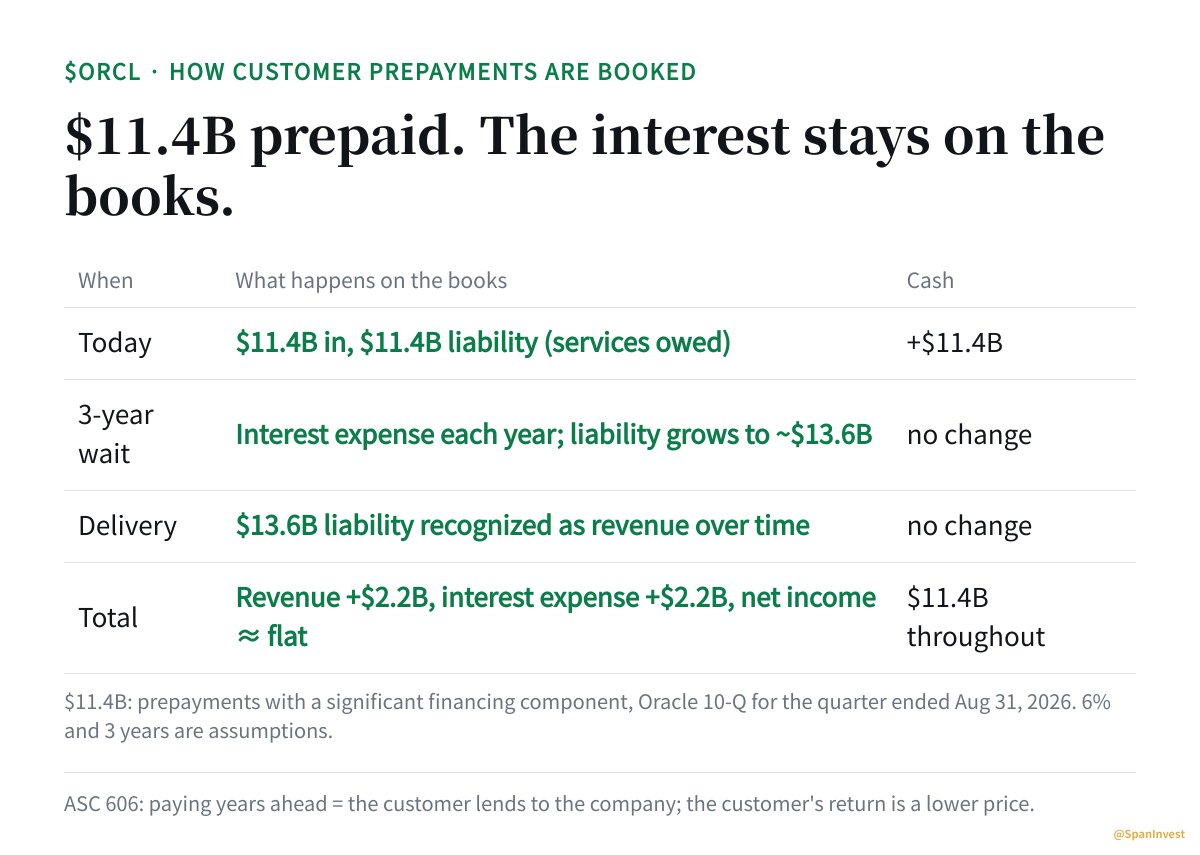
$ORCL When customers prepay Oracle years ahead, Oracle books interest on that money. Not a cent of it goes back to the customer.
Oracle's latest 10-Q: in the quarter to Aug 31 it took in $11.4B of customer prepayments with a "significant financing component". Customers pay now for cloud capacity delivered years later.
Under ASC 606 that counts as the customer lending Oracle money, so it carries interest. The interest never moves cash. It only moves on the books.
Assume 6% and delivery starting in 3 years:
Today: $11.4B cash in, $11.4B liability for services owed
Waiting: interest expense each year, the liability grows to about $13.6B
Delivery: that $13.6B turns into revenue over time
The customer's return is the lower price it got for paying early.
Net result: revenue up about $2.2B, interest expense up about $2.2B, net income roughly unchanged, cash at $11.4B the whole way.
Why take prepayments at all? My off-balance-sheet notes on Oracle have free cash flow at -$23.7B, and only 13% of its $664B backlog converts to revenue within 12 months. Costs arrive first. Customer cash up front is cheap funding for that gap, and its accounting cost is a line of interest expense that never leaves the building.
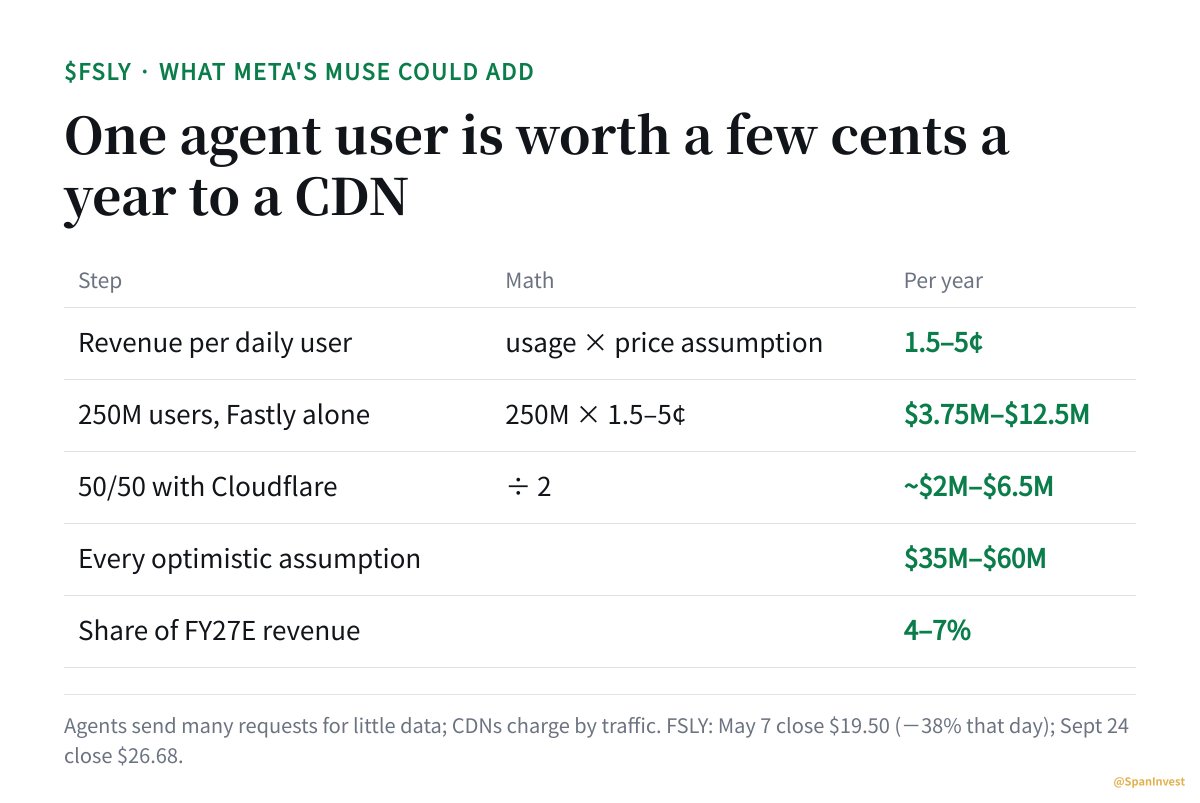
$FSLY Even if 250M people used Meta's Muse every day, Fastly would add a few million dollars a year.
Here's the math.
Start with what one user is worth. Under one set of usage and pricing assumptions, a daily Muse user brings a CDN 1.5 to 5 cents a year.
Multiply by users:
250M × 1.5¢ = $3.75M
250M × 5¢ = $12.5M
That's with Fastly carrying all of the traffic.
Split it 50/50 with Cloudflare: $2M to $6.5M.
Stack every optimistic assumption and the ceiling is $35M to $60M, 4% to 7% of Fastly's expected FY2027 revenue.
Why so little? CDNs charge for traffic. People watching video move a lot of bytes. Agents browsing send many requests for very little data. Fastly's CEO said it this week: agents aren't watching videos yet.
This has happened before. After the last agent run-up, Fastly fell 38% on May 7 when network services grew only 11%. In 2021, Apple's iCloud Private Relay was sized at $40M to $74M a year across three CDNs and never showed up as a step in Fastly's numbers.
The stock closed at $26.68 today, 37% above that May 7 close. For Muse to matter to these numbers, agents have to start pulling video. Until then, the math doesn't carry it.