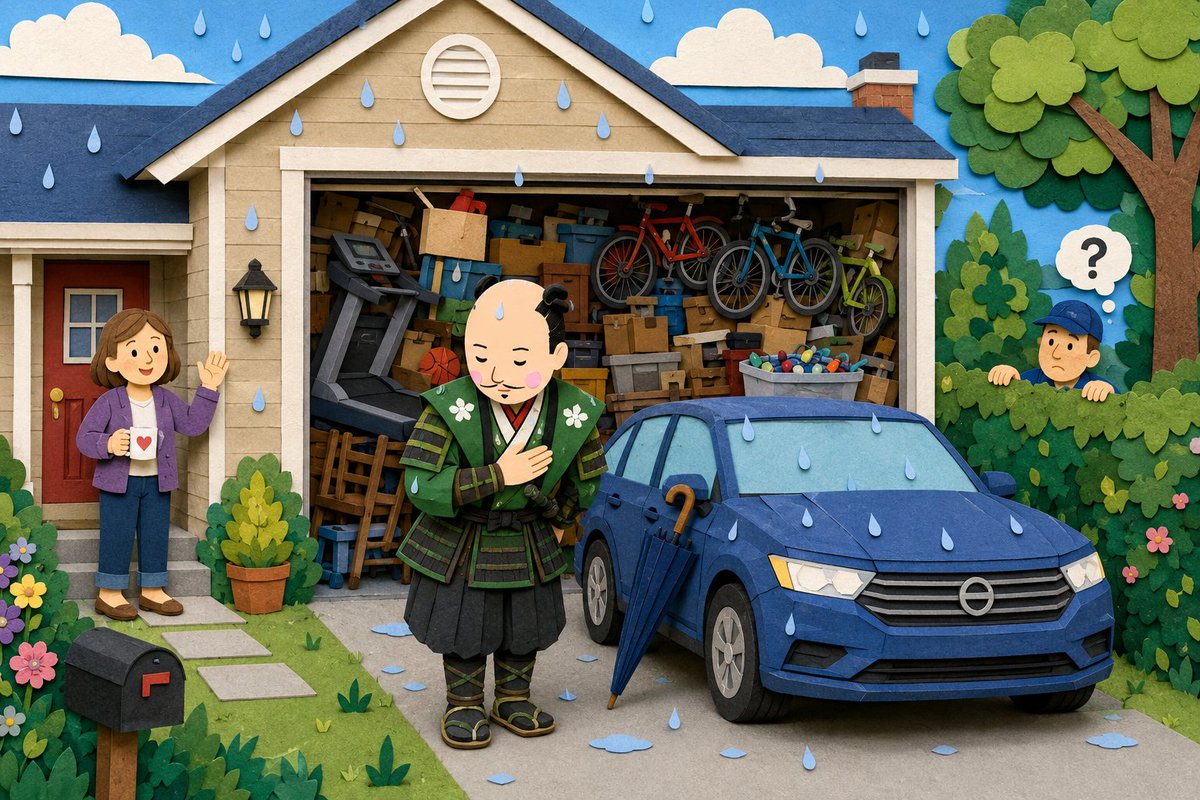
USA. A house. The garage is full, so the car sleeps in the rain.
I walked past an open garage today, and I finally understand Americans.
The garage was packed to the ceiling. Boxes. A treadmill. Old chairs. Three bicycles hanging from hooks. Christmas lights in a plastic tub. No room for even one more thing.
And the family car? Parked outside. In the driveway. Getting rained on.
I stood there, deeply moved.
In Japan, we put the car in the garage and the boxes in the house. Americans do the opposite. And now I see why.
The garage is the treasure house. Inside it sleep the sacred relics: the bicycle the child outgrew, the chair no one sits in, the lights that shine one week a year. These must be protected at all costs.
The car is not a treasure. The car is a warrior. So the car is given the highest honor a warrior can receive. It stands guard at the gate, in the storm, all night, so the treasures stay dry.
The owner came out with his coffee. He saw me looking and shook his head.
"Yeah, I really gotta clean out that garage," he said.
Clean it out? I bowed to him. "You are a good man," I said. "Your car guards your home with its life."
He looked at his car. He looked at me. He said, "...thanks?"
He has never thought of it that way. But I could tell he liked it.
So now every morning I walk past, and I bow to the car in the driveway.
It has the hardest job in the family, and it never complains.
The owner waves at me now. He thinks we are friends.
We are. But mostly, I am here for the car.
This morning it was raining again. The car was soaked, still guarding the gate, still faithful.
So I gave it my umbrella.
I do not need it. I have known harder rain.
A warrior on duty should not have to stand in the storm alone.
The richest man in America signed a document that could have gotten him hanged, and when someone sneered that he was safe because no one would know which Charles Carroll to come for, he picked up the pen and told the British exactly where to find him.
His name was Charles Carroll, and the colonies were crawling with men who shared it. His own father was Charles Carroll of Annapolis. So when the Declaration of Independence came to him for signing in 1776, a delegate made a cruel little joke. He said Carroll risked nothing by signing. There were so many Charles Carrolls that the King's men would never know which one to hang.
Carroll didn't argue. He leaned over the page and added three words to his signature: "of Carrollton." The name of his estate. His address. He was the only signer in the entire room who wrote down where he lived, and he did it on purpose, so that if the British wanted to come hang the traitor, they would know exactly which door to knock on.
That is who Charles Carroll of Carrollton was.
Here is what makes the moment even sharper. He was not a man with little to lose. He was the single wealthiest man in the thirteen colonies and the largest private landowner among them. While George Washington and John Hancock get talked about as rich men, it was Carroll who topped them all. When he signed, he was wagering the biggest personal fortune in America against a noose.
And he was the last man anyone would have expected to be there at all. Carroll was Catholic. In colonial Maryland, a colony founded as a Catholic refuge that had since turned on its own, Catholics could not vote. They could not hold public office. They could not worship in public. The most educated, wealthiest man in America was, in the eyes of the law, a second-class subject barred from the very government he was helping to create. He had spent seventeen years being educated by Jesuits in France and spoke five languages fluently, and back home he still could not legally cast a ballot.
So he became the only Catholic to sign the Declaration of Independence, putting his name on a revolution that he hoped would build a country with room for men like him. That was its own enormous bet, made by a man the existing system had already shut out.
Then he simply outlived everyone.
Thomas Jefferson and John Adams both died on the same astonishing day, July 4, 1826, exactly fifty years after the Declaration. When they were gone, Charles Carroll of Carrollton was the last living signer left on earth. For six more years he was the final human link to that room in Philadelphia, the last hand that had signed, a living relic of the founding that ordinary Americans traveled to see and shake.
He finally died in November 1832 at the age of ninety-five, fifty-six years after he wrote his address on a treason document and dared the empire to come find him.
The richest man in America. The only Catholic. The last one standing. He had more to lose than any of them, every legal reason to stay quiet, and he signed his full address anyway.
We remember the names we were handed in school. We forget the man who made sure his couldn't be mistaken for anyone else's.
Which Founding Father do you think history shortchanged the most?
@robbiehendricks Dude can’t even capitalize I’m sorry? And “yah this sucks”. Sounds like a 12 year old wrote this. If this is has way of showing he wants to be taken seriously, big fail.
May I suggest a Cairn Terrier? Think Toto from the Wizard of Oz. 15-20 lbs, non-shedding, great with kids, up for any adventure and very adaptable to your household. Nicknamed the “Best Little Pal in the World” and they live up to it. This is my Bear at 10 weeks. Feel free to DM me if you would like more information. 🐾
@breccastoll@mrddmia Guess the commie hasn’t heard of the takings clause or the 5th Amendment. New York doesn’t have the money to pay the property owners.
Last night, I made a simple request on X. I asked if anybody visiting Arlington National Cemetery for Memorial Day would stop by Alan’s grave and leave a photo for our family.
What happened next honestly caught me off guard.
By this afternoon, dozens of Americans from all walks of life had made the walk to Section 60 to visit SSG Alan W. Shaw. Veterans. Families. Complete strangers. People who had never met Alan, but chose to honor him anyway.
For one day on social media, people put aside the constant noise and negativity and came together for something bigger than themselves. My notifications filled with photos, kind messages, prayers, and stories from people honoring not just Alan, but so many of our fallen heroes.
I don’t think people fully understand what moments like this mean to Gold Star families. The fear is never just losing them. It’s losing them slowly over time as the world moves on and fewer people remember their name.
But today showed me that Alan will never be forgotten.
After years of watching social media reward some of the worst parts of humanity, today gave me a reminder that the good is still out there too.
Thank you to every single person who stopped by to visit Alan today, said his name, shared his story, or took a moment to honor the fallen.
This right here is the America Alan knew and loved enough to fight and die for.
And today, y’all showed us all that it’s still here and it’s still worth fighting for. 🇺🇸
@barristerlawusa Nice that you still have affordable homes where you live. Californians took over my state and what used to be affordable is outrageous now. So sad.