Most AI content on this feed is theory. Mine is from the other side.
I scale AI engineering across a global regulated pharma and measure what actually works.
Posting what it takes.
Field reports, unpolished takes, occasional hot takes.
One of the most important misconceptions about AI today is that “everyone is already using it”
They are not
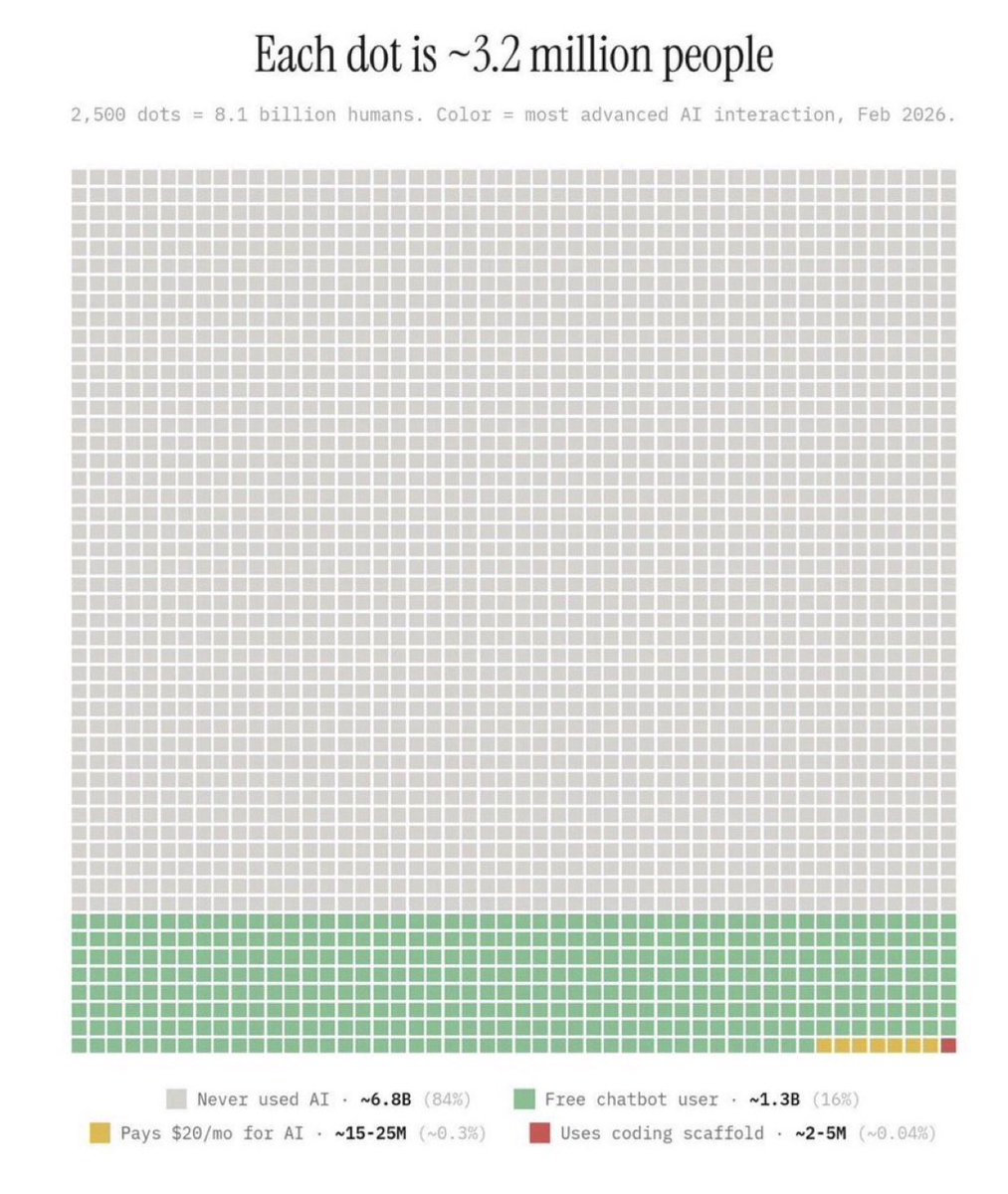
According to figures shared by @SpartDev to HEC Paris MBA students:
- 84% of the world has never used AI at all
- 16% have only experimented with free chatbots casually
- around 0.3% actually pay for AI tools
- and only about 0.04% use AI as a serious workflow or production tool
That final group — the people building with AI, automating with it, coding with it, researching with it, creating with it daily — is still extraordinarily small relative to the global population
Why this matters
We are still extremely early
What feels “oversaturated” online is often just a visibility illusion created by highly active tech circles on:
- X
- LinkedIn
- GitHub
- Reddit
- and startup communities
Meanwhile, most of the world:
- has never prompted an LLM
- does not understand AI workflows
- and has not integrated AI into education, business, or daily productivity
That creates a massive opportunity gap
The people learning AI today are not competing against 8 billion people
They are competing against a tiny fraction of the population actively developing practical AI leverage
The deeper lesson here is important:
AI should not replace thinking
It should amplify thinking
The individuals gaining the most value from AI are usually not passive users asking random questions
They are:
- experimenting
- challenging outputs
- refining prompts
- building systems
- automating workflows
- and combining domain expertise with curiosity
AI works best as:
- a co-pilot
- research assistant
- simulator
- tutor
- brainstorming engine
- and productivity multiplier
not as a substitute for judgment
The bigger picture
We are likely entering a transition period similar to:
- the early internet era in the 1990s
- smartphones in the late 2000s
- or social media in the early 2010s
At first, adoption looks niche
Then suddenly entire industries reorganize around the technology
That is why the current phase matters so much
People who develop AI literacy early may gain disproportionate advantages in:
- productivity
- learning speed
- business creation
- communication
- research
- and career adaptability
Bottom line
The real AI divide today is not between humans and machines
It is between people learning how to work with AI effectively — and those ignoring the shift entirely
#GenoInsights #AI #ArtificialIntelligence #Technology #Innovation #FutureOfWork #DigitalTransformation #Productivity #Automation #Education
Elon Musk built rockets and cars without coming from aerospace or automotive.
Tim Berners-Lee built the Web without coming from hypertext or networking.
Outsiders with depth see what insiders can't. That's where the AI decade gets built.
Any London-based AI events looking for a conference speaker, and planning to professionally film their talks?
I have a banger of a talk lined up that I need to let loose somewhere
I found this info shared by @SpartDev to HEC Paris MBA students and I thought I’d amplify here cause it is super insightful.
84% of the world has never used AI. Not once.
16% tried a free chatbot on a Sunday night.
0.3% pay $20/month for it.
And 0.04%?
That's around 3 million people out of 8.1 billion who actually use AI as a real working tool.
That's the red dot in the image.
→ If AI scares you, good. Fear is energy. Use it. Every job is being reshaped right now, not someday.
→ You're the driver, not the passenger. AI is like a GPS. It calculates the best route. But you decide where to go. The moment you stop thinking, you become the passenger. Don't outsource your thinking.
→ Curiosity beats expertise. You can learn a domain in a week instead of six months. But only if you push, question, challenge. AI is a sparring partner, not a vending machine.
A few thoughts.
Not everyone knows how to mentor. Mentoring is a skill on its own, not a byproduct of being senior. That's the real bottleneck, not AI.
AI doesn't remove friction, it shifts it. From "finding the answer" to "asking the right question and challenging the output."
What I see with our interns: they use AI more creatively than most seniors. Sometimes I learn from them.
Curiosity beats expertise. The risk isn't AI, it's passivity.
you don’t hire interns because they’re gonna ship mad features
Every intern is an investment in a future hire. Perhaps A modern day apprenticeship.
You don’t hire juniors cause you need that extra 2-3 bug fixes per day. You hire juniors so you can turn them into seniors
When you say “ai will replace juniors” all you’re telling me is you don’t understand mentorship in software careers, or you think of every engineer as a ticket factory.
We do need to rethink how we upskill this new generation of SWEs though. The best engineers are great at AI (coding, context eng, etc) and great at software engineering - (systems, algorithms, debugging, architecture)
More seniors are good at the latter, more juniors are good at the former, but a lot of ai coding takes away the “friction” which, as @badlogicgames so helpfully pointed out, is where you learn
OpenAI launches GPT-Rosalind + Novo Nordisk alliance Anthropic adds Novartis CEO to board, acquires Coefficient Bio Amazon launches Bio DiscoveryFrontier labs just stopped treating pharma as vertical #47.The companies that secure strategic depth now will define the primitives everyone else consumes in 3 years.
I'm building an app from the ground up, and I'm filming every part of it. It's called Slopwatch.
It's a great way to pick up tips for using AI Coding tools like a real engineer.
First step is choosing the language. Rust/Go? Node/Bun?
Only way to find out is to /grill-me.
Opus 4.7 just dropped.
The headline is vision + coding improvements. But what matters for anyone running Claude in prod at enterprise scale:
"More literal instruction following", your carefully engineered prompts just got more predictable. Less drift, more precision.
That's the kind of upgrade that actually moves the needle in regulated environments.
The new "xhigh" effort level is also interesting, more control over the reasoning/speed tradeoff. Exactly what you need when some use cases demand thoroughness and others demand latency.
I haven't typed `npm run dev` on my local machine for three days now and it's absolute bliss.
Having my agents 100% in the cloud is a massive unlock.
(One of those agents is openclaw, which is technically on my mbp in my office, but the only way I interact with it is via email/slack so it “feels” cloud)
I'm able to run all the engineering and marketing for my startup through Slack and Linear and because of this the work product that I'm shipping has increased dramatically.
I know all of us devs love creating our own custom solutions to this stuff but the truth is that creating an agent orchestration layer for your company or startup is a full-time job.
Our job as startup founders is to be growing the company, not to be building out an agent orchestration custom platform.
I think if you have a larger engineering team like Ramp, then it does make sense to build an entire layer like Inspect agent.
However, I would venture to say that I'm getting most of the value by simply paying for a pre-built, battle-hardened solution like Devin.
Again to be clear I'm not being paid by Devin or anybody to say these things, just my real-world experience using this stuff.
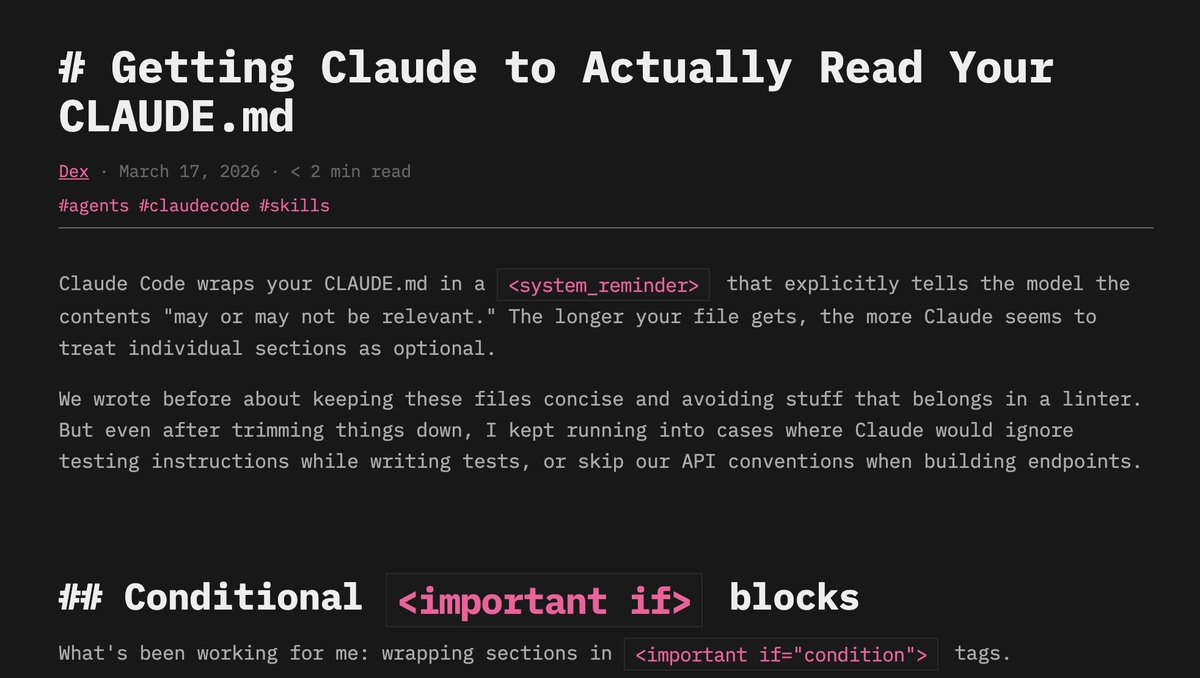
we're testing a new version of /init based on your feedback- it should interview you and help setup skills, hooks, etc.
you can enable it with this env_var flag:
CLAUDE_CODE_NEW_INIT=1 claude
would love your feedback!
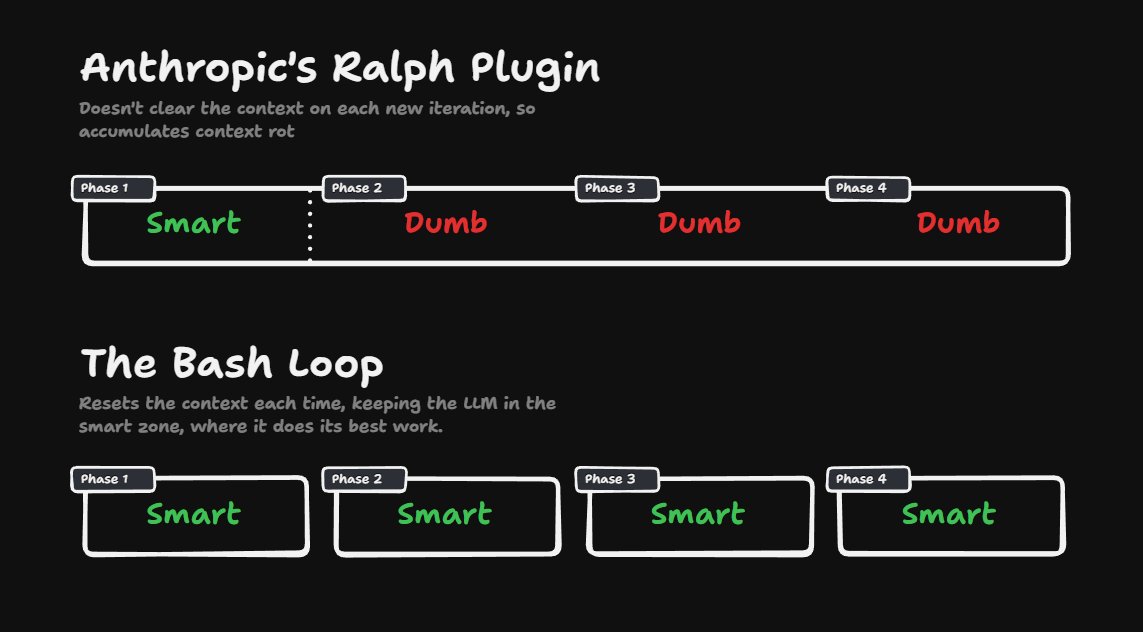
Anthropic's Ralph plugin sucks, and you shouldn't use it
It defeats the entire purpose of Ralph - to aggressively clear the context window on each task to keep the LLM in the smart zone.
Full article here: https://t.co/ssOY9PiPdR
Models being able to work unsupervised for long periods of time is a terrible criteria for quality/effectiveness
every time some vibe coder posts about getting opus or codex to work for 20, 30, 60 minutes straight I’m like yeah okay fun,
But when someone working on production systems says the same I’m shocked. Like in what world do you actually want to review 2k+ LOC with no input and checkpoints? If it’s broken and you can’t vibe your way out, how big is the surface area you’re signing up to dig into? Even if just trying to learn what went wrong for a chuck-and-resteer-in-fresh-new-branch?
It’s unhinged.
New opus is more eager to keep working vs wait for human input, I can only assume cause codex normalized this nonsense and made it a goalpost