This is one of the most beloved paintings in America, and it puts its finger on something we all pass through, first as the child, and one day as the parent left behind...
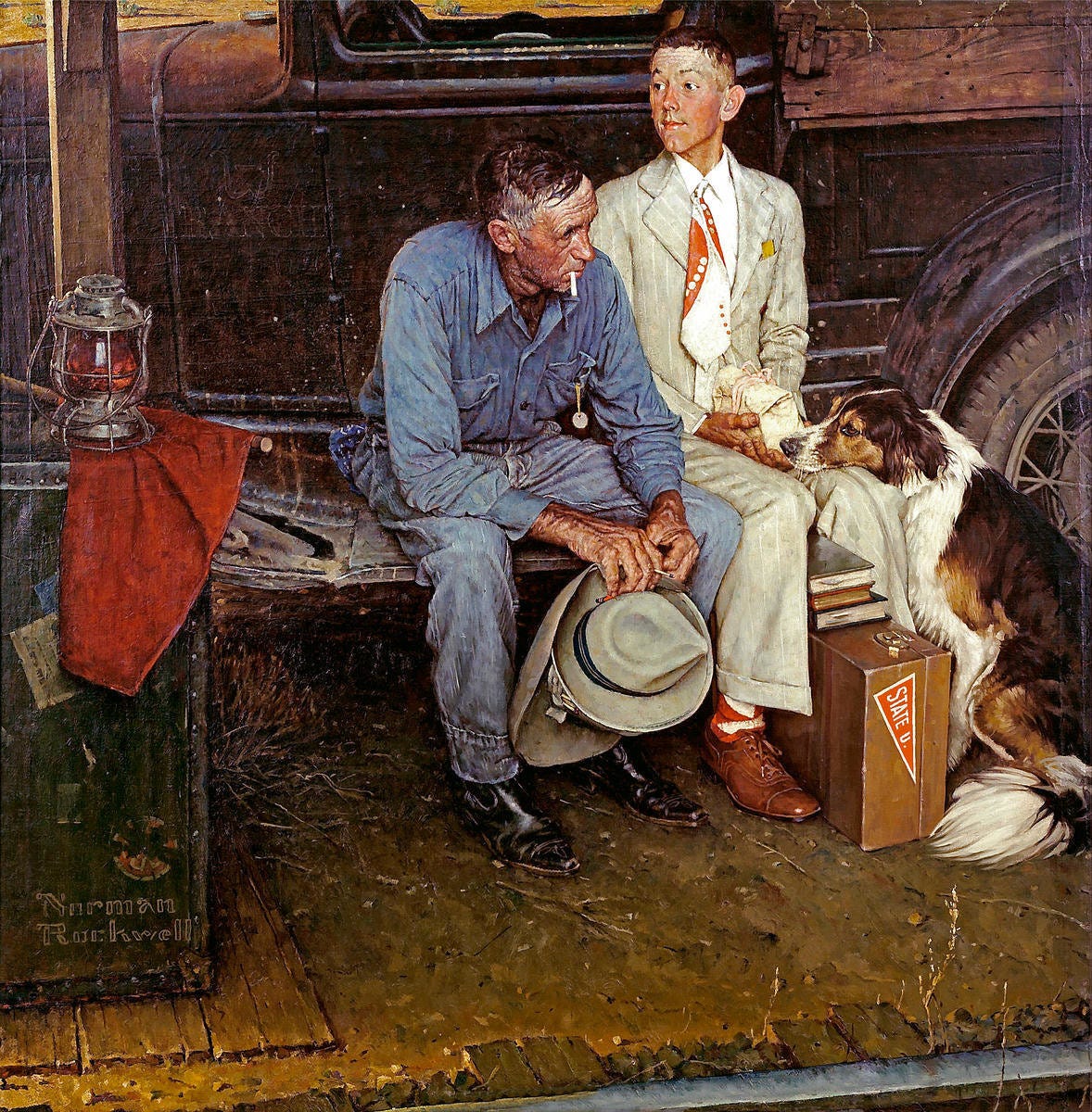
The painting is Breaking Home Ties, by Norman Rockwell, on the cover of the Saturday Evening Post in 1954. A father and his teenage son sit side by side on the running board of a battered farm truck, waiting at a railway stop. A single track runs along the bottom of the picture. A ticket pokes from the boy's pocket. His suitcase is stacked with schoolbooks and wears a "State U" pennant. The train is coming to carry him off to college, away from home, for the first time in his life.
Everything is in the way they sit.
The son sits upright, scrubbed and dressed in his best, eyes fixed on the horizon, on the track, on the future rushing toward him. He is already half gone. For him that train is the beginning of everything.
His father sits beside him in worn work clothes and scuffed boots, looking the other way, down the line, as if he cannot bear to watch it arrive. The same train means the opposite thing to him. For the son it is the start of a life. For the father it is the day the house grows quieter, the chair at the table sits empty, and the person he built his world around walks out into a life that no longer has him at its centre.
Look at his hands. He is holding two hats. His own battered one, and resting on top of it, his son's crisp new one, held carefully together, because it is the last small thing he can still do for the boy...
And then the dog, its head laid in the son's lap, gazing up, refusing to look away. Rockwell knew exactly what that was for: "The father couldn't show how he felt about the boy's leaving," he said. "The dog did."
It has moved people for 70 years because every leaving is a beginning for one person and an ending for another. The child steps out into the world, as they should. And someone stays behind, watching them go, and loving them enough to let them go anyway...
@_MAGA_NEWS_ Ceuta is in Africa not mainland Spain! It is actually an autonomous enclave with a beach in Morocco ! so what’s the fuss all about?As an Asian i just don’t understand?
@ianmiles but this enclave Ceuta is inside morocco on the african continent. technicslly they are in spain but the city is inside africa , so why bother ian miles cheong kups!
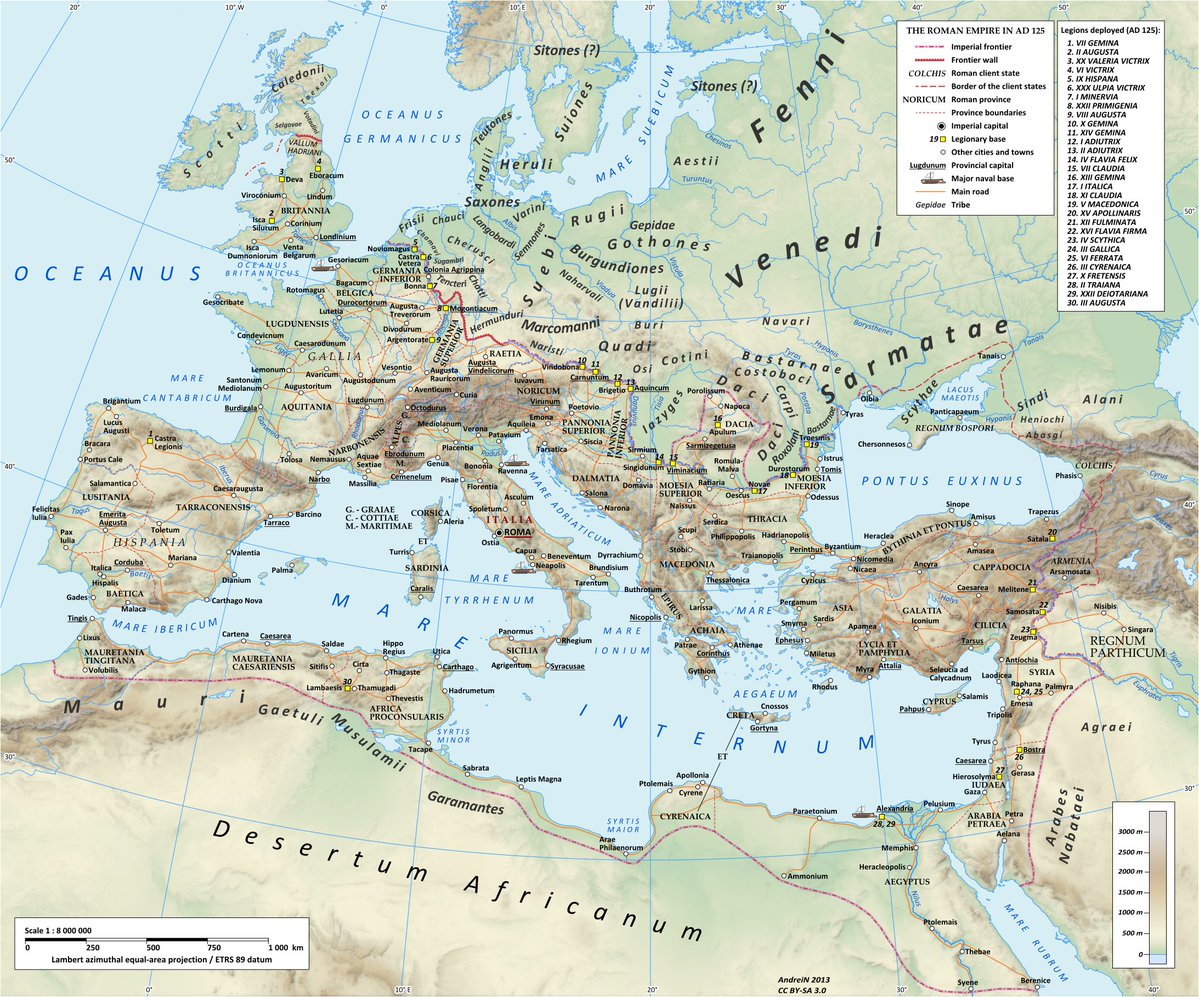
The Roman empire under Hadrian (ruled 117–138) showing the location of roads, cities, provincial boundaries, naval bases, the Roman legions deployed in AD 125 and Germanic tribes from the time of Augustus
“Beauty perishes in life, but is immortal in art.”
But what does immortal beauty look like?
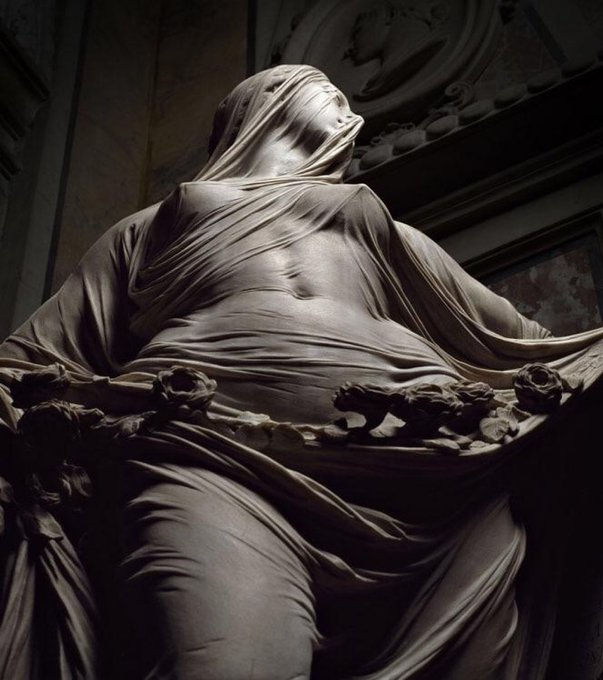
These ten sculptures turn marble into skin, grief, terror, desire, and divine ecstasy. Some will leave you breathless. Others may stay with you for years. 🧵👇
The Alhambra Decree, signed in March 1492 by Spain's Catholic Monarchs, Isabella I and Ferdinand II, was an edict ordering the expulsion of every Jew from Spain. It gave them four months, until July 31 of that year, to either convert to Christianity or to leave their homes and property behind.
The magnitude of the undertaking resulted in social and economic chaos, and the exile of an entire people from the Iberian peninsula.
The Alhambra Decree was only formally rescinded in December 1968, more than 476 years later.
#archaeohistories
A bacchante after a Dionysian rush and a young Mexican sculptor making Paris take him seriously.
Fidencio Luciano Nava carved After the Orgy in 1909 and it became the piece that turned him from a student in Paris into a name people remembered.