one thing about @PlayOnMint that i think deserves more attention is the way XP connects activity on the platform to $MNTD.
you don't simply interact with MINT and walk away with nothing.
every time you play, you earn XP.
that XP contributes to your leaderboard position.
and that leaderboard position plays a role in your Season 1 $MNTD airdrop allocation.
so there's an actual progression:
play → earn xp → climb the leaderboard → increase your potential allocation.
i like this because it gives activity a purpose beyond simply “using the platform.”
your participation becomes part of the reward system.
and that could be important for retention.
because once users know their activity is contributing toward something, the incentive changes from:
“let me try this”
to:
“let me keep participating.”
the interesting part now is seeing how the leaderboard and $MNTD allocation translate once the ecosystem gets more active.
GET MINTED
THE TRIBE LIST IS OPENING. 🗿
200 GTD spots.
No first come, first served.
One entry per person.
Applications open: 21.09.2026 · 1PM UTC
Applications close: 22.09.2026 · 1PM UTC
Apply here: https://t.co/mWVG2bShNj
Once closed, entries lock and the draw begins automatically.
Results go live: 23.09.2026 · 1PM UTC
A checker will reveal results only for the exact wallet or X username submitted.
Choose your name.
Enter once.
Let the stones decide.
⟐ 𐌋 ⊹ ◇ ��
What makes @PlayOnMint interesting isn't simply the number of games available.
It's what happens around the games.
MINT brings together a wide range of iGaming experiences — from slots and table games to live casino, game shows, originals, fast-play experiences and more.
But the important part is the mechanism behind it.
Think of MINT as a progression layer sitting across the entire experience:
1. PLAY
You choose how you want to play.
Slots if you want quick spins.
Table games if you prefer classic casino formats.
Live Casino if you want a more interactive experience.
Game Shows and Originals if you're looking for something different.
The point is that you're not locked into one game category.
2. EARN XP
Eligible gameplay feeds into MINT's progression system.
Instead of every session simply ending when the game ends, activity can contribute toward your XP progression.
Your gameplay becomes part of your account's journey.
3. PROGRESS THROUGH THE SYSTEM
XP isn't just a number.
It is designed to move players through MINT's progression structure, with tiers and status becoming increasingly important as you advance.
So instead of:
Play → stop
the intended loop becomes:
Play → XP → Progress → Status → Rewards → Play
4. UNLOCK REWARDS
This is where the progression system connects back to the platform.
MINT's model is built around rewards such as rakeback, daily rewards, raffles, lossback and other ecosystem incentives, depending on the applicable program and status.
That means the platform isn't treating rewards as a random bonus slapped onto the casino.
They're part of the progression architecture.
5. THE NFT + TOKEN LAYER
Then you have the broader MINT ecosystem.
The NFT side can function as an identity/booster layer, while $MNTD is designed as the utility layer.
So you have three distinct pieces:
NFT → Identity / Boosting
XP → Progression
$MNTD → Utility
And the games are what generate the activity that makes the whole loop move.
That's a much more interesting structure than simply launching a token and putting a casino behind it.
The real thesis is whether MINT can make the entire catalogue feel like one connected progression economy.
Thousands of possible ways to play.
One system tracking your journey.
Play. Progress. Get Minted.
Mint isn’t another bonus-churn casino.
It’s a progression-first iGaming platform rebuilt from the ground up on a proprietary token-integrated stack.
Legacy platforms optimise for arbitrage.
Mint engineers incentives as a rules-based economy:
• Hard-capped XP & tiers
• Revenue-linked rewards
• Real engagement over bonus hunting
Under the surface:
Multi-chain liquidity access
Controlled $MNTD emissions
AI-assisted risk & incentive modelling
On-chain verification where it matters
$MNTD launches on Base (Q4).
Season 1 airdrop is live — $50 wagered qualifies you.
Stake for Status. Climb for higher rates.
Every play can buy back and burn.
This is not a white-label with a rewards tab.
It’s a re-architecture of how iGaming loyalty works.
GM now means Get Minted.
Where Every Play Pays.
@PlayOnMint | https://t.co/0jPwiHkqf1
Most NFTs start with the asset.
MINT seems to be starting with the ecosystem.
Play → earn XP → level up → unlock rewards → build Status.
Then the NFT becomes an identity + booster layer, while $MNTD handles utility.
That’s what makes MintABear interesting to me.
4,444 Bears.
Free mint.
Robinhood Chain.
Connected to an existing iGaming progression loop.
Not just “here’s an NFT, now figure out the utility.”
The utility is being designed into the system from the start.
@PlayOnMint
GM = Get Minted. today.
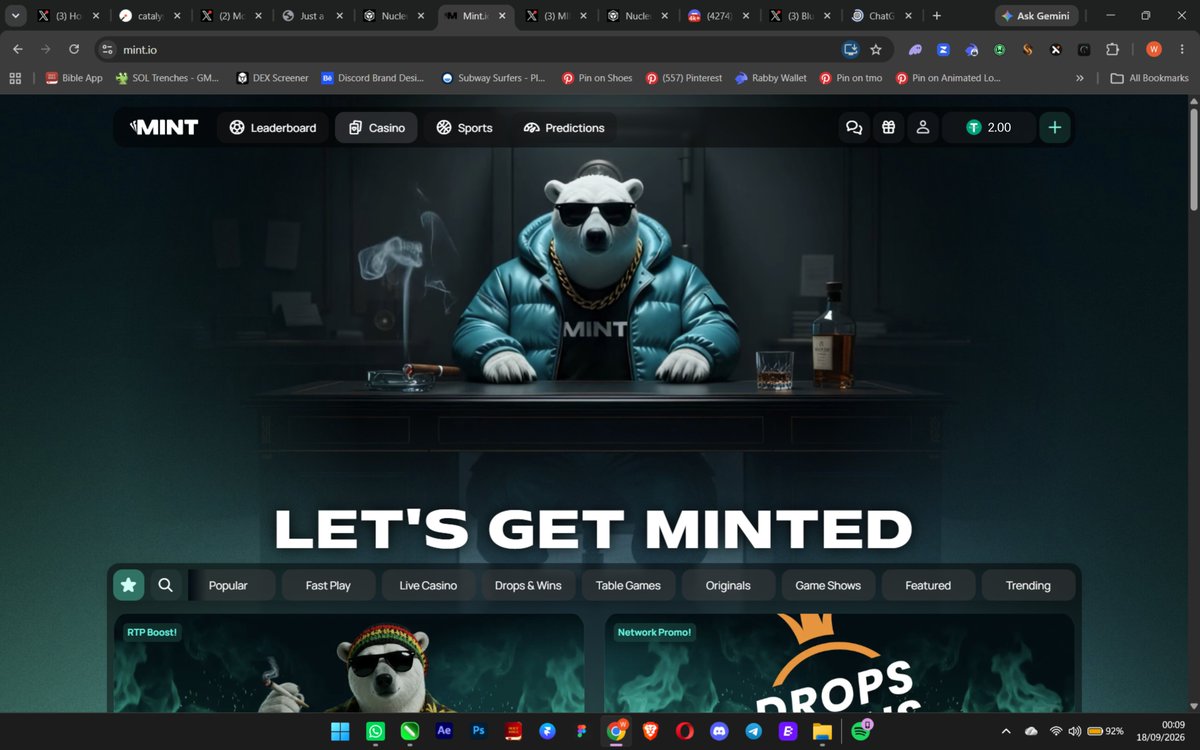
One thing I think people overlook about @PlayOnMint is the UI.
Because MINT isn't simply trying to give you access to a lot of games.
It's trying to make a large gaming ecosystem feel **simple to navigate and connected through one progression system.**
Look at the structure.
You land in the casino and you're immediately given different ways to discover what you want:
→ New Slots
→ Popular
→ Fast Play
→ Live Casino
→ Table Games
→ Game Shows
→ Originals
→ Drops & Wins
→ Featured
→ Trending
That's important.
When a platform has a large catalogue, the problem isn't necessarily finding more games.
The problem becomes **finding the right game without getting lost in the catalogue.
MINT's category-driven UI acts as the navigation layer.
You can browse based on what you want to play instead of searching through an endless wall of titles.
Then there's the individual game experience.
A game page can surface the game, provider, jackpot information and available play mode, while some games offer both **Real and Demo** play.
So the interface is doing more than displaying games.
It's giving the player context before they enter the experience.
And then there's the part that ties everything together:
XP.
MINT prominently connects gameplay with progression.
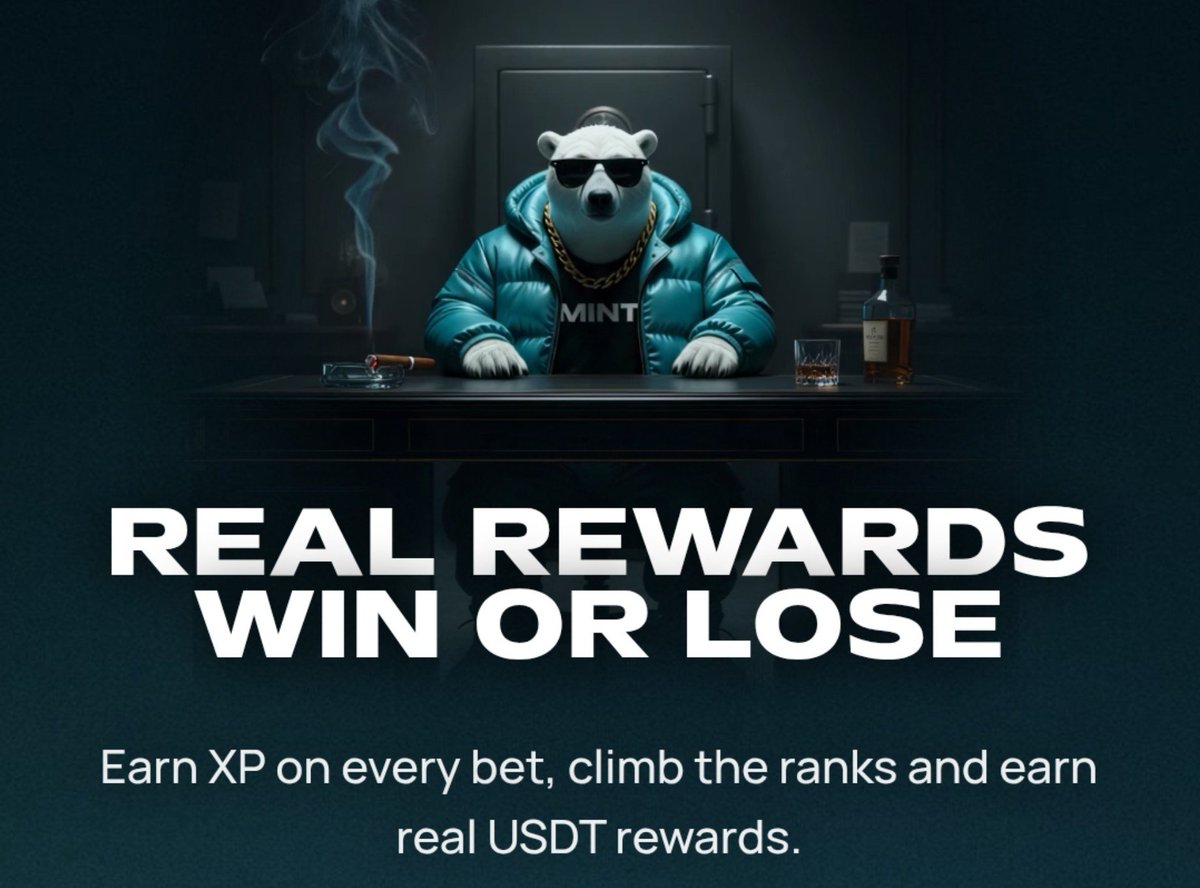
The platform currently communicates the concept as:
**Real rewards. Win or lose.
Earn XP on every bet.
Climb the ranks.**
That changes the role of the UI.
Your interface isn't only a storefront for games.
It's also a dashboard for progression.
The games create the activity.
The UI organizes the activity.
XP records the progression.
Ranks give that progression structure.
Rewards give the progression an incentive.
And the wider MINT ecosystem can then build additional utility around that progression.
So the loop becomes:
DISCOVER
Find a game through the categories.
↓
PLAY
Choose the experience that fits you.
↓
PROGRESS
Eligible activity contributes to XP.
↓
CLIMB
XP moves you through the progression system.
↓
REWARD
Your status and activity connect to the platform's reward mechanics.
↓
RETURN
The interface gives you another reason to continue exploring.
That's why I think the UI matters more than it initially appears.
A good casino UI can help you find a game.
A well-designed progression UI can make the entire catalogue feel like one ecosystem.
And that's the direction MINT appears to be taking:
Not just more games.
Not just more rewards.
But a single interface connecting games + discovery + progression + rewards.
The UI is essentially the bridge between the product and the economy.
That's where MINT gets interesting.
GM = Get Minted.
Delighted to announce our collaboration with @nftquants
This is more than just an NFT.
Holders perk include
- 100% of royalties.
- Special Quant AI tier worth $350+
- Boosted Q & XP farming
Shout out to @pandaanft for securing this collab 👏