Helping vibe coders write prompts their agent can build. Specly reads your repo and writes the spec for Claude Code, Cursor or Codex. Follow for prompt tips.
Specly opens next week. 🚀
Your AI agent can code. It just doesn't know your project.
Type a rough request. Specly reads your repo, asks up to 3 questions if something's unclear, and writes the spec your agent builds from.
For Claude Code, Cursor, Codex, Copilot and Gemini.
Specly early access opens this week. 🚀
Type a rough request. Specly reads your repo and writes the spec your agent builds from.
Join the waitlist and we'll email you the moment it opens:
https://t.co/uXGjCumryj
#vibecoding#buildinpublic
Question for vibe coders: what's the one thing your AI agent keeps getting wrong in your project?
We're building Specly around the answers. Early access opens next week:
https://t.co/uXGjCulTIL
#vibecoding#buildinpublic
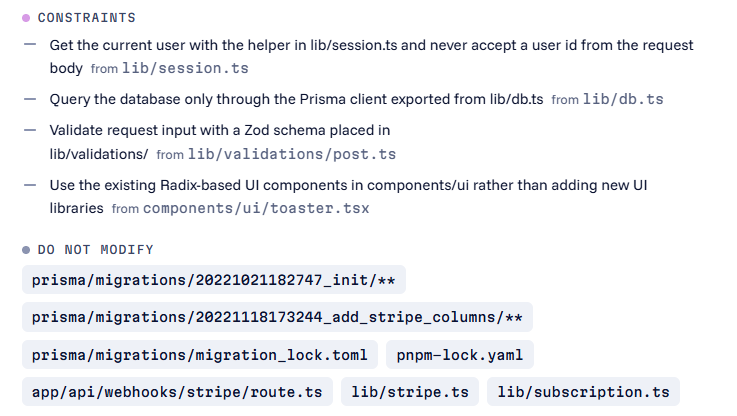
Rules in a Specly spec come with receipts.
"never accept a user id from the request body" → from lib/session.ts
Each rule points to the file it came from, so your agent follows your code, not a guess.
Early access next week:
https://t.co/uXGjCumryj
#vibecoding#AIcoding
POV: you asked your AI to add notifications.
It also "cleaned up" your Stripe webhook.
(dramatized. You've been there.)
Specly reads your repo first and gives your agent a "Do not modify" list. Real run: the Stripe webhook, lib/stripe.ts, lib/subscription.ts.
Waitlist in bio.
@cheneypiano Exactly. A vague request leaves the agent filling the gaps with guesses. Specly only asks when something's actually unclear, so a clear request goes straight to the spec. Thanks, Jon.
Specly opens next week. 🚀
Your AI agent can code. It just doesn't know your project.
Type a rough request. Specly reads your repo, asks up to 3 questions if something's unclear, and writes the spec your agent builds from.
For Claude Code, Cursor, Codex, Copilot and Gemini.
Free vibe coding tip: before you hit enter, add one line.
"Done when: ___"
Your agent stops guessing when it knows what finished looks like. Specly writes that line and the rest of the spec from your repo.
Early access next week:
https://t.co/uXGjCulTIL
#vibecoding
Shipping next week: Specly.
Type a rough coding request. Specly reads your repo and writes a spec your agent can build from: goal, done-when checks, real files, rules from your code, what not to touch.
Waitlist:
https://t.co/uXGjCumryj
#buildinpublic
What goes in your first Claude Code prompt?
Specly writes it from your repo: goal, checks for "done", real files, rules from your code and a do-not-modify list. Real run: it fenced off the Stripe webhook.
Early access next week:
https://t.co/uXGjCumryj
#ClaudeCode
Vibe coders: your agent isn't dumb. It's guessing.
It doesn't know which files matter, what "done" means or what not to touch. Specly reads your repo and writes that down first.
Early access opens next week. Free waitlist:
https://t.co/uXGjCulTIL
#vibecoding
Early access opens next week. The waitlist is free, and we'll email you the moment it's live:
https://t.co/uXGjCulTIL
Building with an AI agent right now? Reply with what it keeps getting wrong. We want to hear it.
We typed 7 words on the public shadcn-ui/taxonomy repo:
"add a delete account button to settings"
Specly wrote:
- a clear goal
- 5 checks for "done"
- 8 real files to work in
- 4 rules pulled from the code
- 3 paths to leave alone
- 2 assumptions to check
@giacomomasseron For the last two: name the files it may edit in the prompt, and add a line to CLAUDE.md like "Keep existing comments. They record decisions the code doesn't show."
A rule with its reason attached tends to hold up better than a bare "don't".
@antonygiomarx The state worth watching is "says done". Give each task a one-line "done when" before it's handed out, and have the agent check its work against that line before it walks over to report.
Then "done" means the same thing to the boss and the builder.
@XkaiiStudio Rule of thumb: pause when a change touches anything that enforces a boundary (RLS policies, auth, billing, migrations).
Keep those on a do-not-modify list in the prompt. When they have to change, do it in its own small PR with a test that queries as a second tenant.
@Sousinr One more that cuts clashes: give every rule a scope.
"In app/api/: return typed errors" can't collide with "in components/: throw early" the way two global "always" rules can. A rule with no scope applies everywhere, so it's the one that ends up fighting.
@byaarav Same split. What decides how the handoff goes is writing the plan down before you switch: what "done" looks like, which files to touch, what to leave alone.
Codex builds from what's on the page, not from the conversation you had with Claude.
Refine is now Specly.
Type a few words. Specly reads your repo and writes the spec your agent needs: what "done" means, the files to work in, rules from your code, what not to touch.
Real output on shadcn-ui/taxonomy ↓
Early access: https://t.co/uXGjCumryj
@simonw Nice pattern. The prompt-side complement: tell the agent up front which paths are off-limits (migrations, lockfiles, billing/webhook code) before it starts.
The sandbox limits what a mistake can damage. The list makes the mistake less likely in the first place.
@imeronn "A native <button> next to our <Button>" is so real.
Naming the files up front helps too. Our spec for a delete-account button on shadcn-ui/taxonomy said: build from the existing components/ui (alert-dialog, button), add no new UI primitives. designspec catches the rest.