I just rewrite entire wgpu from Rust to Swift. Because - I can (and Claude too).
- Builtin compiler from wgsl to spirv, msl, glsl, hlsl
- Supports Android, Windows, Linux, WASM and Apple
- Supports DLSS, MetalFX, Apple Vision OS Composer Layer
Bye SWAN
https://t.co/9hN3HfjuQM
Today I'm sharing lore-swift, Swift bindings for Lore, Epic Games' new version control system: https://t.co/BFax3myCcw
A few months ago, I started making a videogame with my kids. Until then, I'd led a semi-charmed existence of not having to think about Git LFS. But this asset-heavy project brought me back to the dark days of smudge filters and (apparently, given the price) gold-plated blob hosting. So after reading about Lore on HN, I decided to take a look.
I ran a simple trial on my Mac with the game's art, music, and sound effects so far: about 1,300 files and 395 MB, in Lore and in Git with LFS, side by side. After the import, Lore's local store took 4.8 MiB, against 375 MiB for .git (mostly the LFS cache). Five small edits to a 32 MB WAV file grew the Lore server by 1.9 MiB, and the LFS server by 155 MiB.
Provenance matters for this project, which mixes handmade and generated assets. Lore has built-in primitives for it, which is nice. Files, revisions, and branches can carry typed metadata that's part of immutable history, and files can declare tagged dependencies on each other. A generated sprite can point back to the drawing it came from, and the drawing knows what was made from it.
Lore isn't quite ready for my project yet. In the version I tried, locks didn't do much with auth off, and staging needed the server unless you cloned with a cache. I've also reported a couple of bugs so far (EpicGames/lore#263 & #264). But overall it's promising.
For the way we work, I wanted a native macOS app more than a command line, so I started with the foundation. lore-swift covers nearly all of Lore's C API with async/await, including progress streams for clone, push, sync, and interactive login.
These bindings are a start. I'll have more to share as I build on them!
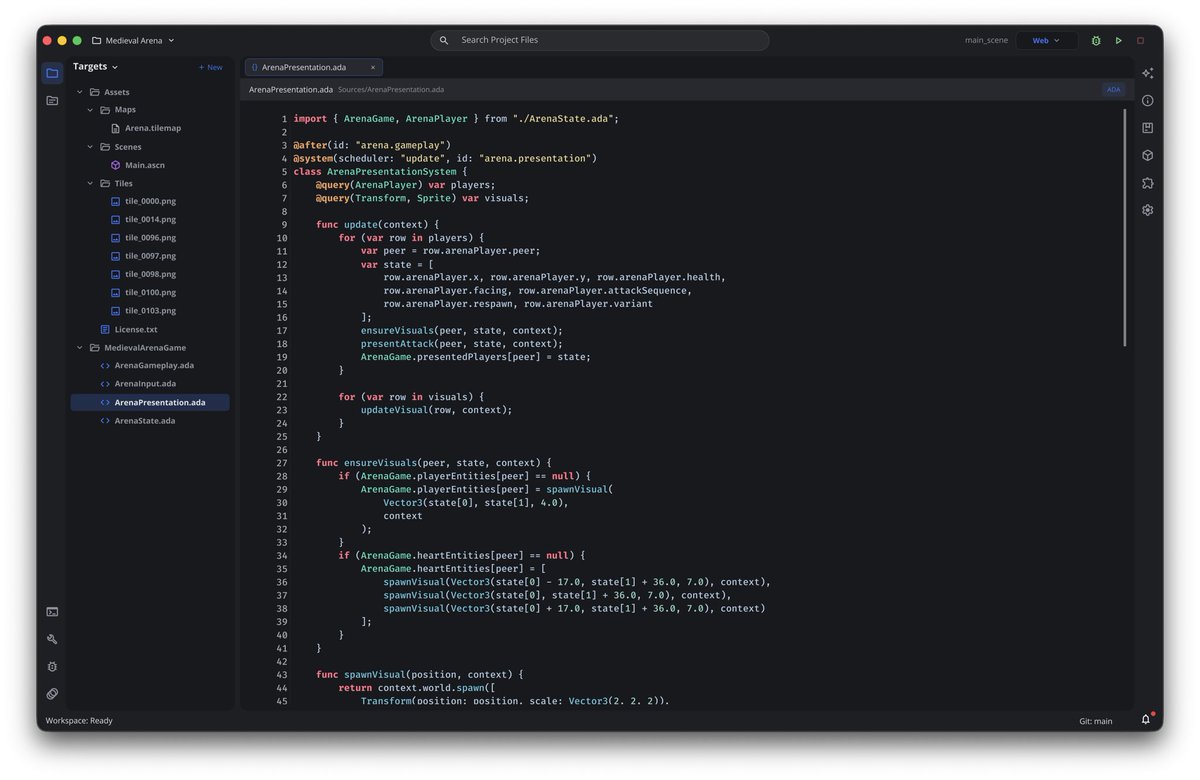
Ada Engine is evolving quickly, and it now supports AdaScript, a scripting language powered by Gravity
l've also added several improvements to Gravity, including annotations and a new file-import system.
This makes scripting for Ada game development feel much more Natural.
Я делаю игровой движок на Swift и вот мой редактор, полностью написанный на AdaEngine.
До сих пор не верю, что у меня получилось собрать рабочую версию полностью на AdaEngine
Сегодня «незнакомка» вышла на новый уровень. Я проснулся от того, что рука онемела, подняв ее, я понял, что не чувствую кисть и пальцы холодные. Через пару секунд, стал потихоньку получать контроль над конечностью, а ощущение, словно внутри меня встроили маленький пьезоэлемент.
For my XR app for smart glasses, I built a PWA studio, and uses the same API that iPhone client. And now, I can use it to make some spatial web apps on iPhone.
https://t.co/xzcCuaIE2C
Я тут решил дать вторую жизнь своим Xreal Air и написать небольшой софт для iPhone.
- Есть с трекингом в пространстве через AirPods
- Управлением через Apple Watch
- оффлайн PWA приложениями
- Моим ИИ агентом
- оффлайн ютубчиком.
OpenAI announced OpenAI Micro keypad. I like that idea and built a plugin for Stream Deck– compatible devices that allows me to use a Sloppy AI agent through Stream Deck.
Built with Codex and GPT 5.6