We're excited to announce #SpectreX, a versatile CPU mining algorithm library, which will soon be integrated with our Rust full-node daemon. It features #AstroBWTv3, a #PoW system based on BWT and is
The worlds first implementation of AstroBWTv3 entirely written in #Rust.
@lunfardo314 Long attacks would trigger social defenses that make them ineffective (also loss of trust). A "slaughter scenario" assumes perfect execution without resistance which rarely occurs in practice.
Here's a very informative read about the history of DAGs, tracing back to Euler's solution to the Königsberg bridge problem. Centuries old math concepts are revolutionizing modern cryptographic consensus mechanisms.
Hello there, $kas and $qubic fans, it's time for a little history lesson.
Our story starts from an unknown time, in the Prussian city of Königsberg (now Kaliningrad, Russia), built on both sides of the Pregel river, which divided it into two land masses and two islands.
Seven bridges were built for passage between the islands and mainlands, bridges that afforded a riddle: can a person take a walk, crossing each bridge exactly once, finishing where they started?
It is unknown for how long this question has been asked, but it is known when it was answered and by whom: 1736, Leonhard Euler.
Euler realized that we can completely forget the geometry of the town. The only information we need is a list of land masses, and the number of bridges between each two land masses. He encoded this information into what we call a graph -- a bunch of nodes connected by edges -- and quickly proved the first theorem in a field now known as graph theory: a graph can be traversed by a route starting and ending at the same point and passing through each edge exactly once if and only if each node touches an even number of edges. Solving the riddle of Königsberg's bridges in the negative.
In the years to come, and already during Euler's life and through his work, math enthusiasts considered all sorts of graphs, including ones where edges can be only traversed in one direction, and it is impossible to take a walk on the graph that ends up where it started. In other words, a directed acyclic graph, or DAG for short.
Albeit its name not yet in its final form, DAGs were used for parallel computation theory at least as early as 1972, as we can see in the seminal paper by Coffman and Graham [1].
Ideas of using DAGs in cryptocurrencies and DLTs started to emerge in the literature since the introduction of the GHOST protocol in 2013, but the idea was first thoroughly researched by Lewenberg-Sompolinsky-Zohar in the 2015 paper "Inclusive Block Chain Protocols" [2]
The first proposal for a DAG based proof-of-work DLT is usually attributed to a 2015 hypothetical protocol called DagCoin. Proposed by Sergio Demian Lerner in 2015, DagCoin was the first to propose that users rather than miners are required to engage in proof-of-work to publish their own transactions. An idea that raised a lot of criticism. In general DagCoin was an interesting proposal, but it could not provide any tangible security, which is why it never left the drawing table.
About a year later, a project called IOTA was the first to attempt building a production-grade DAG-based proof-of-work DLT, based on a protocol called Tangle invented by a guy you all heard of: first name Serguei, last name Popov. Tangle proposed to solve DagCoin's problems using a probabilistic method, but provided very little evidence that it is actually secure.
Serguei and his fellow cofounders (three other guys, one of them, confusingly enough, called Sergey) ignored warnings from fellow researchers that the understanding of DAGs in consensus is yet lacking, and that the security of the Tangle protocol against double-spends seems unclear, and rushed to implement it.
But as they tried to make the move from theory to practice while the theory is insufficient, reality knocked. Several attacks were demonstrated that in theory, could allow liveness and even double-spending attacks, forcing Iota to enrich their network with coordinators: centralized entities that resolve conflict. After years of attempting to fix Tangle and remove the coordinator requirement, Sergey left Iota to seek other ventures, while those remaining decided to scrape Tangle altogether, they started developing Tangle 2.0, a proof-of-stake reimagining of the application of DAGs to consensus.
So if anyone ever tells you that this Sergey or the other "invented DAGs", be sure to audibly laugh in their face.
Want to hear more about the history of DAGs in proof-of-work? Great! My current project is a video journey of the history of proof-of-work protocols, from Bitcoin to DAGknight. Be sure to sub to my youtube channel so that you don't miss it!
https://t.co/PJk21YkQYk
[1] https://t.co/KCoWgdK0VQ
[2] https://t.co/InKmWYZ9SR
astrobwtv3_zeros
time: [1.1944 ms 1.2010 ms 1.2090 ms]
change: [-66.822% -66.582% -66.300%] (p = 0.00 < 0.05)
Same benchmark run on initial vs latest commit of SpectreX, both on identical CPU.
https://t.co/WkSZEveUE6
We are pleased to announce the release of Rusty-Spectre v0.3.17. This update focuses on upstream merges from Rusty-Kaspa, stability improvements and new `send-all` feature. The changelog is extensive:
https://t.co/m00dG28nd4
Reminder for #Spectre miners: Another #blockreward reduction📉is on 05-03-2025 at approximately 22:32 UTC, reducing rewards from 9.75 to 9.50 $SPR. Stay tuned!
https://t.co/a0XME3fWCN
Reminder for #Spectre miners: Another #blockreward reduction📉is on 03-02-2025 at approximately 18:14 UTC, reducing rewards from 10.00 to 9.75 $SPR. Stay tuned!
https://t.co/a0XME3foNf
Reminder for #Spectre miners: Another #blockreward reduction📉is on 04-01-2025 at approximately 08:45 UTC, reducing rewards from 10.25 to 10 $SPR. Stay tuned!
https://t.co/a0XME3fWCN
We’re excited to announce that we’ve officially signed a contract with @coinexcom for our upcoming listing. While the date is TBD, we aim to complete it by Q1 2025, pending successful fundraising of 10,000 USDT and $10,000 worth of $SPR.
In the last 205,053 blocks (~3 days), an impressive 369 unique miners contributed to securing Spectre. No single entity mined more than 15% of the blocks, reflecting the decentralized nature and distributed participation in our #blockDAG. $SPR
Reminder for #Spectre miners: Another #blockreward reduction📉is on 04-12-2024 at approximately 04:04 UTC, reducing rewards from 10.5 to 10.25 $SPR. Stay tuned!
https://t.co/a0XME3foNf
Updated #blockDAG visualization for $SPR
Red now marks actual red blocks (as per merge sets), while non-chained blocks are visually distinct by having grey edges.
With these changes, a continuous chain of chained blocks is now clearly highlighted through blue edge connections.
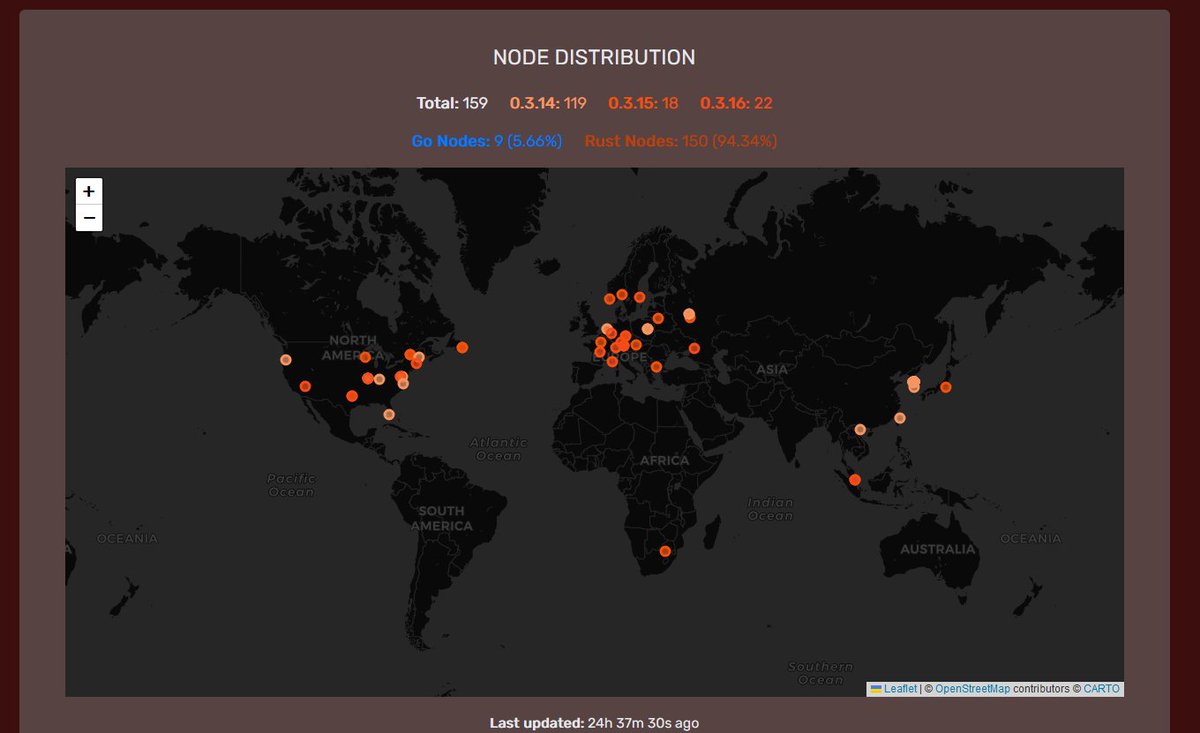
Spectre Block Explorer Update v0.3.20🗺
We're introducing a Node Map in our block explorer to visualize #Spectre node distribution and network decentralization.
This map highlights node versions, node types (Rust/Go) and their geographic locations.
https://t.co/PXldpvrfQ1
Spectre Faucet - Mainnet & Testnet
The #Spectre Faucet is now available and allows anyone to request $SPR without registration.
https://t.co/sbknMWdPNz
https://t.co/KD6ARh1d8M
With that in mind, make sure to keep your $SPR #nodes updated. If you’re mining to a Go node, you might be missing out on rewards as Go nodes can become stuck for long periods during heavy pruning point verifications.
🧵Spectre Network Node Version Distribution
Total discovered unique nodes: 205
v0.3.14: ~74%
v0.3.15: ~16%
v0.3.16: ~10%
By examining version numbers, we infer nodes on v0.3.14 include both Go and Rust, while versions above 0.3.14 are Rust only.
Running your own node is a great way to support #decentralization and boost #privacy across the network. More independent #nodes make it harder to trace or identify individual users, which helps everyone’s #anonymity.


![DesheShai's tweet photo. Hello there, $kas and $qubic fans, it's time for a little history lesson.
Our story starts from an unknown time, in the Prussian city of Königsberg (now Kaliningrad, Russia), built on both sides of the Pregel river, which divided it into two land masses and two islands.
Seven bridges were built for passage between the islands and mainlands, bridges that afforded a riddle: can a person take a walk, crossing each bridge exactly once, finishing where they started?
It is unknown for how long this question has been asked, but it is known when it was answered and by whom: 1736, Leonhard Euler.
Euler realized that we can completely forget the geometry of the town. The only information we need is a list of land masses, and the number of bridges between each two land masses. He encoded this information into what we call a graph -- a bunch of nodes connected by edges -- and quickly proved the first theorem in a field now known as graph theory: a graph can be traversed by a route starting and ending at the same point and passing through each edge exactly once if and only if each node touches an even number of edges. Solving the riddle of Königsberg's bridges in the negative.
In the years to come, and already during Euler's life and through his work, math enthusiasts considered all sorts of graphs, including ones where edges can be only traversed in one direction, and it is impossible to take a walk on the graph that ends up where it started. In other words, a directed acyclic graph, or DAG for short.
Albeit its name not yet in its final form, DAGs were used for parallel computation theory at least as early as 1972, as we can see in the seminal paper by Coffman and Graham [1].
Ideas of using DAGs in cryptocurrencies and DLTs started to emerge in the literature since the introduction of the GHOST protocol in 2013, but the idea was first thoroughly researched by Lewenberg-Sompolinsky-Zohar in the 2015 paper "Inclusive Block Chain Protocols" [2]
The first proposal for a DAG based proof-of-work DLT is usually attributed to a 2015 hypothetical protocol called DagCoin. Proposed by Sergio Demian Lerner in 2015, DagCoin was the first to propose that users rather than miners are required to engage in proof-of-work to publish their own transactions. An idea that raised a lot of criticism. In general DagCoin was an interesting proposal, but it could not provide any tangible security, which is why it never left the drawing table.
About a year later, a project called IOTA was the first to attempt building a production-grade DAG-based proof-of-work DLT, based on a protocol called Tangle invented by a guy you all heard of: first name Serguei, last name Popov. Tangle proposed to solve DagCoin's problems using a probabilistic method, but provided very little evidence that it is actually secure.
Serguei and his fellow cofounders (three other guys, one of them, confusingly enough, called Sergey) ignored warnings from fellow researchers that the understanding of DAGs in consensus is yet lacking, and that the security of the Tangle protocol against double-spends seems unclear, and rushed to implement it.
But as they tried to make the move from theory to practice while the theory is insufficient, reality knocked. Several attacks were demonstrated that in theory, could allow liveness and even double-spending attacks, forcing Iota to enrich their network with coordinators: centralized entities that resolve conflict. After years of attempting to fix Tangle and remove the coordinator requirement, Sergey left Iota to seek other ventures, while those remaining decided to scrape Tangle altogether, they started developing Tangle 2.0, a proof-of-stake reimagining of the application of DAGs to consensus.
So if anyone ever tells you that this Sergey or the other "invented DAGs", be sure to audibly laugh in their face.
Want to hear more about the history of DAGs in proof-of-work? Great! My current project is a video journey of the history of proof-of-work protocols, from Bitcoin to DAGknight. Be sure to sub to my youtube channel so that you don't miss it!
https://t.co/PJk21YkQYk
[1] https://t.co/KCoWgdK0VQ
[2] https://t.co/InKmWYZ9SR](https://pbs.twimg.com/media/GqzsmthXYAAHhj1.jpg)
![DesheShai's tweet photo. Hello there, $kas and $qubic fans, it's time for a little history lesson.
Our story starts from an unknown time, in the Prussian city of Königsberg (now Kaliningrad, Russia), built on both sides of the Pregel river, which divided it into two land masses and two islands.
Seven bridges were built for passage between the islands and mainlands, bridges that afforded a riddle: can a person take a walk, crossing each bridge exactly once, finishing where they started?
It is unknown for how long this question has been asked, but it is known when it was answered and by whom: 1736, Leonhard Euler.
Euler realized that we can completely forget the geometry of the town. The only information we need is a list of land masses, and the number of bridges between each two land masses. He encoded this information into what we call a graph -- a bunch of nodes connected by edges -- and quickly proved the first theorem in a field now known as graph theory: a graph can be traversed by a route starting and ending at the same point and passing through each edge exactly once if and only if each node touches an even number of edges. Solving the riddle of Königsberg's bridges in the negative.
In the years to come, and already during Euler's life and through his work, math enthusiasts considered all sorts of graphs, including ones where edges can be only traversed in one direction, and it is impossible to take a walk on the graph that ends up where it started. In other words, a directed acyclic graph, or DAG for short.
Albeit its name not yet in its final form, DAGs were used for parallel computation theory at least as early as 1972, as we can see in the seminal paper by Coffman and Graham [1].
Ideas of using DAGs in cryptocurrencies and DLTs started to emerge in the literature since the introduction of the GHOST protocol in 2013, but the idea was first thoroughly researched by Lewenberg-Sompolinsky-Zohar in the 2015 paper "Inclusive Block Chain Protocols" [2]
The first proposal for a DAG based proof-of-work DLT is usually attributed to a 2015 hypothetical protocol called DagCoin. Proposed by Sergio Demian Lerner in 2015, DagCoin was the first to propose that users rather than miners are required to engage in proof-of-work to publish their own transactions. An idea that raised a lot of criticism. In general DagCoin was an interesting proposal, but it could not provide any tangible security, which is why it never left the drawing table.
About a year later, a project called IOTA was the first to attempt building a production-grade DAG-based proof-of-work DLT, based on a protocol called Tangle invented by a guy you all heard of: first name Serguei, last name Popov. Tangle proposed to solve DagCoin's problems using a probabilistic method, but provided very little evidence that it is actually secure.
Serguei and his fellow cofounders (three other guys, one of them, confusingly enough, called Sergey) ignored warnings from fellow researchers that the understanding of DAGs in consensus is yet lacking, and that the security of the Tangle protocol against double-spends seems unclear, and rushed to implement it.
But as they tried to make the move from theory to practice while the theory is insufficient, reality knocked. Several attacks were demonstrated that in theory, could allow liveness and even double-spending attacks, forcing Iota to enrich their network with coordinators: centralized entities that resolve conflict. After years of attempting to fix Tangle and remove the coordinator requirement, Sergey left Iota to seek other ventures, while those remaining decided to scrape Tangle altogether, they started developing Tangle 2.0, a proof-of-stake reimagining of the application of DAGs to consensus.
So if anyone ever tells you that this Sergey or the other "invented DAGs", be sure to audibly laugh in their face.
Want to hear more about the history of DAGs in proof-of-work? Great! My current project is a video journey of the history of proof-of-work protocols, from Bitcoin to DAGknight. Be sure to sub to my youtube channel so that you don't miss it!
https://t.co/PJk21YkQYk
[1] https://t.co/KCoWgdK0VQ
[2] https://t.co/InKmWYZ9SR](https://pbs.twimg.com/media/Gqzq446XoAA-8Jy.png)





![DesheShai's tweet photo. Hello there, $kas and $qubic fans, it's time for a little history lesson.
Our story starts from an unknown time, in the Prussian city of Königsberg (now Kaliningrad, Russia), built on both sides of the Pregel river, which divided it into two land masses and two islands.
Seven bridges were built for passage between the islands and mainlands, bridges that afforded a riddle: can a person take a walk, crossing each bridge exactly once, finishing where they started?
It is unknown for how long this question has been asked, but it is known when it was answered and by whom: 1736, Leonhard Euler.
Euler realized that we can completely forget the geometry of the town. The only information we need is a list of land masses, and the number of bridges between each two land masses. He encoded this information into what we call a graph -- a bunch of nodes connected by edges -- and quickly proved the first theorem in a field now known as graph theory: a graph can be traversed by a route starting and ending at the same point and passing through each edge exactly once if and only if each node touches an even number of edges. Solving the riddle of Königsberg's bridges in the negative.
In the years to come, and already during Euler's life and through his work, math enthusiasts considered all sorts of graphs, including ones where edges can be only traversed in one direction, and it is impossible to take a walk on the graph that ends up where it started. In other words, a directed acyclic graph, or DAG for short.
Albeit its name not yet in its final form, DAGs were used for parallel computation theory at least as early as 1972, as we can see in the seminal paper by Coffman and Graham [1].
Ideas of using DAGs in cryptocurrencies and DLTs started to emerge in the literature since the introduction of the GHOST protocol in 2013, but the idea was first thoroughly researched by Lewenberg-Sompolinsky-Zohar in the 2015 paper "Inclusive Block Chain Protocols" [2]
The first proposal for a DAG based proof-of-work DLT is usually attributed to a 2015 hypothetical protocol called DagCoin. Proposed by Sergio Demian Lerner in 2015, DagCoin was the first to propose that users rather than miners are required to engage in proof-of-work to publish their own transactions. An idea that raised a lot of criticism. In general DagCoin was an interesting proposal, but it could not provide any tangible security, which is why it never left the drawing table.
About a year later, a project called IOTA was the first to attempt building a production-grade DAG-based proof-of-work DLT, based on a protocol called Tangle invented by a guy you all heard of: first name Serguei, last name Popov. Tangle proposed to solve DagCoin's problems using a probabilistic method, but provided very little evidence that it is actually secure.
Serguei and his fellow cofounders (three other guys, one of them, confusingly enough, called Sergey) ignored warnings from fellow researchers that the understanding of DAGs in consensus is yet lacking, and that the security of the Tangle protocol against double-spends seems unclear, and rushed to implement it.
But as they tried to make the move from theory to practice while the theory is insufficient, reality knocked. Several attacks were demonstrated that in theory, could allow liveness and even double-spending attacks, forcing Iota to enrich their network with coordinators: centralized entities that resolve conflict. After years of attempting to fix Tangle and remove the coordinator requirement, Sergey left Iota to seek other ventures, while those remaining decided to scrape Tangle altogether, they started developing Tangle 2.0, a proof-of-stake reimagining of the application of DAGs to consensus.
So if anyone ever tells you that this Sergey or the other "invented DAGs", be sure to audibly laugh in their face.
Want to hear more about the history of DAGs in proof-of-work? Great! My current project is a video journey of the history of proof-of-work protocols, from Bitcoin to DAGknight. Be sure to sub to my youtube channel so that you don't miss it!
https://t.co/PJk21YkQYk
[1] https://t.co/KCoWgdK0VQ
[2] https://t.co/InKmWYZ9SR](https://pbs.twimg.com/media/GqzvX72XwAA08IE.png)