Honoured to speak at the panel discussion during the FinX Gold Loan Conclave & Awards 2026 last week, on one of the most important conversations shaping the future of enterprises AI adoption and cybersecurity readiness.
As organizations rapidly adopt AI and agentic systems, the attack surface is expanding faster than ever before. Every new AI agent, automation layer, and connected workflow introduces new security challenges, while the speed, scale, and sophistication of cyberattacks continue to evolve dramatically.
The discussion focused on why cybersecurity can no longer be an afterthought in the AI era and how enterprises must rethink their defence strategies with intelligent, autonomous, and adaptive security capabilities.
It was a great experience sharing perspectives alongside industry leaders and engaging in meaningful conversations with some brilliant minds from the ecosystem.
Thank you for the opportunity to represent @Spharaka Networks and share our vision for the future of autonomous cyber defence.
@rajeevrajr@nalluri4
#FinX2026 #CyberSecurity #AI #AutonomousCyberDefence #FinTech #Banking #DigitalTransformation #Spharaka #SpharakaSphere
Welcoming @Spharaka as the #AgenticAISOC Partner at the #InnovationArcade.
As AI-driven cybersecurity transformation accelerates, conversations around intelligent & resilient SOC capabilities are becoming increasingly important. We look forward to Spharaka joining the showcase.
Proud to share that @rajeevrajr will be speaking at the @DSCI_Connect Innovation Box during the FINSEC Conclave 2026 on 29th May 2026.
As AI-driven cyber threats continue to evolve in speed, scale, and sophistication, the conversation around autonomous cyber defence has become more important than ever. Rajeev will be sharing insights on intelligent security operations, agentic AI in cybersecurity, and the future of autonomous defence for enterprises and financial institutions.
We look forward to connecting with industry leaders, innovators, and cybersecurity professionals at the event.
@I_vishnu_nair@nalluri4
#FINSEC2026 #DSCI #CyberSecurity #ArtificialIntelligence #AgenticAI #CyberDefence #AutonomousSecurity #AISecurity #SOC #DigitalResilience #Innovation #Spharaka #SpharakaSphere #AuraXP #FinTechSecurity
We’re excited to announce that Spharaka Networks will be participating in the DSCI FINSEC Conclave 2026, one of India’s leading platforms for financial security, cybersecurity, privacy, and digital trust conversations.
As AI reshapes both cyber defence and cyber threats, the BFSI sector stands at the center of a rapidly evolving security landscape. At FINSEC 2026, we look forward to engaging with industry leaders, CISOs, regulators, fintech innovators, and security practitioners on the future of autonomous cyber defence.
At Spharaka Networks, we are building AI-native autonomous cyber defence platforms designed to help organizations defend against machine-speed attacks with machine-speed intelligence.
Join us in Mumbai on May 28–29.
Looking forward to meaningful conversations, partnerships, and shaping the next era of cyber resilience for the financial ecosystem.
@I_vishnu_nair@rajeevrajr@nalluri4
#FINSEC2026 #DSCI #CyberSecurity #BFSI #AI #AutonomousCyberDefence #FinancialSecurity #DigitalTrust #CyberResilience #FinTech #SpharakaNetworks
The Last Line of Defence Is Disappearing
Why CISOs and Boards Must Adopt AI-Native Cyber Defence Before Autonomous Attackers Redefine the Rules of Engagement Permanently
Read the full blog below:
https://t.co/cW7g7ykKUO
Your SIEM sees logs. Your EDR sees endpoints.
Spharaka Sphere™ sees behaviour.
Every user. Every host. Every IP. Every process. Every service account. Baselined, scored, and watched continuously.
When the behaviour shifts, Sphere does not wait for a rule to fire. It investigates.
That is UEBA, built into the platform, not bolted on.
https://t.co/G4E36b2DGo
#SpharakaNetworks #UEBA #AutonomousCyberDefence #SpharakaSphere #AIDrivenDefence
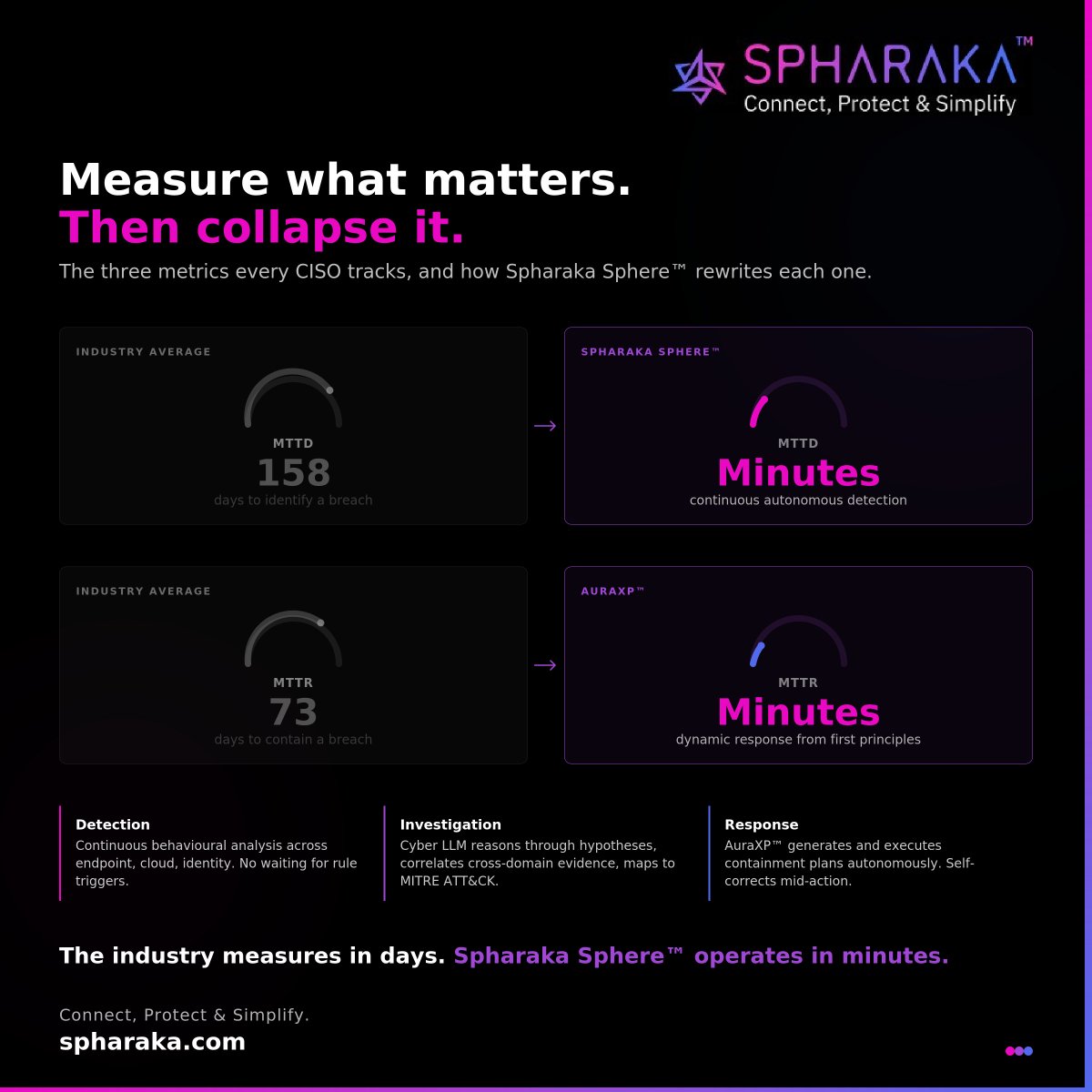
Measure what matters. Then collapse it.
Every CISO tracks two numbers: MTTD and MTTR. Mean Time to Detect and Mean Time to Respond. These are the metrics that define whether a SOC is performing or simply running.
The latest industry data paints a familiar picture. The average organisation takes 158 days to identify a breach. Containment takes another 73 days. That is 231 days of attacker dwell time between first compromise and resolution.
Organisations that deploy AI and automation cut this lifecycle by few days and save $1.9 million per incident. The correlation between detection speed and breach cost is no longer theoretical. It is measured, documented, and widening.
Yet most SOCs still operate with a structural gap between detection and response.
Detection fires an alert. An analyst picks it up, triages it manually, pivots between 5 to 12 tools, gathers context from disparate consoles, builds a hypothesis, validates it, and then constructs a response plan. This process, even in well-staffed SOCs, takes hours per alert. For complex incidents, it stretches to days.
Spharaka Sphere™ eliminates this gap entirely.
Detection: Continuous behavioural analysis across endpoint, cloud, and identity. No rule triggers. No signature dependencies. The platform identifies anomalies the moment they emerge.
Investigation: Spharaka LLM™, the purpose-built Cyber LLM, and AuraXP™'s multi agentic architecture reasons through ranked hypotheses, correlates cross-domain evidence, and maps findings to MITRE ATT&CK. Every investigation is hypothesis-led, not template-driven.
Response: AuraXP™ generates dynamic containment plans from first principles, specific to the threat, the environment, and the compliance context. It executes autonomously, self-corrects mid-action, and delivers analyst-ready outcomes with full traceability.
MTTD: 158 days → minutes. MTTR: 73 days → minutes.
The metrics that define your SOC should not define your risk.
Connect, Protect & Simplify. https://t.co/G4E36b3bvW
#SpharakaNetworks #MTTD #MTTR #AutonomousCyberDefence #SOCEfficiency #AIDrivenDefence #SpharakaSphere #AuraXP #CyberResilience
Most platforms detect. Very few investigate.
Think about how most security tools work today. They collect logs and telemetry. They correlate events and flag anomalies. They send an alert to the analyst queue.
Then they stop.
The alert arrives. The analyst opens it. They pivot across three, four, sometimes twelve different tools to gather context. They manually enrich indicators, check reputation feeds, review user behaviour, trace lateral movement, and build a timeline. They form a hypothesis, test it against available evidence, discard it, form another. They document findings, escalate if needed, and finally decide on a response.
This process takes minutes on a good day. Hours on a bad one. And it depends entirely on the analyst's experience, availability, and cognitive load at that moment.
This is the investigation gap.
Detection without investigation is just a notification. And a notification without action is noise.
Spharaka Sphere™ was built to close this gap.
Where traditional platforms hand off to a human after Stage 03 (Alert), Sphere continues autonomously through Stage 04 (Investigate) and Stage 05 (Respond).
AuraXP™, the agentic AI engine inside Sphere, does not wait for analyst availability. It receives the signal, gathers context across endpoint, cloud, identity, and network telemetry, generates hypotheses, tests them against live evidence, and builds an analyst-ready investigation, complete with timeline, affected assets, root cause analysis, and a recommended response plan.
If the organisation has configured autonomous response, AuraXP executes containment at machine speed. If human approval is required, the analyst receives a fully investigated case, not a raw alert. Either way, the cognitive bottleneck is removed.
The investigation gap is where breaches succeed. Not because detection failed, but because the time between detection and response was too long.
Spharaka Sphere™ eliminates that gap.
Connect, Protect & Simplify. https://t.co/G4E36b3bvW
#SpharakaNetworks #SpharakaSphere #AuraXP #AutonomousCyberDefence #AIDrivenDefence #SOCModernisation #SecurityOperations #CyberResilience
The SOC is evolving. Where does yours stand?
Gartner's 2026 framework outlines the stages of SOC autonomy, from manual triage to fully autonomous threat detection and response. Most organisations today sit somewhere between Stage 2 and Stage 3: playbooks handle the basics, AI assists with enrichment, but the human analyst still carries the cognitive load of every investigation.
Meanwhile, 4.8 million cybersecurity positions remain unfilled globally, according to the ISC2 2025 Workforce Study. Among analysts who are working, 71% report burnout. Annual SOC turnover runs between 15 and 25%.
Hiring alone cannot close this gap. The math does not work.
Here is how the stages break down.
Stage 01, Manual. Every alert triaged by hand. No automation. No scale. This is where most SOCs started.
Stage 02, Assisted. SOAR playbooks automate repetitive tasks. Still rule-bound, still breaks when threats change.
Stage 03, Augmented. AI assists analysts with enrichment, correlation, and recommendations. But the human still decides, still investigates, still carries the bottleneck.
Stage 04, Autonomous. AI reasons through threats from first principles, investigates across domains, generates dynamic response plans, and executes containment. Analysts supervise outcomes, not triage queues.
Human oversight remains, but the cognitive load shifts from the analyst to the platform.
This is the stage Spharaka Sphere™ was built for.
Powered by AuraXP™, Sphere does not wait for playbooks or analyst availability. It detects, reasons, and responds at machine speed, with configurable autonomy levels that keep the security team in control of governance while the platform handles the velocity.
The question is not whether SOCs will reach Stage 04. It is whether yours will get there before the next threat does.
Connect, Protect & Simplify. https://t.co/G4E36b3bvW
#SpharakaNetworks #SOCModernisation #AutonomousCyberDefence #SpharakaSphere #AuraXP #AIDrivenDefence #CyberResilience #ThreatDetection
We’re thrilled to share that Spharaka Networks™ has been selected in NCoE’s 28th Incubation Round!
We are excited to be part of this journey, bringing forward practical and scalable solutions to tackle real-world cybersecurity challenges.
At @Spharaka Networks™, we are building Autonomous Cyber Defence Platforms, where AI works at machine speed to defend against evolving cyber threats.
This is an exciting milestone, and we look forward to collaborating, innovating, and creating meaningful impact in the cybersecurity ecosystem.
@rajeevrajr@nalluri4@I_vishnu_nair
#Spharaka #SpharakaNetworks #CyberSecurity #AI #Innovation #NCoE #StartupIndia
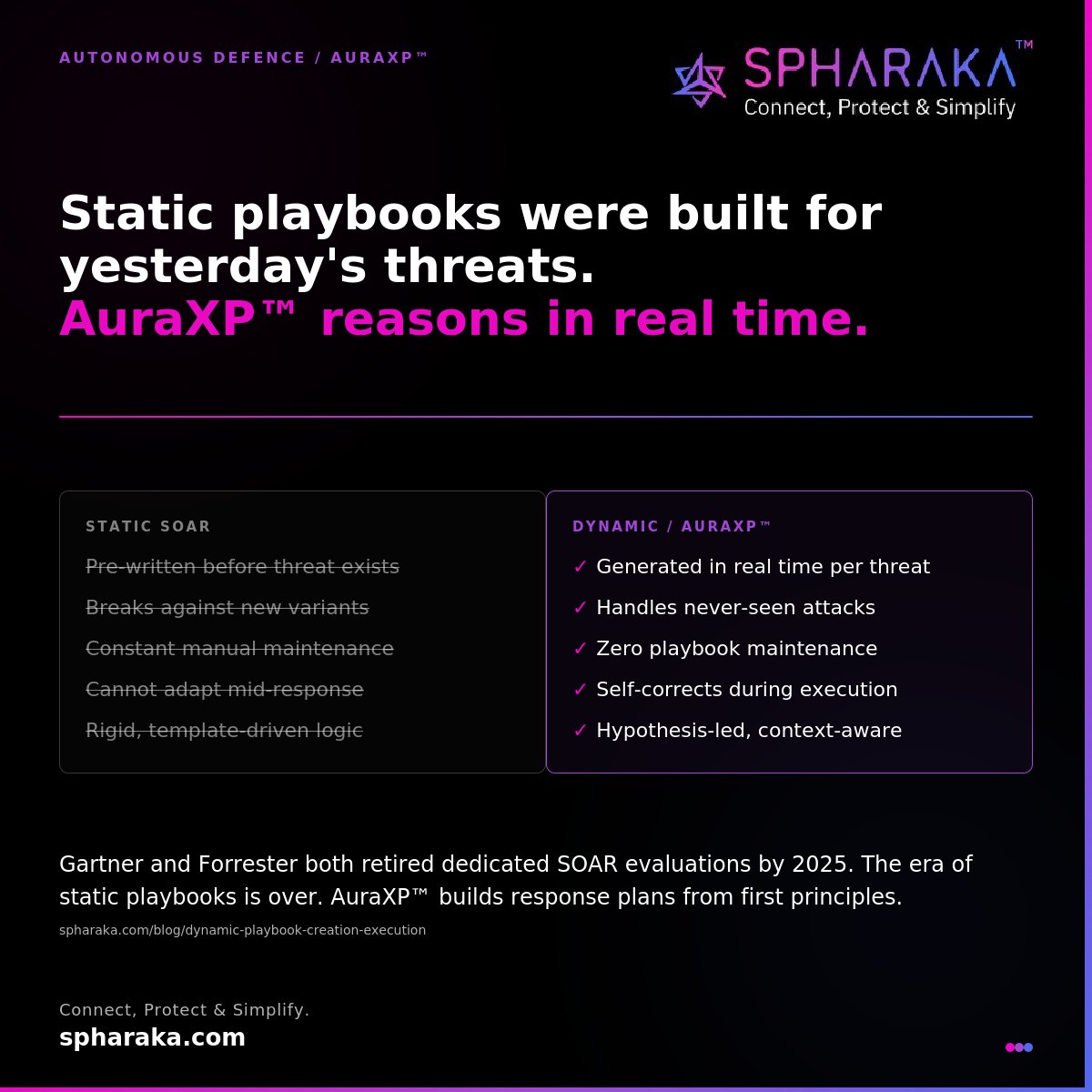
Static playbooks were built for yesterday's threats.
Gartner and Forrester both retired their dedicated SOAR evaluations by 2025. The signal is clear: the era of pre-written, template-driven response is over.
Here is the core problem. A static SOAR playbook must be written before the threat exists. It requires constant manual maintenance. It breaks the moment an attacker introduces a variant the template was not designed for. And it cannot adapt once execution begins.
Organisations with hundreds of playbooks found themselves spending more time maintaining automation than actually responding to threats. The playbook became the bottleneck.
AuraXP™, the agentic AI engine inside Spharaka Sphere™, takes a fundamentally different approach.
Instead of retrieving a template, AuraXP reasons through the full context of the threat in real time: the attack type, affected assets, environmental configuration, regulatory obligations, and available response tools. It assembles a dynamic response plan from first principles, specific to that incident, in that environment, at that moment.
If an action fails or produces unexpected results, AuraXP self-corrects mid-execution. The Cyber LLM adjusts the remaining response path based on live evidence. This is a closed-loop model, not a linear script.
Every dynamic playbook is also compliance-aware: GDPR, DPDP, HIPAA, ISO 27001, SOC 2, and PCI DSS are built into the reasoning layer, not bolted on after the fact.
Configurable autonomy levels let organisations decide what executes autonomously and what requires human review. Control stays with the security team.
Static playbooks document the past. Dynamic reasoning defends the present.
Connect, Protect & Simplify.
#SpharakaNetworks #AuraXP #AutonomousCyberDefence #DynamicPlaybooks #SOCModernisation #AIDrivenDefence #CyberResilience #SecurityAutomation
This weekend, a multi-billion dollar tech company was breached.
Not through malware. Not through a zero-day. Not through phishing.
Through an AI tool that had OAuth access to an employee's workspace.
The attacker compromised a third-party AI application, inherited its trusted permissions, pivoted into internal systems, and accessed secrets and deployment pipelines, all without writing a single exploit.
This is the new kill chain. And most enterprises are completely unprepared for it.
Every AI agent connected to your email, documents, code repositories, or cloud infrastructure is a privileged insider operating at machine speed. When that agent is compromised, the attacker doesn't need your password. They already have your trust.
The numbers should concern every security leader:
→ 490% increase in AI-related attacks year over year
→ 48% of security professionals rank agentic AI as the #1 attack vector of 2026
→ 86% of organisations have zero visibility into where their AI tools are connected
→ Over half of deployed AI agents operate without any security monitoring
This is the threat model we built Spharaka Sphere™ to defend against, autonomous, AI-native defence that monitors identity chains, detects trust anomalies, and responds at machine speed before human analysts even see an alert.
In a world where attackers use AI agents, defenders need autonomous AI agents too.
The next breach won't come through your firewall. It will come through an integration you already approved.
#CyberSecurity #AIAgents #OAuthSecurity #AttackSurface #SaaSSecurity #IdentitySecurity #SupplyChainRisk #AutonomousDefence #SpharakaNetworks #SpharakaSphere #AuraXP #AgenticAI #CISO #EnterpriseSecurity #InfoSec
https://t.co/JzzjQRbBFF
The attacker doesn't get tired anymore.
For many years, cybersecurity was built on one silent assumption: make it annoying enough and the attacker moves on.
Rate limits. CAPTCHAs. Manual triage. Alert queues. Multi-step logins.
All of it was friction, designed for adversaries who were human, impatient, and expensive to operate.
That era just ended.
When the attacker is an autonomous AI system running the same exploit chain 10,000 times overnight at near-zero cost, friction is not security. It's theater.
Boards are no longer asking "Are we protected?"
They are asking: "When something breaks, how fast are we back?"
We wrote about what changed in the last 12 months, why legacy defense assumptions have collapsed, and what the shift to autonomous cyber defense actually looks like.
Link: https://t.co/39H3aLvLdq
@rajeevrajr@nalluri4@I_vishnu_nair
We built firewalls like castle walls. Spharaka thinks more like an immune system; 40+ AI agents that learn, reason, and respond in real time. Not a bigger lock on the door. A living defence that evolves faster than the threat. That's the shift from cybersecurity to cyber-resilience. 🧬
@ETtech I request @ETtech team to have a look at this. At @Spharaka, we have built what organizations need now: autonomous, AI-native cyber defence designed to meet machine-speed threats with machine-speed response. @rajeevrajr
https://t.co/FB51cWmKja
The noise in your SOC is not random. It’s engineered. The volume of false positives your team drowns in every day is not a side effect, it is the attack. It’s designed to exhaust attention so that the real incursion passes unseen in the flood.
Meanwhile, most defences are still pattern-matching against yesterday’s threat signatures. Still waiting for a human to make the call. Still asking whether an anomaly is worth investigating.
Every month you operate with a legacy security model against an AI-native adversary, the gap widens. The attackers are not waiting. They are not in a pilot programme. They are in production, improving, deploying.
The organisations that move now are not just buying better security. They are building an asymmetric advantage, a defence that gets harder to beat the more it is attacked. That compounds. The organisations that wait are building technical debt in their security posture that will be brutally expensive to close later.
Read the full article here: https://t.co/9BjF5UWcTP
@rajeevrajr@I_vishnu_nair@nalluri4
#CyberSecurity #CyberDefense #CyberSecurityStrategy #SecurityModel #ZeroTrust #CyberResilience #ThreatDetection #RiskManagement #InfoSec #SecurityLeadership #CISO #SOC #EnterpriseSecurity #DigitalSecurity #CyberThreats #AttackSurface #SecurityArchitecture #AIinCybersecurity #AutonomousSecurity #AgenticAI #FutureOfSecurity #CyberInnovation #SpharakaNetworks #SpharakaSphere #AuraXP
Anthropic is an AI research company. It builds models. It does not run your SOC. It does not monitor your endpoints at 3am. It does not respond to an active intrusion in your cloud environment, integrate with your SIEM, orchestrate remediation across your identity layer, or produce the incident reports your compliance team needs by morning.
Legacy cybersecurity vendors are retrofitting AI features onto platforms built for a previous era. General-purpose AI companies like Anthropic operate upstream of the operational layer entirely. Neither is positioned to deliver what the Mythos era demands: an autonomous, continuously operating, security-native defence that reasons about threats at the same speed and intelligence as the threats themselves.
At @Spharaka Networks™, we have been building toward this moment since before it had a name. Spharaka Sphere™ exists because we believed, deeply, architecturally, in the design of every agent and every model, that the future of security was autonomous or it was lost.
The Mythos moment validated that belief in front of the entire world.
We are not reacting to the future. We were built for it.
If your organisation is ready to move from reactive to autonomous, we are ready to show you what that looks like.
@I_vishnu_nair@rajeevrajr@nalluri4
https://t.co/zFXAy9oKli
The next wave of cyberattacks won’t be manual.
They’ll be autonomous, and they won’t wait for human operators to catch up.
What’s coming:
Self-improving attacks
Attacks that adapt in real time
Attacks that learn your defenses as they break them.
#CyberSecurity#AI#CyberDefense