@KoF_Benedikta || At long last. Finally feels like I found people I really vibe with. People who really wanna give my lady a chance, and are not interested in lewding my muse just because "she is a Rosaria".
A million thanks for giving me a chance, Nana... 🫂
@KoF_Benedikta || Seriously.
This? Nearly made me cry.
For all these years in girp, I always deemed my portrayal...boring, not interesting. Plus the constant struggle of being able to find someone who would be actually interested in interacting at all, the drama moments etc.
+
But I genuinely doubt...anyone would get to SEE me. Or learn to tolerate every single bit of darkness left in me. Ready to face my scars, literally speaking.
Don't get me wrong, Mr Albedo.
Your words are kind and thoughtful.
I just.
Don't think it'd ever happen.
Former Sister drops her gaze for a moment.
Deep in thought.
Is the alchemist even fully aware...of the real extent of her suffering?
"You speak about an ideal, utopian world. A world where such a person could exist.
↓
ㅤ
〝 I'm fully convinced.
You've suffered enough already.
All you deserve is a peaceful,
warm embrace, and someone
who loves you and can provide
said embrace.
Someone who pays attention
to every detail, to your interests,
your needs, your smile and
your grief as well. 〞
#Caturday 🐈⬛🐾
The witch and her cat, often black, is a symbol rooted in folklore and history, tracing back to European medieval and early modern beliefs.
Cats were associated with mystery due to their nocturnal nature, stealth and independence. In folklore they were sometimes seen as familiars ~ supernatural entities that aided witches by spying, delivering messages, or channeling magical energy.
During the witch trials of the 16C /17C cats were demonized alongside accused witches.
Superstitions painted black cats as omens of bad luck or incarnations of the devil.
In English witch trial records of 16C and 17C cats were cited as evidence of witchcraft and were regularly killed along with the accused.
Witches were often depicted as solitary women and their deep intuitive bond with cats reflected a shared marginalisation, both were misunderstood, independent and distrusted by rigid societies.
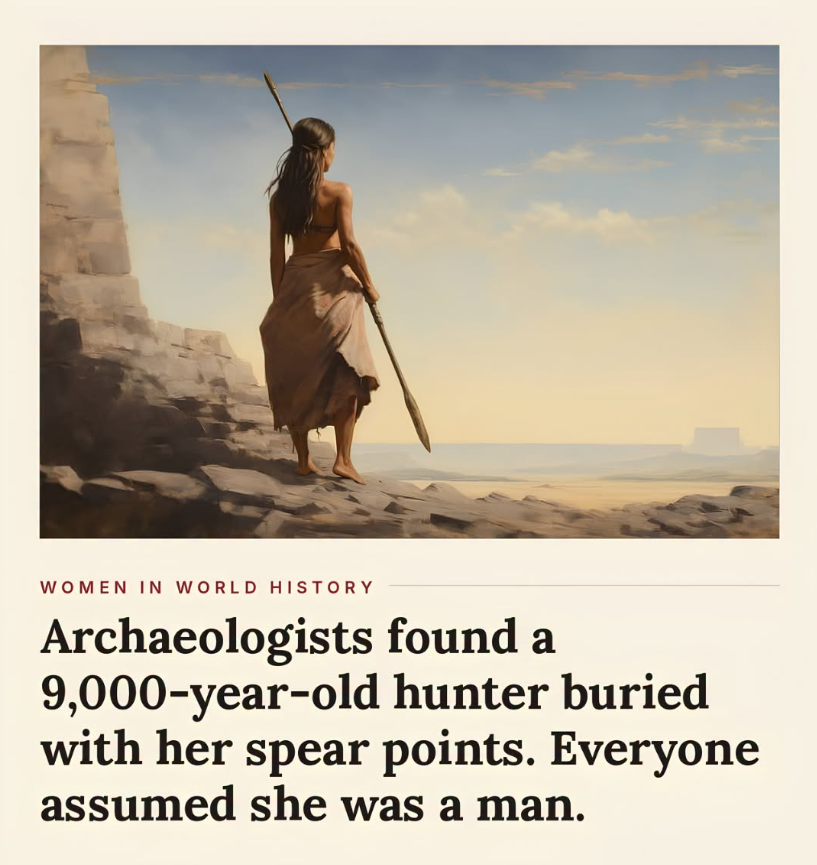
In 2018, archaeologists digging high in the Andes of Peru opened a grave that was about 9,000 years old. Inside lay a hunter, buried with a full kit of stone spear points and tools for butchering big game.
They assumed it was a man. An important one, judging by the toolkit.
Then the bones and a protein test of the tooth enamel came back. The hunter was a young woman.
That one burial at a site called Wilamaya Patjxa sent the team back through the records. They looked at hundreds of early burials across North and South America and found 27 people laid to rest with big-game hunting tools. Eleven of them were women. The researchers concluded that in some early societies, women may have made up a third to a half of the people hunting big game.
For generations, we were taught a simple picture of the past. Man the hunter, out with his spear. Woman the gatherer, back at camp with the baby and the berries. It showed up in textbooks, museum dioramas and cartoons. It was often used to argue that women belonged in a smaller role.
But the evidence was not always as simple as the story. Women buried with weapons were sometimes explained away. The tools must have belonged to a husband. A brother. Archaeologists were reluctant to call a woman a hunter, even when she was buried like one.
In 2023, another study added fuel to the debate. Researchers combed through a century of records on 63 foraging societies and reported that women hunted in 79 percent of them. In about a third, women went after big game.
Not every scientist agrees. A group of hunter-gatherer experts pushed back hard in 2024, arguing that the study had coding errors and that in most foraging groups, men still do most of the hunting. Even they agreed on one thing, though. The idea that women never hunted is wrong.
Some anthropologists go further and point to the female body itself, arguing that estrogen supports the kind of endurance that long chases on foot demand.
The debate is still going, and it should be.
via Women In World History
#HERstory #WomenInMaleDominatedFields #Women #Archaelogy #anthropology