Me : Excellent Book with Super-Annoying Cover ,MUSIC FREAK (Shafqat Fan) ♬♪ ▃ Proud Indian ☺⇨ if u were to say & u swallowed, i'll hear it louder ( ͡° ͜ʖ ͡°) ॐ
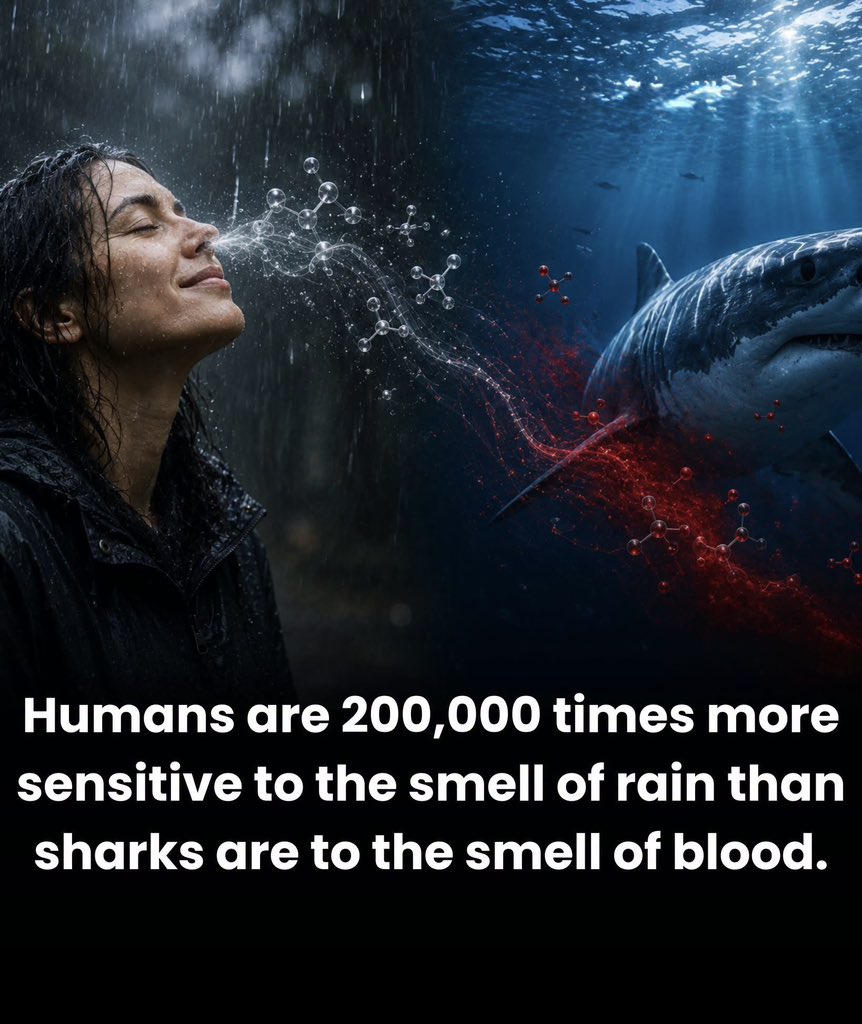
👃 YOUR NOSE MAY BE BETTER AT FINDING RAIN THAN A SHARK IS AT FINDING BLOOD
You know that smell in the air when rain is on the way? That earthy smell can sometimes reach you before the first drop even falls.
One of the main reasons is a chemical called geosmin. It is produced by bacteria living in soil, especially bacteria from the genus Streptomyces. And humans are ridiculously good at detecting it. Our noses can pick up geosmin at extremely tiny concentrations, sometimes just a few parts per trillion.
Sharks get all the attention for their sense of smell, especially the famous claim that they can smell a drop of blood from miles away. The reality is much less dramatic. Their chemical sensitivity is impressive, but the exact ability depends on the species and the substance.
So why are human noses so sensitive to something produced by dirt bacteria?
Nobody knows for sure. One interesting idea is that it may have helped our ancestors find water. Geosmin is often associated with wet soil and rainfall, so being able to detect it from a distance could have been useful in dry environments where finding water was a matter of survival.
And humans aren’t the only ones paying attention to it. Camels can detect geosmin too, and researchers have found an unusual connection between the chemical, desert animals and the bacteria that produce it.
There is another strange side to geosmin. It is also responsible for that muddy taste sometimes found in freshwater fish and contaminated water. The same molecule that makes wet soil smell so good can make food taste awful.
And that famous smell after rain has a name: petrichor. The word was coined in 1964 by Australian researchers who were studying the oils and compounds released from dry earth and rocks when rain arrives.
So when you smell rain before you see it, you’re not imagining things.
Your nose is detecting chemistry happening around you — and that ability may be much older than human civilization itself.
Source: U.S. Geological Survey (USGS)
India has just ranked 176th out of 177 countries in Yale's 2026 Environmental Performance Index (EPI), based on indicators related to climate change, environmental health, and ecosystem vitality.