🚨BREAKING: The DOJ is announcing CHARGES against 455 defendants across 45 states for healthcare fraud schemes, including over $6.5B in false Medicare and Medicaid claims.
The supplement of IVUS-CHIP includes several across-trial comparisons that are key to its interpretation.
In addition, these two trials demonstrate that geography matters. Different patient-risk profiles, different lesion characteristics and complexity, different clinical practices, and different results and outcomes.
EU guidelines need EU data 📊, US guidelines need US data 📉, and South Korean and Chinese guidelines need regional data as well — if we want to call it confirmatory data. Class IIa should be the maximum recommendation without large-scale regional confirmatory data.
These data are difficult to digest and are nuanced. Assuming that some of the largest centers in Europe and top-performing imagers (looking at the co-authors) did not use IVUS information appears as looking things upside down. A better look is that expert operators recalibrated their angio-only practices with IVUS knowledge making the impact (i.e., effect size) smaller or non-existent. Stent thromboses were much lower in IVUS CHIP, though. Education and training are key and the adequate learning-curve volumes are unknown.
That is correct. Not all bifurcations require a 2 stent approach, consequently, this was not mandatory. And in relation to heavy calcification the numbers speak for themselves in the supplement. We see approx. 45% in IVUS-CHIP vs. <20% in RENOVATE. Penetration of IVL remains low and needs further education (and data as well).
No lo llamaría contradicción, sino evolución. Hace 20 años IVUS ayudaba a mejorar las estrategias de ICP. Hoy los algoritmos de ICP son muy similares con o sin imágenes intracoronaria. Predilatación, modificación de lesiones, post-dilatación son ya rutinarios sin imágen intracoronaria. Hemos recalibrado el ICP con angiografía en base al conocimiento del IVUS.
@omendiz Please see our supplements, where we compared Asian, US, and EU studies. Geography matters. EU patients were sickest, highest risk ever reported. All centers high volume (>1000 PCIs /year).
Our data strongly suggests geographic differences. IVUS-CHIP is the highest risk population ever enrolled (please see our comparative tables in the supplement): older patients, higher prior MI and prior revascularizations, much higher heavy calcification, left main disease, and CTOs compared to prior trials. All high volume, expert centers. Much higher plaque burden at edges despite longer stents. Different geographies, different CAD burden, different practice, different outcomes, and different effect size. Data ought to be reconciled, at least in Europe.
Of course and the argument can be misleading without additional info. In IVUS-CHIP, non-complex lesions were to be treated according to the randomized strategy except for concurrent non-complex lesions <2.5 mm in diameter, which were left to the operator. All complex lesions (including those with diameter <2.5 mm) underwent IVUS-guidance. Approx. 12% of the complex (study) lesions were <2.5 mm (similar to RENOVATE COMPLEX PCI) and certainly underwent IVUS-guidance. This is nicely shown in the Supplementary tables. Happy to continue the dialogue after reviewing the Supplement.
Highly arguable. Please see our supplement which explains this in detail. IVUS-CHIP has the most complex population ever enrolled in these trials. Heavy calcification (using similar definitions) several X higher than RENOVATE or ILUMIEN Complex or OCTOBER. Prior MI or prior PCI higher as well. We haven’t reported stenting strategies in bifurcations so conclusions cannot be established. Curious why Dr. Mamas suggests that a long lesion is not a complex lesion - all prior meta-analysis on imaging guidance included long lesions as a criterion - some > 20 mm. IVUS-CHIP uses 28+ (recognized cut-off). Robust data that takes some time to digest.
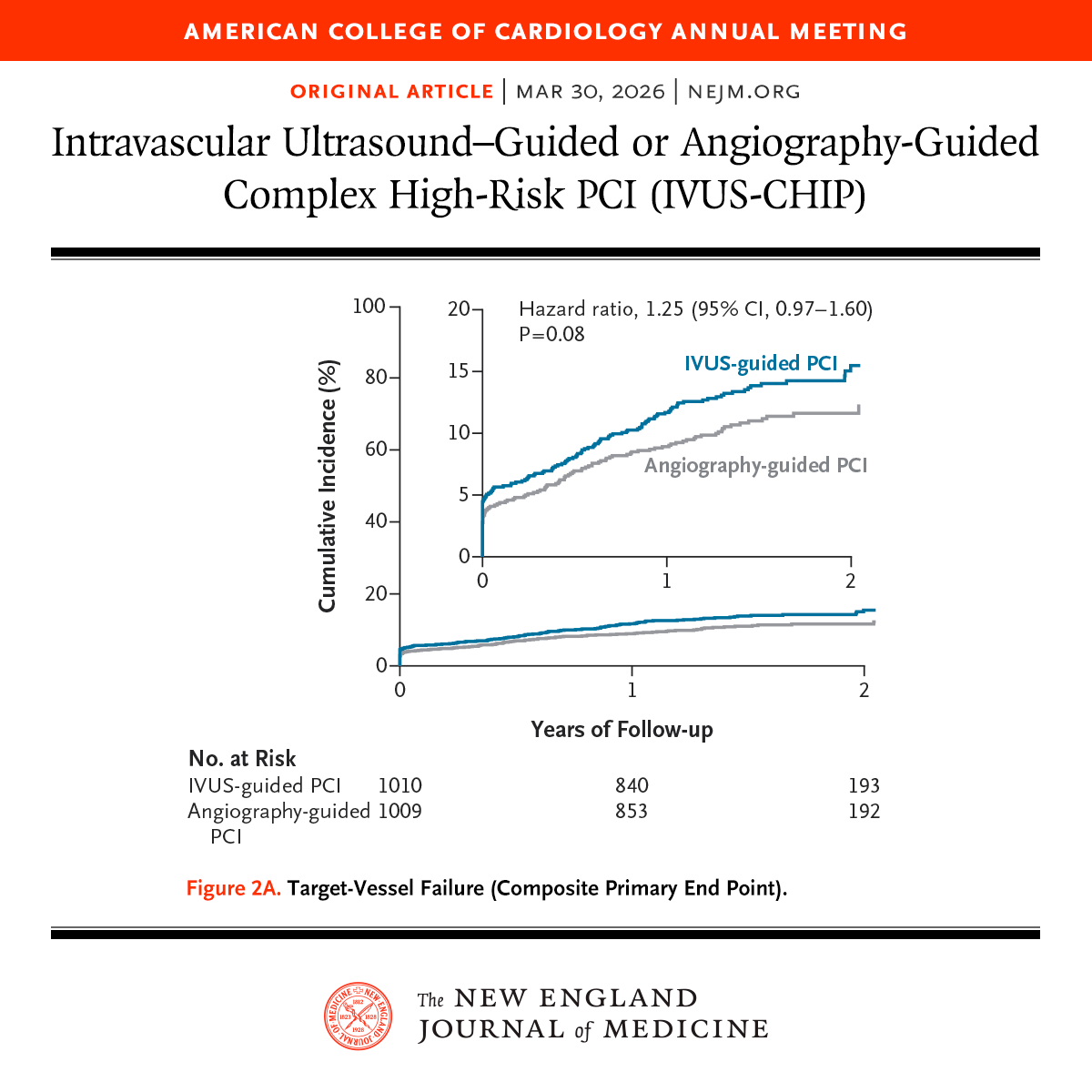
Dr. Roberto Diletti and Dr. C. Michael Gibson discuss the IVUS-CHIP trial: IVUS-guided PCI showed similar rates of target vessel failure compared to angio-guided approach among patients undergoing complex high-risk indicated procedures. #ACC26 Watch video here: https://t.co/q9c8XYoMYb
Presented at #ACC26:
In the IVUS-CHIP trial involving patients undergoing complex high-risk PCI, the risk of target-vessel failure (a composite outcome) was not lower with intravascular ultrasound guidance than with angiography guidance. Full trial results: https://t.co/oqHofLJUi6
Editorial: IVUS — A Zigzag Path to Success https://t.co/hb7PwRPlR3
@ACCinTouch