Selling a tokenized asset to raise cash is the most expensive liquidity there is.
For one, you lose the position you actually want.
And the main alternative right now is variable rate lending. Which means your cost can change after you've already borrowed.
The solution is simple: fixed rate, fixed term lending.
Borrow against the asset, keep the exposure and know exactly what the debt costs from day one.
We are happy to share that we have completed our smart contract security assessment for @SplyceFi! 🔐
Splyce is an onchain credit platform offering fixed-rate, fixed-term institutional lending.
Everyone measures RWA by how much gets tokenized.
Arrakis followed where $91B of it actually went.
Almost all of it gets bought, then sits idle. For most tokenized assets, there's nowhere to borrow against them even if you want to.
Then one private credit fund got listed on a lending market. Holders borrowed against 42% of it almost immediately.
The demand to use these assets already exists. The infrastructure doesn't.
Institutions haven't stayed out of onchain lending because they don't want the yield.
They've stayed out because it has no defined recourse.
When something breaks, a bot liquidates you at a threshold. No counterparty, no answer agreed in advance.
Galaxy's report says the same thing.
The recourse we build gets written before the money moves. Terms set at origination, and a defined answer for what happens if a borrower doesn't repay.
An asset becomes more useful the moment it can support credit.
Homes got mortgages. Treasuries got repo. Companies got bond markets.
Tokenized real-world assets went onchain. The credit layer didn't follow.
Access was phase one. Structure is phase two.
Tokenized assets don't just need to exist onchain.
They need financing that matches how they behave.
Fixed rate.
Fixed term.
Isolated by asset and borrower.
That's how institutional credit has always worked.
Onchain shouldn't be any different.
Everyone's trying to improve DeFi lending.
Almost nobody is questioning the architecture.
Crypto and real-world assets don't behave the same.
Why would they share the same credit architecture?
Financing works best when you know the cost before you take the risk.
That's true in mortgages. It's true in bonds. It's true in repo.
Yet it's not true in most DeFi lending.
Your position didn't get riskier.
Your financing did.
A rate fixed at origination is the one rate no one else can move.
Most onchain lending is a pool. A Single Asset Vault is a deal.
One borrower. One collateral. One rate. One term.
Fixed yield. Known counterparty. Underwrite it before you deposit.
This is what onchain credit was supposed to look like.
Crypto had its worst week in months. Real-world assets onchain kept attracting holders.
Demand for tokenized credit doesn't track crypto sentiment. It tracks the need for yield that pays whether the market is up or down.
Tokenized RWA holders are up 15.75% in the last month.
The selloff didn't change the trajectory.
Fixed-rate borrowing is the default everywhere except DeFi.
Mortgages. Corporate bonds. Repo. The structures that move trillions in TradFi credit price at origination and hold the rate.
Onchain lending priced everything variably from day one. That worked for crypto-native traders. It doesn't work for anyone running a credit book.
SAVs bring the primitive onchain. Borrower sets the rate. Locks the term. Lenders fund the named vault.
Real credit needs the real primitive.
You've never known who has your money.
A pool. A curator. An algorithm. Someone else making decisions after you deposit.
Single Asset Vaults change that.
One borrower. One collateral type. You see the name, the rate and the term before you commit a dollar.
Then you decide.
In DeFi lending, you don't witness default. You inherit it.
The bot sells the collateral into thin markets. Recovery is whatever survives the spread.
In a SAV, you know the resolution path on day one.
Who liquidates. How. At what price reference. What's agreed at origination is what executes.
A pool is a position. A SAV is a relationship.
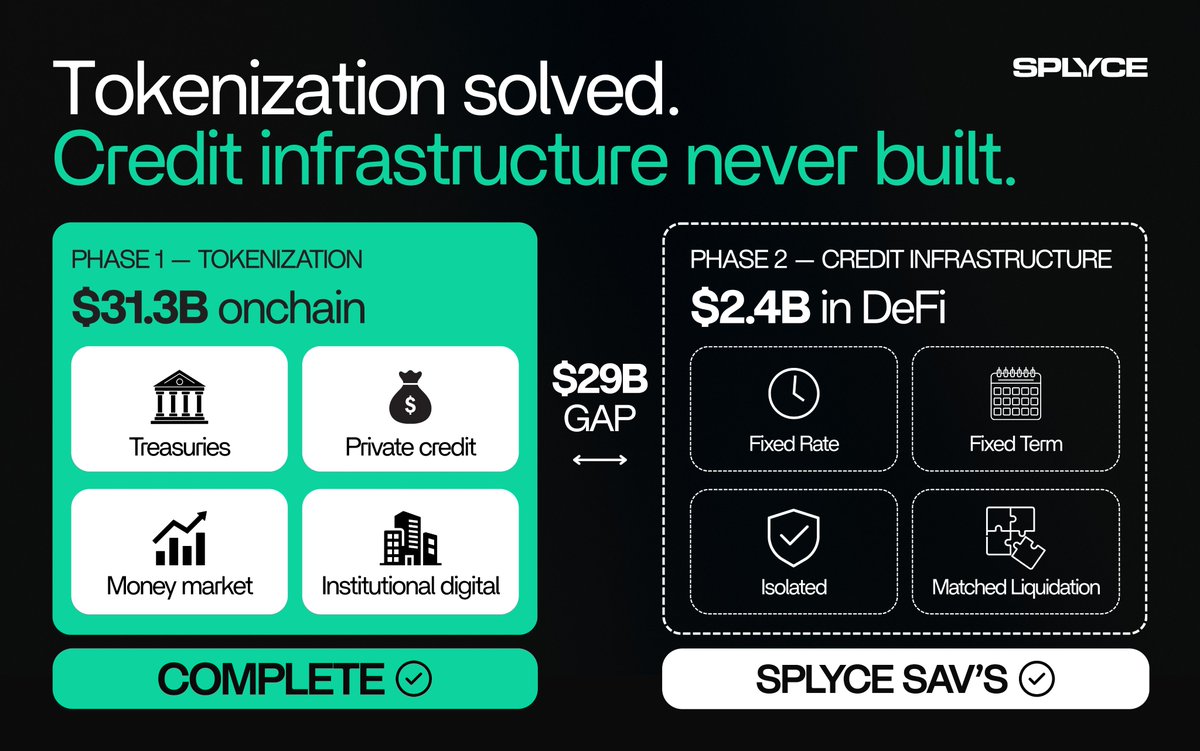
$29B gap between what's tokenized onchain and what's active in DeFi.
Tokenization put the assets onchain. The credit infrastructure was never built.
Variable-rate pools assume collateral is fungible, prices are live and one liquidation logic fits every asset. None of that holds for institutional credit.
SAVs are the credit infrastructure.
Fixed rate. Fixed term. Isolated by borrower. Liquidation matched to the asset.
Built for the gap.