If you haven’t bought my kindle books (chapters) yet, now is as good a time as any. Just head to the Amazon Kindle Book Store and download today. You don’t need a Kindle, just the Kindle app on your phone or iPad will do. Cheaper than a coffee at a cafe, and the result of years of thought. I am sure you will find them thought provoking.
https://t.co/LbPacNPrPu
🚨 OMG. President Trump CUTS OFF and WALKS OUT of a Kristen Welker interview
He looks her in the eyes and tells her SHE'S A LIAR, then storms off!
"The elections are like a 3rd world country. YOU'RE CROOKED...let's call it QUITS. I've HAD ENOUGH."
WELKER: Please, I traveled all the way to Wisconsin!
TRUMP: "I've sat in the RAIN with you for an HOUR! I've given you enough time. You ought to straighten out your press. You know what? A country can never be great with a dishonest press. Let's GO."
WELKER: *Whines*
BEST PRESIDENT EVER 🔥🔥🔥
Elon Musk measures every civilization by a single number.
By that number, we have not begun.
Not by armies. Not by gold.
By energy. By how much of it you can actually hold.
A Russian physicist named Kardashev drew the scale in the sixties.
The first rung should be easy.
Musk: “If you’re Type I, you’re using most the energy of your planet.”
That is not greatness. That is the entry fee.
The moment a species stops being primitive.
We have not paid it.
Musk: “We’re still using a tiny fraction of the sun’s energy that reaches our planet.”
And what reaches us is already almost nothing.
Musk: “The Earth only receives about half a billionth of the sun’s energy.”
Half a billionth.
That is the entire inheritance of everyone who has ever lived.
And we built everything we know on the fraction we bothered to catch.
Musk: “The sun is 99.8 percent of all mass in the solar system.”
Everything you have ever called the world is the rounding error.
Every empire, every fortune, every border rose and fell inside a fraction of a fraction.
Every war was fought over scraps.
Beneath a furnace pouring out more in a single second than we will burn in a hundred years.
Every economy ever designed assumed there was not enough.
The sun disproved that assumption every morning since the Earth was formed.
The abundance was never missing.
It fell on us the whole time.
We kept our eyes on the dirt.
So the scale stops being a measurement.
It becomes a verdict.
It does not ask how advanced you are.
It asks how much smallness you agreed to.
Musk looked at the same sky as everyone else.
And refused to sign.
Scarcity was never handed to us.
The sun never rationed anything.
We did.
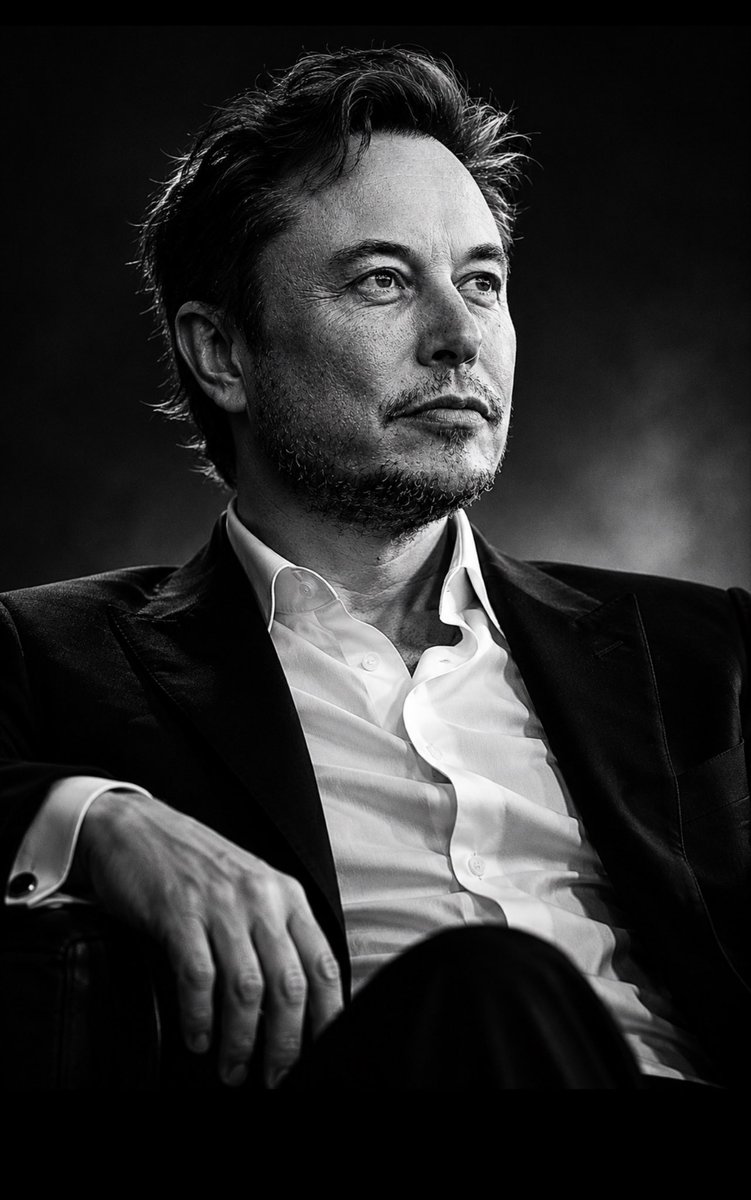
The more you watch Elon Musk, the more obvious it becomes that this was never just about money. He could have walked away years ago and lived in total comfort for the rest of his life. Instead, he chose constant pressure, sleepless nights, and one impossible mission after another. He does it because he genuinely believes humanity can achieve so much more if we push ourselves harder.
He is 54 years old and still working with the intensity of someone half his age. Grinding until 3am at the office, working every waking hour seven days a week. People keep betting against him, and he keeps winning. You can disagree with him on things, but you cannot deny the level of dedication, sacrifice, and belief he has put into pushing humanity forward.
History is repeating itself once again.
Godspeed, SpaceXAI.
Happy Eid Al-Mubarak to all the faithful of Islam. I once spoke to a man I thought he spoke like the Prophet Muhammad. He told me in the end when the Koran is fulfilled the people of Islam would follow Jesus. For he is the Lord of men, the King of men, the God of men.
The encyclical contributes a values-based framework (“human person as end, not means”) without rejecting technology outright. Whether one agrees depends partly on worldview, but the dangers flagged are substantive, not invented.
Pope Leo XIV’s first encyclical, Magnifica Humanitas (“Magnificent Humanity”), released on May 25, 2026, is largely accurate in highlighting genuine, well-documented dangers of AI, while framing them through a Catholic lens of human dignity, the common good, and ethical responsibility. It is not misguided fearmongering but a thoughtful application of longstanding Church social teaching (echoing Rerum Novarum on the Industrial Revolution) to current technology.
Key Warnings in the Encyclical and Their Accuracy
The document (over 42,000 words) affirms AI as a “valuable tool” with potential for good (healing, education, efficiency) but stresses vigilance against misuse. Main concerns:
• Job Displacement and Economic Inequality: It warns of large-scale unemployment, hollowing out the middle class, and wealth concentration among tech elites without adequate support for displaced workers. Accurate: Economists and reports (e.g., from OECD, IMF, and AI labs themselves) widely project significant disruption in white-collar and routine cognitive jobs. Historical parallels to automation show short-term pain without policy buffers (retraining, UBI experiments, etc.).
• Autonomous Weapons and Warfare: Calls to “disarm” AI, condemns lethal autonomous systems (LAWS) as lowering thresholds for violence, making conflict more impersonal and harder to control. Accurate and urgent: This aligns with concerns from groups like the Campaign to Stop Killer Robots, UN discussions, and experts (including some at Anthropic and OpenAI). Real-world developments in drone swarms and AI targeting already raise escalation risks.
• Bias, Discrimination, and Loss of Agency: Algorithms tainted by biased data denying access to jobs, healthcare, or security; erosion of human decision-making, creativity, and relationships (especially for youth). Well-supported: Documented issues with biased models in hiring, lending, and policing; studies on AI companions affecting child development and social isolation; “black box” opacity complicating accountability.
• Misinformation, Power Concentration, and Dehumanization: Tech giants’ dominance, spread of falsehoods, transhumanist narratives reducing humans to data/performance metrics. Accurate: These are active debates in AI ethics (e.g., alignment problems, superintelligence risks, filter bubbles). The encyclical rejects both naive techno-optimism and Luddite rejection.
It promotes regulation, transparency, ethics by design, education, and AI serving the common good rather than profit alone. It draws on biblical imagery (Babel vs. Nehemiah’s collaborative rebuilding) and principles like subsidiarity and solidarity.
Strengths and Potential Criticisms
• Strengths: Balanced—not anti-AI, but pro-human. Pope Leo XIV (with a math background) engaged experts like Anthropic’s co-founder at the launch. It elevates ethics as a core imperative, similar to how prior popes addressed labor or environment. Many risks are empirically grounded, not speculative doom.
• Criticisms (from various sides):
• Too cautious/slowing progress: Some in tech argue it underplays AI’s poverty-reducing, scientific-accelerating potential and over-relies on government regulation (which can stifle innovation).
• Ideological: Left-leaning on inequality/labor; traditional on human uniqueness (soul, dignity) vs. materialist views.
• Not technical enough: As a moral document, it doesn’t dive into specifics like alignment or compute governance, which some experts prefer.
Overall, the Pope is not misguided. The Church has a track record of engaging industrial-era disruptions productively. AI’s trajectory involves real trade-offs between capability and control, efficiency and equity, innovation and safety—issues experts across fields (including inside AI companies) debate intensely.
The displaced people of Palestine do maintain a great deal of dignity in the face of unbearable suffering and living conditions in the face of a brutal 77 years occupation and sytematic genocide at the hands of the brutal regime of Israel. They don’t need a flotilla of activists stealing the momentum of their very real struggle for survival. They need food, clothes and sanctuary. A new homeland for the displaced. Kindness and open arms from the rest of the world. There is no way out of the rubble, send some light on their situation. Stop killing them Israel. And some country, maybe the United Arab Emirates, give them homes and running water with bathrooms, bedrooms, kitchens and family dinner tables. These people need to be rescued from their situation which has become unbearable and inhumane. Think of the children. Already over 20,000 children have been slaughtered while they slept. I know Hamas chose war, a small group of terrorists chose to do what they did on October 7 three years ago. But over 100,000 innocent unarmed civilians men women and children have been slaughtered, in retaliation, and all the homes destroyed And the people that remain are sleeping in tents in the rubble. While the rest of the civilised world do nothing and the radical left flotillas of activists steal the focus of the issue. Gaza doesn’t need activists grandstanding in flotillas, they need sanctuary, a new life, charity and care. There are those who say they want to stay in Gaza, that Gaza is their land. But I come from a country built by migrants fleeing war, dispossession, famine and who believed in a better life in a new home free from the reasons for their displacement. I do think the Arab country’s could assist in helping the people of Gaza out of their dispossession by offering these people sanctuary. Most of the Hamas terrorists have been killed. It’s time now for a new start for the people of Gaza. There is no use holding onto the rubble. Sanctuary for the surviving people of Gaza is what is needed. I’d like to see the rest of the Arab world offer them a new start in comfortable homes free from the misery that is the situation in Gaza.
She saw the different levels of Purgatory… and said even the “lightest” pain would change how you live today 🙏👇
Shortly before her death in 1607, St. Mary Magdalene de' Pazzi experienced a deep ecstasy while walking with her sisters in the convent garden.
During this state of prayer, she was given a vision of Purgatory.
In her own accounts, she described it as a place of purification where God’s justice and mercy work together.
She understood that the souls there already belong to God. They are saved, but they are being purified from the effects of sin and any remaining attachment to it.
She saw different degrees of suffering. Some souls endured intense purification for attachments to sin or for faults they treated lightly in life. Others suffered more deeply, especially for sins against charity, pride, or for neglecting their responsibilities. There were also souls who had lived good lives, but still needed to be purified from smaller imperfections before entering Heaven.
The suffering was not the same for everyone, but all of it had a purpose.
One moment that stayed with her was seeing the soul of a sister who had recently died. The soul was in suffering, but also filled with desire for God. There was no despair. Only longing and trust, knowing that this purification would end in Heaven.
Even small sins matter more than we think.
This matches what the Church teaches. Purgatory is not a second chance, but a final cleansing for those who die in God’s grace. The souls there cannot help themselves, but they can be helped by us.
The Church has always taught that our prayers, sacrifices, and especially the Holy Mass can assist them.
Catechism of the Catholic Church explains that this purification is necessary so that a soul can enter the full holiness of Heaven. It also reminds us that praying for the dead is an act of charity that has been practiced since the earliest Christians.
“It is therefore a holy and wholesome thought to pray for the dead, that they may be loosed from their sins.”
(2 Maccabees 12:46)
“…the fire will test what sort of work each one has done… If any man’s work is burned up, he will suffer loss, though he himself will be saved, but only as through fire.”
(1 Corinthians 3:13–15)
Many souls are remembered less as time passes. Some may have no one praying for them anymore.
So the question is simple and honest:
💬 Have you ever experienced a moment that made you suddenly realize how serious sin actually is?
What happened at Pentecost?
Fifty days after the Resurrection of Jesus, the Apostles were gathered together in the Upper Room when the Holy Spirit descended upon them. Scripture says there came “a noise like a strong driving wind,” and “tongues as of fire” rested on them (Acts 2:2–3).
Everything changed in that moment.
The same Apostles who had been afraid and hiding suddenly went out and preached Jesus Christ boldly to the world. Through the power of the Holy Spirit, people from many nations could understand them in their own languages (Acts 2:4–11).
Then St. Peter stood up and preached his first public sermon, and about 3,000 people were baptized that day (Acts 2:41).
Pentecost was not just a moment in history. The same Holy Spirit still strengthens, guides, and transforms souls today through the life of the Church and the Sacraments.
📖 “But you will receive power when the holy Spirit comes upon you, and you will be my witnesses…” (Acts 1:8)
Do you think the world today has forgotten the power of the Holy Spirit?
🚨 "An Agreement has been largely negotiated, subject to finalization between the United States of America, the Islamic Republic of Iran, and the various other Countries, as listed..." - President Donald J. Trump
Dubai is constructing the world’s largest solar-powered seawater desalination plant, which will convert saltwater into drinking water for up to two million people daily using only solar energy.
The Hassyan Desalination Plant is being developed by the Dubai Electricity and Water Authority (DEWA) in partnership with ACWA Power and Veolia. Once completed, it will produce 818,000 cubic meters of fresh water per day, making it a landmark project in sustainable water infrastructure.
The facility employs advanced reverse osmosis technology and energy-efficient systems that reduce power consumption by up to 35% compared to conventional plants. Entirely powered by solar energy, the plant will operate with zero fossil fuel use and zero direct emissions, offering a groundbreaking solution to water scarcity in arid regions.
Located approximately 55 kilometers southwest of Dubai Creek, the Hassyan plant is scheduled to become fully operational by 2027. With a budget of €848 million, the project forms a key part of Dubai’s strategy to achieve carbon neutrality while securing reliable water supplies for its rapidly growing population.
This ambitious initiative demonstrates how clean energy can be effectively integrated with essential public services to address future environmental and resource challenges.
[image: artist's impression]







![Rainmaker1973's tweet photo. Dubai is constructing the world’s largest solar-powered seawater desalination plant, which will convert saltwater into drinking water for up to two million people daily using only solar energy.
The Hassyan Desalination Plant is being developed by the Dubai Electricity and Water Authority (DEWA) in partnership with ACWA Power and Veolia. Once completed, it will produce 818,000 cubic meters of fresh water per day, making it a landmark project in sustainable water infrastructure.
The facility employs advanced reverse osmosis technology and energy-efficient systems that reduce power consumption by up to 35% compared to conventional plants. Entirely powered by solar energy, the plant will operate with zero fossil fuel use and zero direct emissions, offering a groundbreaking solution to water scarcity in arid regions.
Located approximately 55 kilometers southwest of Dubai Creek, the Hassyan plant is scheduled to become fully operational by 2027. With a budget of €848 million, the project forms a key part of Dubai’s strategy to achieve carbon neutrality while securing reliable water supplies for its rapidly growing population.
This ambitious initiative demonstrates how clean energy can be effectively integrated with essential public services to address future environmental and resource challenges.
[image: artist's impression]](https://pbs.twimg.com/media/HJA5TWeWQAAKvom.jpg)





