The number of $ICP Node Machines in Subnets continues increasing now 12.2% up MTD (from 677 to 760) 📈
We are getting ready for Cloud Engines. 20% Burn is coming🔥
I wouldn't call it a failure. You could have 10,000+ dApps running and it still wouldn't matter much if there aren't a few hundred thousand people actually using them. Hosting on ICP is dirt cheap, especially for personal dApps.
ICP definitely hasn't reached million of users yet, but crypto activity is down 90%+ across pretty much all blockchains.
https://t.co/N4ZiRyaAIM is a great product and keeps getting better, but I wouldn't expect crazy activity before the next bull market. We'll see what happens once Bitcoin is well above $100k and making new highs again.
I always wonder why people invest in something without doing even the most basic research.
Let me explain.
Unlike all other blockchains, #InternetComputer pays node providers fixed fiat-denominated rewards.
The average node reward is ~$1,500 per month (will be slightly lower with Mission70).
There are currently 1,447 nodes on the network (748 assigned to subnets), which means the protocol must cover roughly:
1,447 × $1,500 = $2,170,500 per month
That $2.17 million doesn't magically appear.
The protocol mints new $ICP every month to pay node providers. The amount of ICP minted depends entirely on the market price (using the 30-day average price):
PRICE → MONTHLY MINT
$1 ICP → 2,170,500 ICP minted
$2 ICP → 1,085,250 ICP minted
$5 ICP → 434,100 ICP minted
$10 ICP → 217,050 ICP minted
$20 ICP → 108,525 ICP minted
$100 ICP → 21,705 ICP minted
$500 ICP → 4,341 ICP minted
The inflation impact of node rewards becomes ridiculously small when ICP price is high.
However, the lower the price, the more ICP must be minted.
For example, if ICP were to drop to $0.10, the protocol would need to mint ~21.7 million ICP per month, creating significant new supply pressure. (death spiral, possible but unlikely)
The lower the price, the more ICP gets minted.
The higher the price, the fewer ICP get minted.
It's basic math, yet many discuss tokenomics without understanding one of the most important mechanisms in the ICP protocol.
Other blockchains pay node/validator rewards directly in their native token. If the token price goes up 10x, the cost of the network goes up 10x too.
That's why achieving deflation for them is practically impossible unless transaction fees are extremely high.
Ethereum was only slightly deflationary during periods when gas fees reached $300+ per transaction. (Despite all the deflationary narratives, no other blockchain has come close to achieving any kind of deflation.)
One of ICP's biggest advantages is that transaction fees are extremely low. The real deflationary mechanism isn't transaction fees, it's compute, storage, and bandwidth.
Every time a canister consumes resources, cycles are spent. Those cycles can only be created by burning ICP, permanently removing it from circulation.
That's fundamentally different from buybacks.
A buyback may support the price, but if the purchased tokens aren't burned, they still exist and will be sold later. It's essentially price support while the token supply continues to grow.
With ICP, the token is actually destroyed. The supply is permanently reduced.
There's a big difference between moving tokens around and removing them from existence.
And lastly, @dfinity doesn't mint ICP.
The protocol automatically mints node and staking rewards according to predefined rules.
Changing those rules requires an NNS proposal to pass, meaning the decision ultimately belongs to ICP governance and its voters.
$ICP has the best narrative in crypto
Right now, crypto is:
- 90% narrative
- 10% fundamentals
And currently, $ICP is sitting on the most overlooked narrative in the entire market: moving the entire internet on-chain
Once that becomes the consensus, all eyes will be on #ICP
This is my last interview with the $ICP legend @JanCamenisch at World Computer Day 2025 in Davos
He's one of my all-time favorite people at @dfinity
His brilliance is only outshone by his sense of humour
Thank you for your contributions to our eco, Jan. You're the GOAT 🤝
The staked $ICP supply is now worth $2B 🚀
239M ICP are locked and can not be sold on the open market (the vast majority - 149.8M is locked for 8 years)🔐
ICP is more than a Blockchain.
$ICP = World Computer ♾
In the last 5 days, $ICP recorded a 10-15X (depending on the day) increase in Social Activity.
People are finally starting to pay attention to the World Computer♾
$ICP extends the internet's functionality (via @dominic_w)
Because you can host everything on the #ICP blockchain, it addresses the security problems that we see today
44.3% of the $ICP supply is locked and can not be sold on the open Market ❌
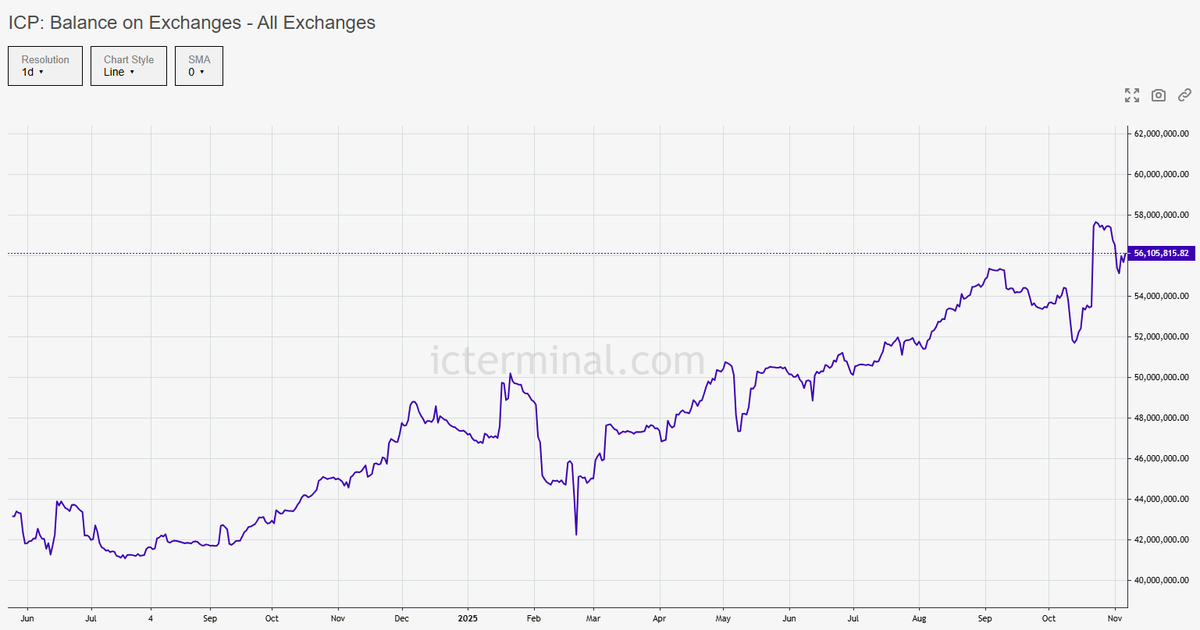
Only 10.3% of the supply is currently circulating on Exchanges📊
As a comparison, the $BTC Supply on Exchanges = 12%
Only 56.1M ICP is currently circulating on Exchanges. The higher the price, the lower the inflation as we pay less ICPs to Node Providers.
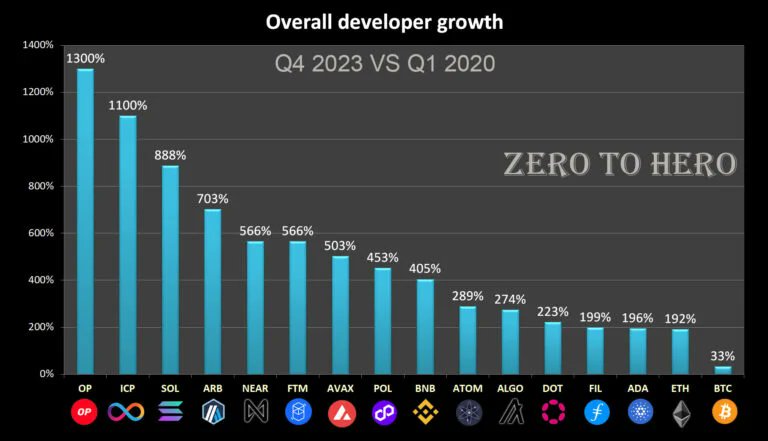
Currently, due to a lot of hype and momentum, ICP became very attractive for new users & developers. With the launch of @caffeineai ☕️the number of new users should dramatically increase.
ICP is more than a Blockchain. $ICP = World Computer♾
Data: @icterminal
This is why $ICP is unstoppable (via @dominic_w)
It processes:
- 300,000 ETH-equivalent transactions/s
- more smart contract compute than ALL other blockchains combined
You're still NOT bullish enough 🔥
🚀 ICP vs NEAR vs Solana vs Avalanche
A quick look at the network performance metrics:
Operational E2E Latency
Performance / Real-time TPS
Max recorded TPS
Average TX fee (Watt-hour per TX)
The data shows how $ICP stands out in efficiency, speed, and low energy consumption compared to other major chains. ⚡💡
Source: Zero To Hero — Watch the full video https://t.co/OpWQzz7iIY🎥
🚨WEB3 falls short if users ownership is limited to tokens only.
Let's Start at the Beginning: WEB1, WEB2, and WEB3
WEB1 was all about "read-only" content. Then came WEB2: "read and write," where users could create and share content, making the internet more interactive and social.
⚠️ But here's the catch: today, a handful of big tech companies control nearly the entire internet, hosting around 80% of it.
They have absolute power over what stays online and how it’s used. Social media giants like Meta, Google, and X don’t just provide services; they track everything users do, mine personal information, and profit from it.
Privacy is practically nonexistent; everything users share is harvested and monetized, with little regard for individual rights.
💡 Don't get me wrong progress requires incentives, and that's understandable. But the reality is, if you're not paying for it, you're not the customer; you're the product being sold.
🔗 WEB3 aims to change the game by adding "ownership" to the mix.
But how do we provide ownership without everyone having to run their own servers, like in the early days of the internet? That model was too demanding, which is why cloud services became popular, they let users pay as they go and scale up when needed, offering better value overall.
🚀 It all started with Bitcoin and its decentralized blockchain model, designed to prevent any single entity from having control while giving users full sovereignty over their digital asset.
For a few years, numerous blockchains emerged, replicating Bitcoin's model in various forms. The next major breakthrough was Ethereum, which introduced smart contracts that enabled coding for tokens and interactions, giving rise to DeFi services and providing a framework that other blockchains adopted.
Essentially, these are token ledger databases with computations limited to token interactions, lacking the capability to store data efficiently or affordably.
✅ Their core purpose is to provide an efficient trustless database that serves as a settlement layer for tokenized assets and they've succeeded.
🔐 The tokenized asset aspect of WEB3 is largely addressed, but what about everything else?
Ledger blockchains are limited to managing tokens and transactions, they're not designed to handle complex computations, store data, or host websites, all of which are essential for user interaction and true data sovereignty.
Storing even small amounts of data is prohibitively expensive. On the most affordable ledger blockchains, storing just 1MB would cost over $1,000, and the cost only rises as token values increase.
😟 How safe do you feel knowing that your preferred dApp is running on centralized cloud, exposed to hacks, malicious employees, and the risk of data being changed, copied, sold, or deleted?
🛠️Did you know that most dApps run 70%-80% of their operations offchain, with only 20%-30% actually on the blockchain?
Onchain components handle token management, transactions, and DeFi smart contracts, while offchain components are responsible for hosting, complex computations, and all non-token/transaction related data.
⚖️ To truly achieve the Web3 vision, users need sovereignty and ownership over their data and computing in a secure, verifiable, and decentralized manner, ensuring that no single entity has control.
🌐 In 2015, Dfinity set out to address this exact challenge.
While most projects were focused on designing blockchains for tokenized assets, Dfinity created something entirely new: a blockchain capable of hosting the entire internet in a decentralized way, building a fully sovereign network independent of big tech services.
#InternetComputer design choices are decoupled from traditional ledger-based blockchains. It is a general-purpose cloud computing blockchain that provides the raw computational power and data availability needed to migrate away from centralized big tech cloud services.
The ledger token aspect represents less than one percent of its overall capabilities.
⚙️ The blockchain's computational power and throughput rely on the underlying hardware.
#ICP nodes are standardized, high-performance enterprise servers costing ~$30K and connected via dual 10GB internet links in independent data centers.
Node providers are required to own the hardware, ensuring the network maintains full sovereignty, ultimately delivering a true decentralized version of the internet.
🚧 This approach stands in stark contrast to traditional ledger blockchains, which are focused on minimizing hardware requirements to allow anyone to run a node, even on decade old hardware.
Some newer blockchains require slightly better, mid-range hardware due to improved consensus mechanisms that boost throughput through parallelization and other advancements.
✨ The amazing part of ICP's design is that not only do smart contracts serve websites directly, but they also have HTTPS capabilities, allowing them to interact seamlessly with WEB2 and other blockchains.
Additionally, they provide native multichain functionality, meaning their smart contracts can directly interact with other blockchains that are already integrated.
🤝 InternetComputer is designed to complement, not replace ledger blockchains, enabling dApps to move away from centralized infrastructure entirely.
⭕️ICP is not a one-size-fits-all solution; there are scenarios where other ledger blockchains are better suited for tokenized assets management.
However, dApps can still leverage ICP for hosting, computation, and data management, combining the strengths of different blockchains for a genuine WEB3 solution.
📜 A defining feature of the new WEB3 cloud internet is its governance model, how changes to the network are proposed, voted on, and implemented.
In this regard, ICP stands out, being fully governed by the NNS #DAO, giving users complete control.
No changes, including adding or removing nodes, can happen without an approved proposal.
The blockchain is fully autonomous, eliminating reliance on node providers for upgrades, as approved proposals automatically trigger code changes.
💰Hosting costs for computation and data are fixed, unaffected by the value of the ICP token.
📖 I highly recommend reading the Signal App founder's post to gain insight into why the WEB3 vision cannot depend solely on ledger blockchains and tokenized assets. https://t.co/MpB1H2Ng3x
☢️The current crypto space is plagued by misleading narratives like AI, DeSci, and SocialFi, running on ledger blockchains as if they were designed for or capable of supporting them.
💊In reality, it's deceptive, with everything offloaded offchain, failing to address the core issues and truly solve the problems at hand.
👉 Spot any flaws in my reasoning? I’d love to hear your thoughts in the comments.
Found this helpful? A like, reshare, and follow @ajki76 would mean a lot! 🤞
#InternetComputer $ICP every blockchain and their grandma, jumps on the world computer narrative, despite lacking the design to support it.
Meanwhile, some were built for it from the ground up.