@DannyDayan5@sidprabhu But you’ve also had treasury yields higher since May and dollar higher. Credit spreads flattish. So what is offsetting that to loosen fci?
@NikLentz The rich people that owned lots of fixed income as we transitioned from zirp to a high(er) rate regime certainly didn’t benefit.
That said I get your point. Risk assets have done well. And agree on those near 3% real yields
@Dr_Gingerballs@DannyDayan5 Where do you show it didn’t tighten credit? Every category in the Fed SLOOS showed meaningful tightening in lending standards. Yields for levered borrowers hit nearly 10% driving a 30-40% reduction in corp issuance in ‘22. It became more expensive and harder to borrow.
@BenKizemchuk Your chart is just showing that treasury yields have risen over the past month. High yield credit spreads are still at very tight levels.
@fkronawitter1 And to add - the multiple on the market is down almost 20% since last oct. Not far from where it bottomed on liberation day.
We’ve cleared out some froth in the past 6mo - crypto, profitless tech, mag7, etc… If the cycle is still in tact, this may have been a healthy reset.
@dampedspring Question is where is the market today on earnings since the P moves faster than the E. We’ve had a sizable correction in the forward p/e since it peaked at 23x last oct (almost 19x now). Not exactly ‘cheap’ historically but starting to bake in some softness.
The forward 12-month P/E ratio for the S&P 500 is 19.9.
This P/E ratio is equal to the 5-year average (19.9) and above the 10-year average (18.9) @FactSet
@toiletkingcap@TXMCtrades@Dcpcooks@BlacklionCTA Not scientifically and I don’t know how this plays out. But just like after liberation day, markets didn’t need the tariffs to go away to look through them, they just needed to reduce the probability of the extreme tail. Think it’s a similar playbook here.
@SereneInvesting@Dcpcooks@toiletkingcap@TXMCtrades@BlacklionCTA A 10% correction (assuming we gap down on Monday) and 30 Vix is serious vol and some pain. Not saying you pile in. But worth thinking about whether investors are doing what they often do - hoping for a dip, then not buying when it comes.
@Dcpcooks@toiletkingcap@TXMCtrades@BlacklionCTA Assume we know for certain oil stabilizes ~$100. Yes, s/t CPI is ugly and Fed prob does nothing. Growth gets hit by a few 10ths. In that scenario do stocks drop another 10% or do we look through it? I’d bet the latter.
We can handle an oil shock. Just not this uncertainty.
@toiletkingcap@TXMCtrades@Dcpcooks@BlacklionCTA Not scientifically and I don’t know how this plays out. But just like after liberation day, markets didn’t need the tariffs to go away to look through them, they just needed to reduce the probability of the extreme tail. Think it’s a similar playbook here.
@TXMCtrades@Dcpcooks@BlacklionCTA@toiletkingcap I think you buy. A gap down likely brings this to ~10% correction. Think the 1-3mo risk/reward starts to become pretty good there weighing the various scenarios. Surprised by the extent of the negativity on here… and I’m typically glass half empty
@DannyDayan5@yieldsearcher Agreed. A few cracks here and there to pay attention to. But overall still very tight spreads in the grand scheme of things. Even CCCs no where near where they would be trading if they were saying ‘recession.’
@yieldsearcher I think it’s partly risk management, partly income, and partly relative returns. The few times 10s got into the high 4s, I was buying fixed income with long term money, not as a recession hedge but b/c I’m pessimistic on long-term stock returns at these valuations.
@kurtknapp Also for the love of everything holy please stop comparing the U.S. to Singapore. Singapore has a massive positive NIIP. If you don't understand what that means and how the U.S. situation is different you need to do more work on this topic.
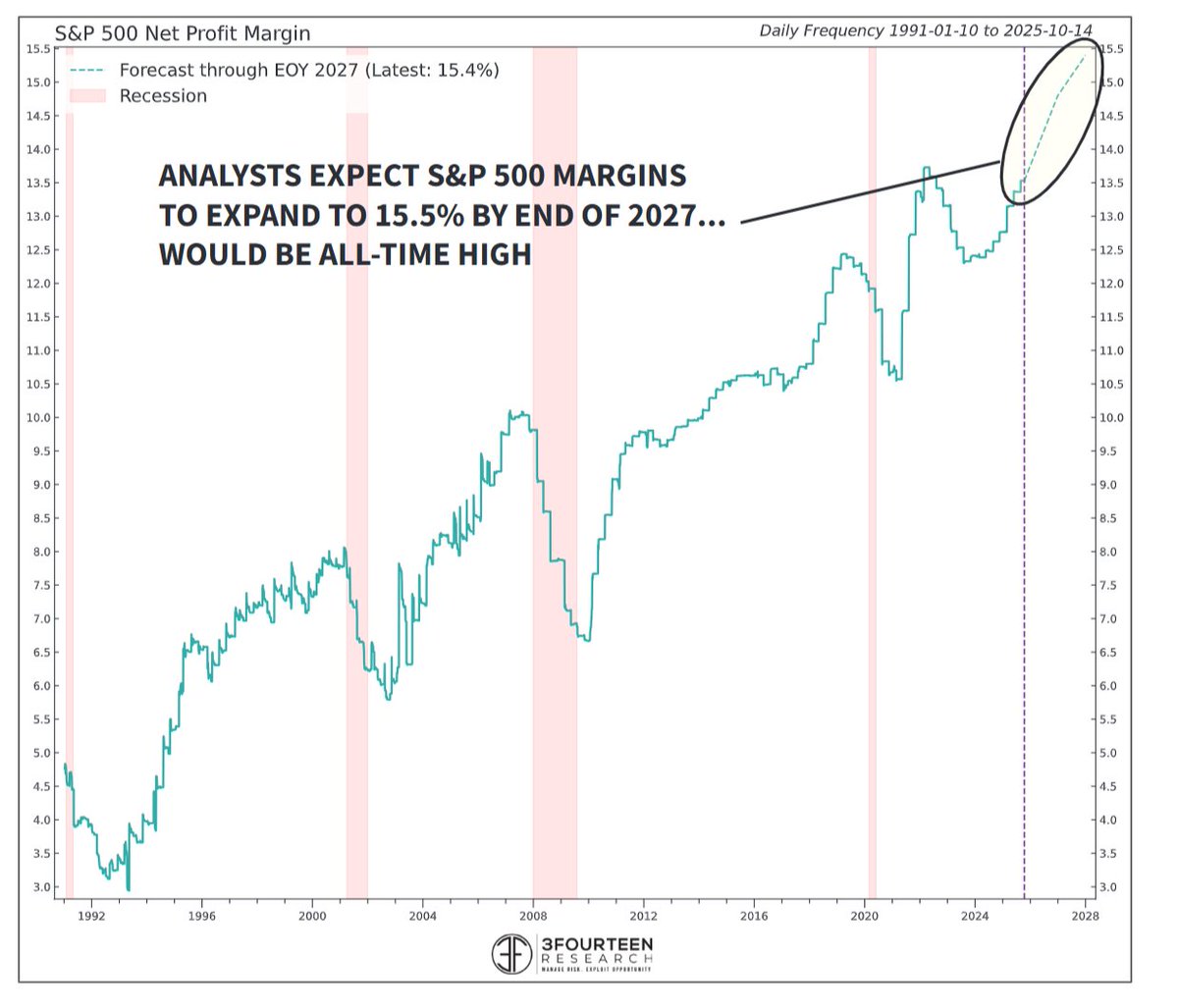
Warren makes a good point. But another way you could phrase it is current multiples are baking in the expectation that record margins rocket even higher (a productivity boom). If that doesn’t happen, then you are left with peak multiples and peak margins.
S&P 500
Is the market overvalued or in a bubble? Contrary to consensus - no.
If analysts are correct and margins expand to 15.5% by 2027 (+180 bps), then multiples remain more likely to expand than contract.
Less cyclical index composition + higher margins = rising multiples.