This week will be a busy one for economic data, Fed speeches and, likely, further clarity (🫠) on the status of the Clarity Act.
Top things to watch:
📌CPI & PPI: Fresh inflation data that could shape expectations for the Fed’s next interest rate decision.
📌Fed Chair Kevin Warsh delivers the semiannual monetary policy report to Congress, and will likely be quizzed by lawmakers on a variety of topics relating to the Fed. Other speeches are expected from Michelle Bowman, Chris Waller, Michael Barr, Lisa Cook and several regional Fed presidents.
📌An updated version of the Clarity Act that merges the Senate Banking and Senate Agriculture Committee texts. While stakeholders are anticipating text, some industry sources tell me key provisions are still being “actively negotiated” and that an ethics deal is “not done.” It’s unclear, as of now, what that means for the timing of a Senate floor vote, which many are hoping could be scheduled as soon as the week of the 20th.
SWIFT confirms 17 banks are now preparing to pilot crypto style cross-border payments. The pilots will use tokenized deposits on Swift’s new blockchain ledger, allowing banks to move funds 24/7. Banks include: ANZ, BNP Paribas, BNY, Citi, DBS, First Abu Dhabi Bank (FAB), FirstRand Bank Limited, HSBC, Itaú Unibanco, Lloyds Bank, Mashreq, MUFG Bank, OCBC, Standard Chartered, UBS, UOB, and Wells Fargo. Swift says its infrastructure moves the equivalent of world GDP every 2 to 3 days across 200+ markets 🌊
🏆 RANK THESE ALTCOINS:
Best Hold → Worst Hold
kaspa:native
canton-network:native
ethereum:0xfaba6f8e4a5e8ab82f62fe7c39859fa577269be3
hyperliquid:native
zcash:native
Drop your full order in the comments 👇
RT to get more opinions in here.
🥳BIG NEWS For KASPA: Tocatta Is Live Tomorrow!
I will Give 1 Lucky winner 1 $KAS for every like this post gets in the next 24 Hours! Winner announced on tomorrows Live Show (3 PM EST).
Will double to 2 $KAS if the winner Follows me and shared this post!
Food for thought.
Trump, Hormuz and the End of the Free Ride
For half a century, Western strategists have known that the Strait of Hormuz is the acute point where energy, sea power and political will intersect. That knowledge is not in dispute. What is new in this war with Iran is that the United States, under Donald Trump, has chosen not to rush to “solve” the problem. In Hegelian terms, he is refusing an easy synthesis in order to force the underlying contradiction to the surface.
The old thesis was simple: the US guarantees open sea lanes in the Gulf, and everyone else structures their economies and politics around that free insurance. Europe and the UK embraced ambitious green policies, ran down hard‑power capabilities and lectured Washington on multilateral virtue, secure in the assumption that American carriers would always appear off Hormuz. The political class behaved as if the American security guarantee were a law of nature, not a contingent choice. Their conduct today is closer to Chamberlain than Churchill: temporising, issuing statements, hoping the storm will pass without a fundamental reordering of their responsibilities.
Trump’s antithesis is to withhold the automatic guarantee at the moment of maximum stress. Militarily, the US can break Iran’s residual ability to contest the Strait; that is not the binding constraint. The point is to delay that act. By allowing a closure or semi‑closure to bite, Trump ensures that the immediate pain is concentrated in exactly the jurisdictions that have most conspicuously free‑ridden on US power: the EU and the UK. Their industries, consumers and energy‑transition assumptions are exposed.
In that context, his reported blunt message to European and British leaders, you need the oil out of the Strait more than we do; why don’t you go and take it? Is not a throwaway line. It is the verbalisation of the antithesis. It openly reverses the traditional presumption that America will carry the burden while its allies emote from the sidelines.
In this dialectic, the prize is not simply the reopening of a chokepoint. The prize is a reordered system in which the United States effectively arbitrages and controls the global flow of oil. A world in which US‑aligned production in the Americas plus a discretionary capability to secure,or not secure, Hormuz places Washington at the centre of the hydrocarbon chessboard. For that strategic end, a rapid restoration of the old status quo would be counterproductive.
A quick, surgical “fix” of Hormuz would short‑circuit the dialectic. If Trump rapidly crushed Iran’s remaining coastal capabilities, swept the mines and escorted tankers back through the Strait, Europe and the UK would heave a sigh of relief and return to business as usual: underfunded militaries, maximalist green posturing and performative disdain for US power, all underwritten by that same power. The contradiction between their dependence and their posture would remain latent.
By declining to supply the synthesis on demand, and by explicitly telling London and Brussels to “go and take it” themselves, Trump forces a reckoning. European and British leaders must confront the fact that their energy systems, their industrial bases and their geopolitical sermons all rest on an American hard‑power foundation they neither finance nor politically respect. The longer the contradiction is allowed to unfold, the stronger the eventual synthesis can be: a new order in which access to secure flows, Hormuz, Venezuela and beyond, is explicitly conditional on real contributions, not assumed as a right.
In that sense, the delay in “taking” the Strait, and the challenge issued to US allies to do it themselves, is not indecision. It is the negative moment Hegel insisted was necessary for history to move. Only by withholding the old guarantee, and by saying so out loud to those who depended on it, can Trump hope to end the free ride.
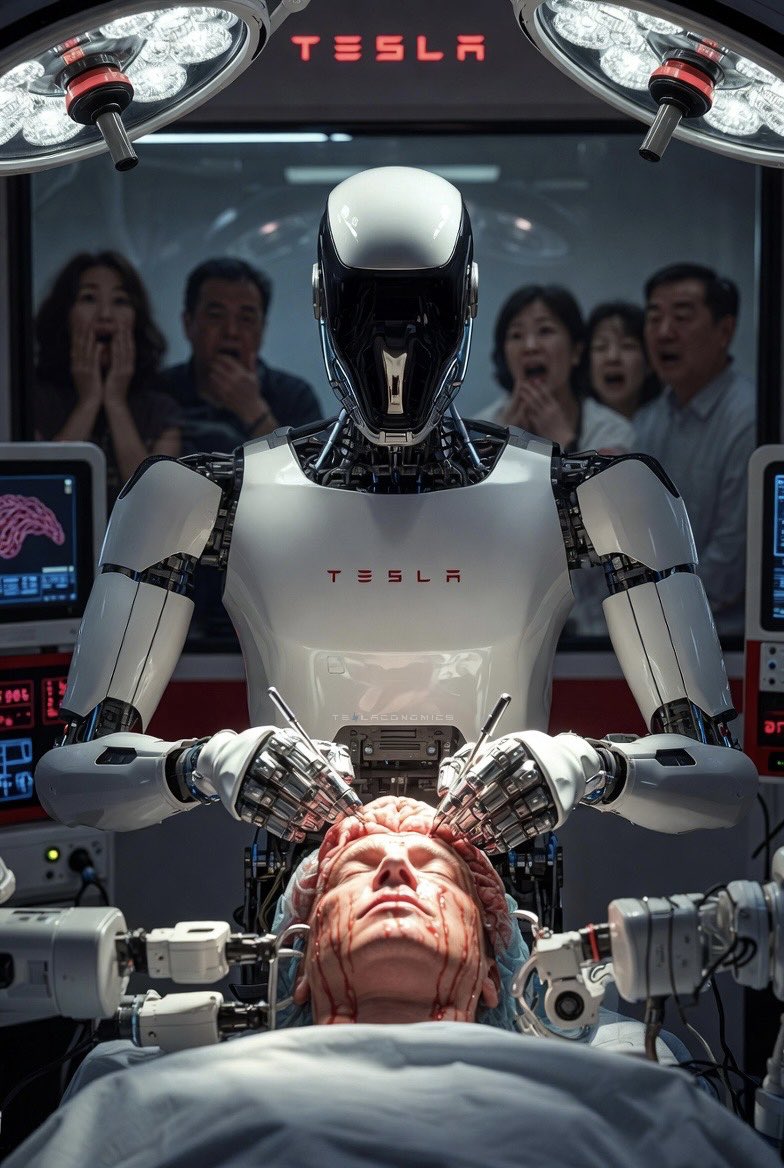
Elon Musk predicts that Tesla Optimus robots will surpass today's best human surgeons within 3-4 years at scale.
“There will probably be more Optimus robots that are great surgeons than there are all surgeons on Earth. I'm not absolutely certain, but if you say four years, I'd be absolutely certain.”
All Elon Musk’s companies are headed toward convergence
Charles Hoskinson: "Like when you look at Elon Musk, he seems like insane and chaotic from the outside. But when you integrate things together, you start realizing there's a cohesive picture behind all of his startups. Like why does he have the boring company? That doesn't make any sense
He's drilling all these tunnels underground. Like why would he do that? Well, if he wants to go to Mars, humans aren't going to live on the surface of Mars. They're going to live underground. So, you're going to have to build massive tunnel complexes underground to be able to go through.
Well, why does he have a solar company? Why does that make any sense? Well, you know, he's going to have to be pretty good at building power plants, right? So, why don't you build large solar fields? Cuz there's no real estate problems on Mars, so you can build like a m solar solar field on Mars if he wanted to, right?
Um why is he building a robotics company? You know, why why does he have all these Tesla bots and these types of things?
Well, he has all those Tesla bots because, you know, where's your workforce? If you're on Mars, you're not going to have million humans show up overnight, but you can ship millions of robots ahead of time and use them as your labor force to help build up everything. And they don't need atmosphere or any of these other things.
Why does he have an AI company? Well, you need some sort of intelligence to coordinate and run and terraform the planet and do all these things.
Why does he need a battery powered car company? Cuz you're not going to be running internal combustion engines. There's no fossil fuels to consume on Mars. So you need battery power cars to be able to drive them around.
So it's it's actually coherent when you see that entire framework. Makes so much sense. I'm so smart and he's just got like this pure force of will. So you know he's just doing it and just having fun doing it. But if you look at it from the outside like everything looks like chaotic and crazy"
Source: @ShawnRyanShow, @IOHK_Charles
In my opinion, there should be the least amount of government
• Paying people to do nothing doesn’t make sense
• Jobs aren’t valuable just because they exist
• You want people working on things that are productive
• People should be building things and providing real products and services
• Creating jobs for the sake of jobs is not the goal...
- Elon Musk
🚨ELON: GROK WILL BE INCREDIBLE FOR MEDICINE
“Right now, you can actually upload a PET scan and ask Grok to analyze the PET scan for you.
You can compare that to what a doctor tells you and see what the difference is.
You can literally upload your image to Grok, and it will analyze your MRI, your PET scan, whatever the case may be, and tell you what it thinks the probable issue is.
So I think it'd be really helpful to medical professionals and to individuals.
I think there's a lot of amazing potential.”
Source: Town Hall in Philadelphia, Pennsylvania, October 2024
I think I get what Elon means when he says Tesla Optimus will end poverty.
It’s all about ending artificial scarcity.
For all of history, access determined everything.
If you were wealthy, you had the best doctors, tutors, skilled labor, more time, and opportunity.
If you were poor, you didn’t and one bad event could put you into lifelong trouble or debt.
Optimus is going to change this.
When a Tesla Bot can do things that once required years of training and massive cost like surgery, caregiving, construction, education, or daily labor, it levels the playing field by raising access.
Everyone deserves access to the tools needed to live with proper healthcare, safety, mobility, productivity, and time. I’m not saying life should be fair, it never will be imo, but I’m saying Optimus will give everyone a fair chance, a fair opportunity at things that they could never have. Optimus is going to give every human the leverage that only the wealthy used to have. For example, procedures like brain surgery can literally bankrupt families for life, but in the future, they won’t have to. There won’t be much consideration to $ cost in the future, it will be more about whether we want it or whether it’s the right thing to do. And there are countless other examples we can easily think of.
This product is going to cost $20-$30K in the long run. Everyone will be able to buy one. Everyone will have access to the skills Optimus can do. This is going to be the best product to ever be created. This is what’s going to make Tesla a $10T+ company.
This is how poverty actually ends.
Yeah… I get it now.
$PLUME is now live on Binance Pay, powered by @binance
You can now send $PLUME payments to more than 45M users with instant, gas-free transfers.
To celebrate, we’re giving away up to 3,000 $PLUME to first-time Binance Pay users ⤵️
THE COMMUNITY-FIRST TOKEN LAUNCH OF SYND IS HERE.
SYND will be the first ever Community-First Token Launch on @aeroxyz on @base now integrated with @coinbase—a radically open, transparent, and decentralized model that puts the community at the center from day one.
↓
Today, we're proud to announce that Syndicate Network is one of the FIRST decentralized networks to be built and launched in AMERICA—formed under a Wyoming-based DUNA with no offshore entities.
This is a major step forward for the crypto industry and U.S. 🇺🇸
Learn more ↓
First there were smart contracts. Then smart wallets.
Today, Syndicate is introducing Smart Rollups with Smart Sequencers––the next major leap forward in crypto infrastructure.
↓
Pharos Network is now live on Layer3.
Learn about @pharos_network, the fastest EVM L1 for RWAs and TradFi and experience the testnet exclusively on Layer3.
Start here: https://t.co/PhbdU70jRf