10 reasons @QANplatform is the quantum-resistant L1 worth watching.
1️⃣ Any programming language: QVM opens blockchain development to 20M+ programmers
2️⃣ Quantum-resistant from genesis: CRYSTALS-Dilithium (NIST-approved ML-DSA) built in
3️⃣ QAN XLINK: cross-signer protocol ensures 100% migration path when quantum attacks hit ECDSA
4️⃣ Harvest now, decrypt later: every ECDSA public key exposed onchain today is a future attack vector, QAN eliminates this
5️⃣ Audited core tech: QVM audited by Hacken (2025), XLINK audited, integration audit ongoing
6️⃣ EVM compatible: existing Ethereum DApps, DeFi, NFTs can migrate without rebuilding from scratch
7️⃣ Developer rewards: first L1 that pays developers lifetime royalties when their smart contract code gets reused
8️⃣ 5-minute cloud deployment: deploy QAN blockchain to AWS, Azure, GCP in under 5 minutes
9️⃣ Ethereum rebase: QVM core logic being ported to Ethereum infrastructure (~70% complete)
🔟 $21M mcap, mainnet 2026: audited, testnet live, CTO publicly committed
The title insurance story says it better than any whitepaper. A property signed onchain in 2022 with ECDSA could have two mathematically valid owners by 2030.
QAN signed its first block assuming ECDSA wouldn't hold. Most chains didn't. $QANX
Important Update
Our Co-Founder & CTO has released an open letter addressing community feedback and reinforcing our commitment to the MainNet launch this year.
https://t.co/G32Kbilx4P
Quantum-safe readiness has a score.
IBM’s Quantum‑Safe Readiness Index (QSRI) gives a shared language: scores, activities, phases to discuss quantum‑safe readiness with boards, regulators and partners.
Once quantum computers reach sufficient scale and stability, many of today’s widely deployed encryption schemes can be broken, and that’s a problem because cryptography underpins everything from payment rails and core banking to smart contracts and cross‑chain bridges. Governments have already moved: NIST’s 2024 PQC standards are now the de facto reference for quantum‑resistant algorithms, with the UK, Europe and multiple Asia‑Pacific countries building national PQC migration plans around them.
QSRI itself is built on 14 activities across three areas: quantum‑safe discovery, observability and transformation combined into a 100‑point index that can be re‑assessed over time for organizations, industries and regions.
The 2025 results show discovery and observability improving faster than transformation, which means many players are still just mapping where cryptography lives instead of fully rebuilding for a quantum‑safe world.
QSRI puts the 2025 global average at 25/100, only a modest rise from 21 in 2023, while the top 10% quantum‑safe champions are already scoring 35–50.
IBM warns that quantum computers capable of breaking today’s encryption may show up five to six years before most organizations finish that migration.
For blockchains and Web3, this isn’t just about swapping algorithms; it’s about treating post‑quantum cryptography and quantum‑safe design as core to how chains are built, upgraded and governed.
https://t.co/8oLrd0fp2Z
🔐⏰ France starts the timer and sets it to 2027.
Thales (a global high-tech leader in defense, aerospace, and cyber & digital) and CEA (a public research body) just wrapped up GIVERNY, a groundbreaking joint assessment of HAWK and FAEST post-quantum algorithm implementations.
Their security analysis? They discovered vulnerabilities not yet disclosed to the scientific community and tested the strength of existing countermeasures.
But here's the real headline: France's ANSSI (France’s national cybersecurity authority) isn't waiting anymore. Products on the market after 2030 must be quantum-safe. For sensitive systems seeking qualification? That deadline is 2027.
Across Europe, the EU's coordinated roadmap mirrors this urgency: critical infrastructure quantum-ready by 2030.
The US (via NIST), UK, Canada, Australia, Germany, Japan: they've all published timelines. They're all aligned. This isn't debate anymore, it's momentum.
For enterprise leaders and developers: if your cryptographic stack still runs on classical algorithms in 2030, you're already behind. Not by months. By regulatory cycles. By trust cycles.
The organizations that transition now own the narrative. The ones that don't? They inherit the risk.
Our Co-Founder & CTO, Johann Polecsak, is gearing up for his panel discussion with Gert Jan van Hardeveld from Europol titled “From Detection to Prevention: Advancing Cybersecurity and Fraud Controls” at the Blockchain for Europe Summit.
The Summit is organized by Blockchain for Europe, a leading association advocating for the adoption of blockchain technology across the European Union.
Be quick to register if you'd like to attend in person, admission is free!
Alternatively, you can join the live discussion online on December 3rd, streaming directly from Sparks in Brussels.
You can register via Blockchain for Europe’s website.https://t.co/7JxckL5NOr
INSIGHT: A new audit by Hacken validated @QANplatform’s post-quantum signature tool, confirming it can help blockchains prepare for future quantum threats.
Will more networks begin adopting quantum-ready security?
[Brought to you by @QANplatform]
We are excited to announce a major step towards our quantum-safe MainNet!
After our QAN Virtual Machine (QVM) , yet another core element of our post-quantum blockchain has proven itself: QAN XLINK, our cross-signer protocol that makes QANplatform quantum-safe, has successfully passed an in-depth security audit by the renowned blockchain security firm Hacken (@hackenclub).
Dive into the details to learn about QAN XLINK!
https://t.co/v0aAwkSnz8
Enterprise adoption without privacy is impossible. The Web3 space has long been insisting on transparency. However, every business, even small ones, holds internal data that is not meant to be shared publicly.
Privacy blockchain tech isn't just about moving funds in an untraceable way. It's also about privately storing business-critical data on a mathematically tamper proof infrastructure.
At @QANplatform we understood early on that institutions wouldn't adopt blockchain tech without the ability to store their data privately.
That's why we built the QAN Enterprise Blockchain: a private and a secure way to leverage blockchain technology while keeping your privacy as an enterprise.
Bitcoin, Ethereum, Solana, and most of the L1/L2s use elliptic curve cryptography to verify that transactions came from the owner without revealing the private key. When sufficiently powerful and fault-tolerant quantum computers arrive, they will be able to use Shor's algorithm to reverse the math and derive private keys from public keys. This means that malicious actors will gain full access to the account.
When?
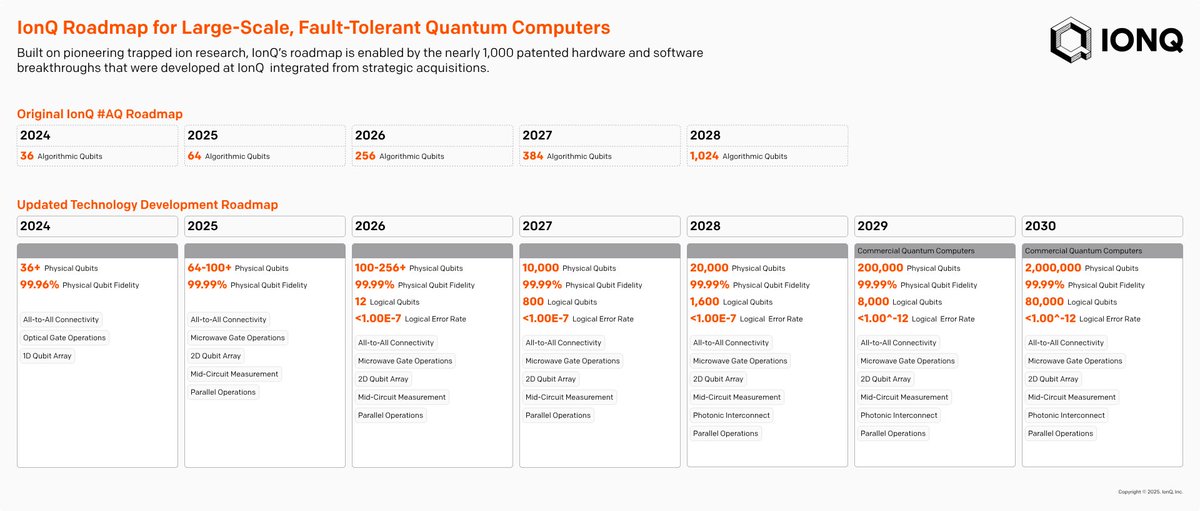
According to @IonQ_Inc's public roadmap, by 2028 they aim to ship a quantum computer that will likely be able to break ECC. By 2029, they plan to release a commercial quantum computer with significantly more logical qubits than what's required to break ECC. The worrying part is that it will be available to the public.
The clock is ticking. We are about to enter the era when quantum innovation goes parabolic.
https://t.co/fOZ0p9GgNM
🖥️ Last week, Quantinuum delivered Helios, the world’s most accurate commercial quantum computer with 98 fully connected barium ion qubits and gate fidelities near perfection: 99.9975% for single-qubit and 99.921% for two-qubit operations. This machine doesn’t just inch toward quantum advantage, it leaps forward, achieving complex simulations that classical supercomputers could only match with the energy of every star in the universe, while Helios uses the power of a single data center rack.
With unprecedented capability across its full stack, Helios is the most powerful quantum computer in the world.
Built on advanced ion trap technology using barium ions instead of traditional ytterbium, Helios benefits from more stable, visible-spectrum lasers, allowing it to detect and remove error leakage at the atomic level, supercharging reliability. It features a first-of-its-kind “junction” that routes qubits like traffic through a city grid, enabling parallel operations that speed up processing and minimize errors.
Beyond raw power, Helios introduces dynamic quantum programs with Guppy, a new programming language enabling real-time feedback and seamless integration with classical computing. This combination paves the way for scalable, fault-tolerant quantum computing.
Even before its public debut, Helios had demonstrated its capabilities as the world’s first enterprise-grade quantum computer, with select partners including SoftBank Corp. and JPMorgan Chase conducting commercially relevant research during a two-month early access program. Helios is now accessible to all customers through Quantinuum’s cloud service and on-premise options, including integration with NVIDIA GB200 for targeted market applications.
As these advances push quantum technology beyond the reach of classical simulation, they accelerate the approach of Q-Day, the point when quantum computers will be powerful enough to break cryptographic protections underpinning cryptocurrencies and blockchains. Helios represents a major milestone on this path, underscoring the urgency for quantum-safe cryptography and resilient blockchain designs.
The XLINK audit process has reached its final stage. The technical part is completed, and we’re happy with the results. The marketing teams are now preparing to publish the news together with Hacken. Stay tuned!


![Cointelegraph's tweet photo. INSIGHT: A new audit by Hacken validated @QANplatform’s post-quantum signature tool, confirming it can help blockchains prepare for future quantum threats.
Will more networks begin adopting quantum-ready security?
[Brought to you by @QANplatform] https://t.co/xFUKHY2tcU](https://pbs.twimg.com/media/G6NqV3CXcAAPsu4.png)