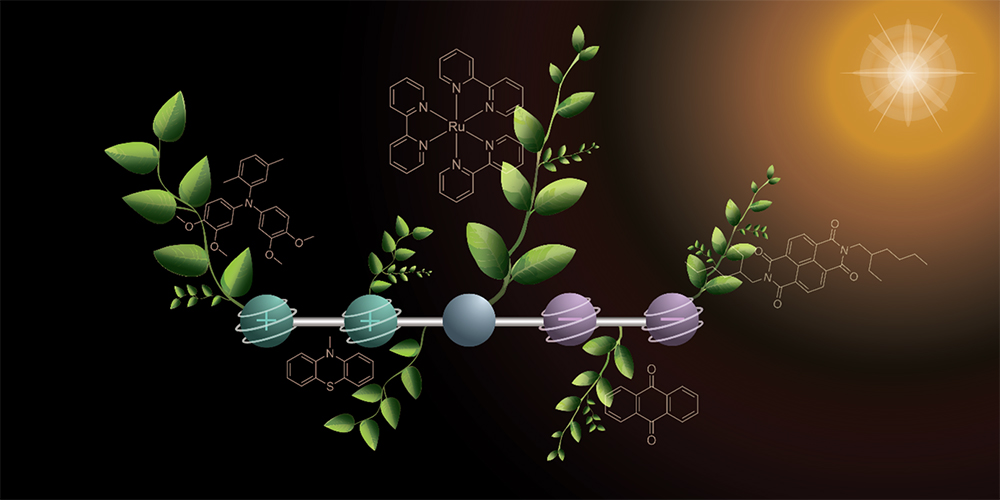
New molecular design absorbs 2 photons to store 2 positive and 2 negative charges
100 ns lifetime, 3 eV energy storage, and 37% quantum yield
A step toward multi-electron photochemistry
Mathis Brändlin and @BjornPfund in @NatureChemistry
https://t.co/CwtRDeoRY3
Artificial photosystems where light-harvesting antenna, exciton transport, and photocatalysis all function in singlet manifold. While @SreehariSR4@bapan__saha led establishing the mechanism, REU and UGs made a laudable contribution in expanding the scope.
https://t.co/xPAOdbusZg
Molecular Nanographenes, Multilayers, and Beyond: My PhD Journey on C64 Nanographene Tetraimide.🧵
1/ Graphene is a single, flat layer of carbon atoms. Nanographenes are miniature fragments of graphene, known for over a century to chemists as polycyclic aromatic hydrocarbons.
I have a really good PhD student graduating this Fall who is looking for a postdoc. Let me know if anyone has an opportunity. He has worked on a variety of supramolecular systems, some PAH stuff, and library synthesis of chlamydia inhibitors. Can do the org. synthesis needed.
The Historical Development of the Concepts Underlying the Design and Construction of Targeted Coordination Polymers/MOFs: A Personal Account https://t.co/FMJEQjeZUQ
It is with profound sadness that IOCB Prague announces the sudden passing of Prof. Josef Michl, a globally esteemed Czech chemist, on Monday, 13 May, at the age of 85. Prof. Michl led research groups at @IOCBPrague and @CUBoulder.
"He was one of the few true geniuses I have had the honor to meet," says Prof. @konvalinka_jan, director of IOCB Prague. "He mastered several world languages, had extensive knowledge of history and culture, and a deep understanding of the natural sciences. The science he did was not only brilliant but also beautiful, playful, and witty. Besides that, and above all, he was a kind and generous man. We will miss him dearly."
Dr. Zdeněk Havlas, Vice President of the @CzechAcademy and a long-time friend and colleague of Josef Michl, responded to the news of his passing: "The passing of Prof. Michl is a great loss both professionally and personally. He knew everything there was to know about chemistry and science in general. It was a joy to discuss with him. For the past 20 years, I traveled to Boulder annually for a month, not because of a lack of computing technology, but for discussions about work and life in general. This often took place while enjoying a plum cake, which he loved and which I baked for him at their home."
Prof. Josef Michl, Ph.D. (12 March 1939 in Prague – 13 May 2024 in Prague), was a distinguished figure in the field of chemistry with an extremely wide range of professional interests in which he achieved significant results and worldwide renown. He excelled as both a theoretician and an experimentalist, devoted, among other things, to macromolecular chemistry, photochemistry, molecular electronics, research towards the development of efficient solar cells, and the creation of molecular "building blocks" enabling, for example, the creation of nanorotors and nanomotors.
Josef Michl studied chemistry at @science_charles and completed his dissertation under the supervision of quantum chemist Rudolf Zahradník at the Institute of Physical Chemistry of the Czechoslovak Academy of Sciences. He earned his doctorate in 1965 and subsequently worked at the Universities of Houston and Austin. After a brief return to Czechoslovakia, he attended a summer school in quantum chemistry in Norway in 1968, from which he did not return following the Warsaw Pact invasion of Czechoslovakia in August 1968. He then served as an assistant professor in Denmark before moving to the United States, where he held positions at the University of Utah in Salt Lake City and the University of Texas at Austin. In 1991, he joined the University of Colorado at Boulder, where he led a research group until his death. From 2006, he also worked at IOCB Prague, where he received the prestigious ERC Advanced Grant in 2009.
In 1986, he was elected to @theNASciences, and in 1988, he became a member of the International Academy of Quantum Molecular Science and served as its president from 2012 to 2018. In 1995, he became a member of the Learned Society of the Czech Republic @ucena_spol. In 1999, he was elected to @americanacad. He authored over 600 scientific papers, several books, and numerous patents.
Throughout his illustrious career, Josef Michl received many prestigious awards, including the Alexander von Humboldt Award (1980), the Schrödinger Medal (1993), the Hammond Award (2015), the Neuron Award for Contribution to World Science (2016), the Medal of the Learned Society of the Czech Republic for Merit in the Development of Science (2019), and others. He also received honorary doctorates from @Georgetown University, @UniPardubice, and @MasarykUni.
https://t.co/lDqEje84lf
an old observation, now probed, explains why some MOFs can be a good photocatalyst. NU-1000 that had fast (multi-linker) exciton displacement ability can also have CT state without any foreign redox unit. good work by @SreehariSR4 Chris Fry @bapan__saha@riyark2017
Chandrayaan-3 Mission:
'India🇮🇳,
I reached my destination
and you too!'
: Chandrayaan-3
Chandrayaan-3 has successfully
soft-landed on the moon 🌖!.
Congratulations, India🇮🇳!
#Chandrayaan_3#Ch3
for common organic linker-based MOF, forming triplet is tough until E(S1) ≲2E(T1) due to poor ISC between delocalized S1 and localized T1. but possible in E(S1) ≳2E(T1) through SF via electron super-exchange. by @SreehariSR4, @JieruiY, ANL folks, n @dgomez_gualdron
It was a pleasure to participate in this research with this great team! I’m really happy to share the results published on @J_A_C_S of the work lead by @PDeria1 at @Deria_Lab and where I had the chance to participate with @dgomez_gualdron
https://t.co/TzvT2AxgzA
Feeling blessed! Going through the process learned a lot! years of hard work spearheaded by @SreehariSR4 and @JieruiY with great contribution from @dgomez_gualdron, folks at ANL (CNM and APS), and @Dawn_JDuan