Long term investor taking short term gains. Focussing on medium term Growth stocks with capital appreciation. Risk free dividend too.
FYIO,not financial advice.
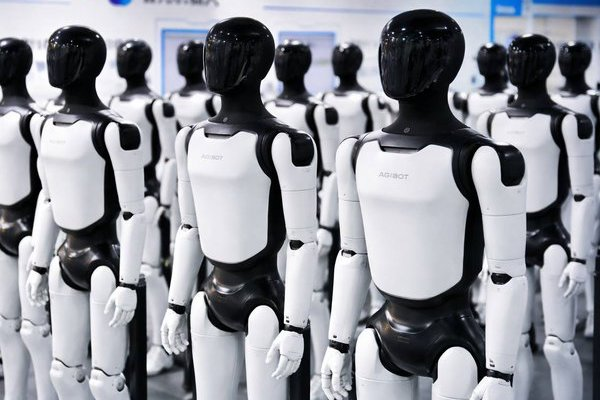
$MU CEO said humanoid robots carry 10x more memory than the average L2+ vehicle setting up what Micron expects to be a substantial multi-decade demand cycle later this decade.
Micron also expects L2+ and above vehicles to exceed 40% of the vehicle mix by 2030.
I believe that these 10 stocks will outperform the market over the next 5 years:
1. $AMZN - Amazon
Q1 revenue $181.5B (+17% YoY). AWS hit $37.6B in revenue growing 28% YoY - the fastest growth in 15 quarters. AI run rate within AWS now exceeds $15B and is scaling faster than AWS itself did in its early years. The infrastructure backbone of the internet and now AI.
$AMZN $MU
First of all $AMZN is bottoming out and building a base at the 200DMA, prob $245 - $250 this week or next
Secondly, I love Micron and said HBM will be explosive for them at $130. The fact is the insatiable demand for Micron from CAPEX like AMZN is because there’s that much or more demand from customers for AI related products via AWS
Micron benefits from this CAPEX cycle and Amazon benefits from the demand immediately (back log) and beyond from customers
Micron margins coming down in the future and Amazon margins going up in the future
Also both can win, it’s not one has to lose for the other to win, I own both
$MU ABSOLUTELY CRUSHED THEIR EARNINGS
• Revenue $41.5B vs Est. $35.5B
• EPS $25.11 vs Est. $20.39
• Net Income $33.7B vs Est. $23.9B
• Gross Margin 85% vs Est. 82%
Q4 Guide
• Revenue $50B vs Est. $43B
• EPS $31.00 vs Est. $25.07
• Gross Margin 85% vs Est. 84%
@baldguymoney Mr Bald Guy, thanks for your continued coverage on precious metals. I am of the same view as you - "this is new money".
Can you please throw in some mining ETFs? Which of these you like currently?
$GDX $GDXJ $SGDM $SGDJ $SIL $SILJ
$MSFT announces it’s adding 2 GW compute capacity, and the stock gets hammered, but when a neocloud announces new capacity, it skyrockets.
The market acts like hyperscaler compute capex will have negative ROI but neoclouds will somehow have it positive.
This is nonsensical.
The whole reason neoclouds exist is that they are willing to take fleet ownership risk and ramp capacity faster. They mark up their compute and sell it to hyperscalers.
If this is the case, hyperscalers can also mark up their compute enough to generate ROI. After all, it’s the capacity crunch that gives neoclouds some pricing power. This power should be elevated at the hyperscaler level because them leasing neocloud compute also shrinks supply further and leaves no alternative for AI workloads to fall back on.
Long $MSFT
$MSFT CEO Satya Nadella warned that the AI race cannot become a world where a few companies control the learning, labor disruption & power needed to build data centers.
Microsoft is pushing cheaper models & Copilot agents to lower costs & reduce dependence on frontier labs.
How does $MSFT valuation make sense?
Here is a quick back-of-the-envelope valuation:
It’s set to generate $145 billion net income in FY 2027. Capitalising it using cost of equity of 8.5% gives us nearly $1.8 trillion steady-state value for the current business.
Current valuation is at $2.8 trillion, this means that the market gives it $1 trillion valuation for all future growth.
What’s that growth we are talking about? The management projects to add around $700 billion cloud revenue alone by 2035.
So, the market is basically valuing at least $700 billion recurring revenue from 2035 at just $1 trillion now.
Assuming same cost of equity, steady state value of that incremental revenue will be $8 trillion in 2035. Use 10% annual discount rate and its current value is $3 trillion.
Adding on the current steady-state value to this gives us at least $4.8 trillion valuation for $MSFT.
Current valuation implies 42% discount.
One of the most obvious longs in the market.
$MSFT is now at 20x forward earnings.
It’s never been cheaper since 2016 in terms of both forward P/E and PEG.
Management expects annual revenue to surpass $500 billion by 2030.
Microsoft Office is going nowhere as it’s more than a software, it’s the communication medium. Windows revenues will remain intact as well.
On top of that we get the second largest (and possibly the largest by then) cloud business.
All at 20x forward earnings.
Why wouldn’t this work well from here?
$MSFT stock is back at 2023 levels
Here is my 5 year base case:
- 5y CAGR 16% (vs 3Y adj. EPS CAGR 21%)
- P/E of 26x
That gives us:
- Stock price $917 (vs current $367)
- Total return 150% (20.1% annualized)
Not counting dividends of 1% per year or buybacks
$MSFT is a strong buy for me
Everyone selling while some of the best businesses in the world are trading at lower forward PE than the S&P500
1) Microsoft $MSFT
Owns 27% of OpenAI, second largest cloud player in the world, biggest enterprise software player in the world, biggest cyber security player in the world, second biggest CPU player in the world, one of the best cost for performance inference chips in the world. All trading for less than the average company in the Nasdaq-100
$MSFT completed its first Wisconsin datacenter bringing online what it calls the world’s most powerful AI supercomputer.
The company expects to spend $4.7B in Wisconsin through 2028 with a second datacenter already under construction.