𝐈𝐧𝐭𝐞𝐫𝐯𝐢𝐞𝐰𝐞𝐫: “𝐖𝐡𝐲 𝐝𝐢𝐝 𝐲𝐨𝐮 𝐥𝐞𝐚𝐯𝐞 𝐲𝐨𝐮𝐫 𝐥𝐚𝐬𝐭 𝐣𝐨𝐛?”
It might look like an easy question, but believe it or not, over 75% of people answer it wrongly. Here are 6 simple examples you can use:
1. Salary reasons
"I have made the most of my job at [company] and successfully achieved the objectives I set. Now I need a new challenge to expand my skills and to enjoy the rewards that come with more responsibility."
2. Job description changed
"I was hired for a specific position, but over time, that has changed significantly, and I no longer get the opportunity to use the skills that I was hired for or do the work that I am best equipped for. My abilities are matched to the requirements of this job."
3. Company is struggling financially
"I have valued my time at [company]. Unfortunately, the company is currently cutting costs, and some members of my department were let go. I can't see any prospects within the organization. So I think it's the right time to move on."
4. Opportunity for professional growth
"I feel I have reached the ceiling in my current job, and I am eager for a fresh challenge. This job appeals to me because I will be dealing __ and developing my __ skills."
5. Structural changes
"I have valued my time at [company] and am proud of my accomplishments there, but we are undergoing structural changes and many of my projects have been canceled. The recent organizational changes have limited future advancement opportunities."
6. Changing goals
"I have re-evaluated my career goals and I am determined to find a position that better fits with my long-term objectives and where I can contribute to the best of my ability. This job opportunity will allow me to develop my __ skills while using my __ experience."
No interview invitation in the last 5 weeks?
Let’s help you fix that CV and get you noticed. Email your CV to [email protected] with subject 'Revamp'.
I requested Hon. Walukagga to paint a picture of #ANewUganda in song. He did the job in just two days. Oh what a talent! Listen in and spread the message.
#UgandaEmpya
WHAT HAPPENED TO ALL THE EVIDENCE AGAINST EPSTEIN?
The FBI's chain of custody for evidence is a meticulously documented process designed to ensure the integrity, authenticity, and admissibility of physical or digital items from the moment they are collected until they are presented in court or disposed of.
It serves as a chronological record that tracks every interaction with the evidence, preventing tampering, contamination, loss, or unauthorized access.
This protocol is critical in criminal investigations, as any break in the chain can render evidence inadmissible or undermine a case.
The process is governed by strict guidelines outlined in resources like the FBI's Handbook of Forensic Services and aligns with broader federal standards from the Department of Justice and National Institute of Justice.
Evidence is collected at the scene using sterile tools and protective gear to avoid contamination.
Each item is immediately documented with details such as the date, time, location, collector's name, case number, and a unique evidence number.
For digital evidence like videos or lists, items are sealed in tamper-evident packaging to preserve their state. Photographs or videos of the evidence in situ are often taken for verification.
Items are packaged separately to prevent cross-contamination - in breathable paper bags for biological evidence or airtight containers for digital media. Seals use tamper-evident tape that shows if opened. Labels include chain-of-custody forms listing all handlers.
Every transfer (e.g, from field agent to lab, or between units) requires a signed log on the chain-of-custody form, noting the handler's name, date, time, purpose, and condition of the evidence.
Evidence is stored in secure facilities under controlled conditions - refrigerated for perishables, dark and cool for digital media to prevent degradation. Access is limited to authorized personnel, with audits and inventories conducted regularly.
Shipping uses trackable methods like registered mail or couriers, complying with regulations for hazardous or sensitive items.
During lab analysis, each step is logged. If evidence is returned or destroyed post-case, this is documented with approvals. Breaks in the chain trigger internal investigations, as they could indicate negligence or misconduct.
This system creates multiple redundancies: physical seals, digital logs, audits, and legal accountability.
In the context of Epstein's investigations, the FBI raided his properties and seized vast amounts of evidence, including hard drives, CDs, videos, documents, and other media potentially containing "blackmail" videos or client lists.
Official reviews, including a 2025 DOJ-FBI memo, confirm the seizure of over 300 gigabytes of data, including victim images/videos and over 10,000 downloaded child sexual abuse materials (CSAM) and pornography.
The FBI's chain-of-custody protocols make accidental loss virtually impossible without deliberate interference.
Every item would be logged at collection (e.g, during the 2019 NY raid, agents photographed contents of a safe containing hard drives, CDs labeled "Young [Name] + [Name]" or "Girl pics nude," diamonds, cash, and passports).
Transfers require signed forms, and digital evidence is cataloged in secure databases.
Losing an item would leave a glaring gap in records, triggering automatic audits or alerts.
Evidence is stored in locked, monitored facilities with limited access. For digital items like videos, backups and encryption are standard.
Accidental loss (e.g, misplacement) is improbable due to inventories and surveillance. If "lost," it would imply someone with access intentionally removed or deleted it - e.g, a 2025 whistleblower alleged FBI agents systematically deleted Epstein-linked files, and a 2021 court hearing revealed safe contents temporarily "went missing" after the raid.
High-profile evidence like Epstein's undergoes extra scrutiny, with DOJ oversight and potential Inspector General reviews.
The FBI's protocols create a near-impenetrable system where "loss" demands active subversion - such as falsifying logs, breaking seals, or deleting data - implying corruption or cover-up rather than oversight.
So what happenend to the mountain of evidence?
The High Court has affirmed that the absence of burial grounds on a piece of land does not disqualify ownership. As the ruling (lower courts ruling) emphasized, individuals can own multiple pieces of land and choose where to be buried.
In this case, Zakaria Solimo’s ownership of the suit land was upheld despite not being buried there, as supported by evidence from the Appellant and witnesses.
The Court dismissed the notion that having graveyards on land automatically confers ownership. If that were the case, the Appellant would also qualify as an owner since his brother was buried on the suit land.
The Court reinforced that under customary tenure, long-term possession of land does not equate to ownership unless additional proof is provided. Simply being in possession of the land, as the Respondents were, does not mean they own it.
The Court noted that, in disputes over land ownership, historical features of the land are critical to establishing rightful ownership. Parties should rely on historical evidence to substantiate their claims. This aligns with principles from Banan Alex v. Kapsandui Ndiwa Chepkwulei HCCA No. 54 of 2009, which highlight the need to verify claims based on the land's history.
While acknowledging that a locus visit (physical inspection of the land) is helpful in such disputes, the Court held that the trial magistrate had enough evidence on record to make a proper decision, even without a visit to the land. Therefore, the lack of a locus visit did not result in a miscarriage of justice.
Implications:
This decision highlights the importance of presenting robust evidence in land ownership cases and reaffirms that burial practices or possession alone cannot establish ownership.
Read full case
https://t.co/Jg4W7VbiUA
Bringing service closer to the people. @USPC_LTD provides technology that allows for the delivery of services in a convenient and timely manner.
@UDLSOfficial mobile team was able renew driver's licence for the speaker Rt. Hon @AnitahAmong in the convenience of her office.
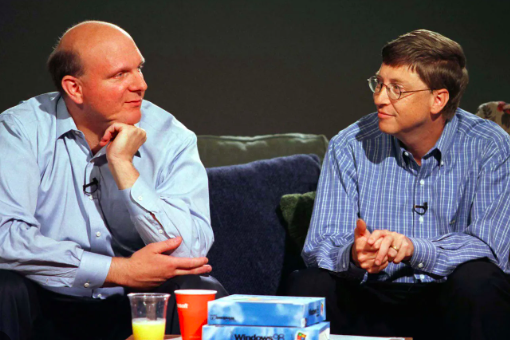
Steve Ballmer’s net worth ($157.2B) just passed Bill Gates ($156.7B) for the first time ever.
When Ballmer joined Microsoft in 1980, he was employee #30 and got ZERO equity. By the 1986 IPO, he owned 8% of MSFT and is now its single largest shareholder.
How did he get the stake? An interesting contract quirk.
Ballmer's Microsoft tale began in 1975, his sophomore year at Harvard (he lived down the hall from Bill Gates).
While Gates dropped out to start Microsoft, Ballmer was a total Harvard head: he managed the football team and wrote for The Crimson.
After graduating, Ballmer tried his hands at a few different jobs:
◽️Product Manager at P&G, where he worked with future GE CEO Jeff Immelt
◽️A brief attempt at Hollywood screenwriting
◽️Went to Stanford Business School
While at Stanford, Ballmer was convinced by Gates to drop out and come join Microsoft.
It was 1980 and the software firm was seeing rapid revenue growth. Sales had jumped from $16,000 in 1976 to $8,000,000 in 1980.
Ballmer was Gates' first non-technical hire and the offer he gave reflects the fact that Gates' hadn't recruited a business person before.
This was the deal for Ballmer:
◽️the title of "business manager"
◽️$50k base salary
◽️NO equity
◽️CRUCIALLY – as Microsoft was so desperate for sales knowledge – Gates (and co-founder Paul Allen) offered Ballmer "10% of profit growth" he could generate
With Microsoft growing like a weed (it would 2x to $17m in 1981), Ballmer's "10% of profits" deal was not sustainable.
At the time, Microsoft was a partnership (Gates owned 64% while Allen owned 36%).
One early VC (Dave Marquardt) wanted to restructure the corporation for wider stock ownership. Gates wanted nothing to do with the restructuring effort, so Ballmer and Marquardt took the lead (Ballmer was especially keen to get actual equity in the company).
They drafted the following corporate structure:
◽️Gates and Allen own 84%
◽️8% goes to investors
◽️8% goes to Ballmer (in exchange for waiving his 10% profit share deal)
Gates was OK with the deal but Allen was not. Allen wanted Ballmer to own 5% max. So, Gates agreed to drawdown the difference from his own equity stake.
By 1986, Ballmer owned 8% of MSFT. It was worth ~$56m when Microsoft IPO'd at a $700m valuation.
In the decades since, Ballmer – who was Microsoft's high-energy CEO from 2000-2014 – has largely held onto his MSFT equity.
Today, Ballmer owns ~4% of the tech giant while Gates owns ~1%. Ballmer's MSFT position is ~$140B and makes up 90% of his total net worth (making him the 6th richest person in the world).
LESSON: Hodl.
***
Read More:
1. Forbes: https://t.co/zLxb0JHc2Q
2. The Guardian: https://t.co/f0lESUhNyt
3. CNBC: con
TAX ALERT
The Ugandan tax appeals tribunal has recently made a key withholding tax pronouncement that should interest all real estate dealers AND generally taxpayers with commercial interests in the real estate industry.
Mid last year, i wrote an opinion on taxation of the real estate sector, and one of the key distinctions i made in that opinion was taxation of;
1. Capital gains on disposal of real estate assets which are “business assets” and are therefore of a capital nature, AND
2. Taxation of profits arising from the normal course of trading in real estate properties which are trading stock and are therefore of a revenue nature.
I did note that Ugandan tax law was at the time not yet settled on this point because the Income Tax Act does not expressly make a pronouncement on this point but indicated that we have guidance from case law from other jurisdictions on the application of general tax principles on the point in the Ugandan legal perspective, and further to the effect that all land/property on which a real estate dealer carries on his business is part of their circulating capital/part of their stock in trade.
In the first case, I observed that the investor might not be a trader in real estate assets but merely one who happens to hold real estate assets as part of their long term/capital asset portfolio as balance sheet items. An example is a factory warehouse or office building upon which a manufacturer operates. Income arising upon sale of the office or warehouse building is taxed under this head.
In the second case, the investor has a “shop” and their stock in trade(the revenue account items) are real estate properties which are on sale just like with any other shop selling any random trade items you can think of and for a real estate dealer this includes the property upon which the real estate dealer carries on their trade and has a locus in quo, or simply put, the trader's operations location.
MAKERERE UNIVERSITY RETIREMENTS BENEFITS SCHEME LTD v URA and ANOTHER, TAT Application 17 of 2021.
The tribunal has upheld this distinction and observed; "If the tribunal was to hold that 'business assets' includes all items used in the ordinary course of business because they are 'sold' or ready for sale, and are to attract withholding tax, it would mean that the definition of 'business assets' extends to stock in trade". and then held;
Business assets and stock in trade comprises assets in a business, however it is only business assets and not stock in trade that attracts withholding tax.
I however expect a fight back from URA in the form of an appeal or even an amendment to tax legislation on this owing to the now several tax planning loopholes open to an aggressively advised taxpayer.
You can follow up on this and read the updated opinion here.
https://t.co/ZWFgl3NvyM, under the 'Tax' navigation tab.
Hello Allan,
Tukkilize Ssebo tuyiseewo kububaka ku timeline yo wano mangu mangu.
Let’s try to appreciate what tax a business person down town actually pays and what he doesn’t pay.
1. VAT is paid by you the final consumer. It is simply collected by the business person on behalf of URA from you and then remitted. Some businesses have not been remitting it after collecting it.
2. Withholding tax is paid by suppliers to that business person. It is withheld by the business person at the point of paying a supplier. Again, some business persons have been withholding it and not remitting it. Nga balya mulye!
3. Rental tax is paid by the landlord. Not the business operator. The business operator pays rent to the landlord. This rent is an allowable expense when computing income tax.
4. Trading license is also a cost to the business man to run his business. Business costs are deducted by the businessman when computing his income tax. He gets to remove all allowable expenses from the income earned in a year to arrive at chargeable income.
5. Income Tax is the tax that is payable by the business person and it is arrived at where a profit has been made. Where a business is in a loss position, even this income tax is not expected to be paid but the business person has the duty to file a return to URA indicating that business reality.
6. That is where EFRIS - a smart book keeping solution can even come in to aid the said business to keep track of its business records.
Walai, EFRIS is not a problem to a compliant business person. It is however, a problem for a non-compliant business person because the non-compliance becomes detectable.
#FfeBanno
#KakasaWithEFRIS
📷Courtesy image
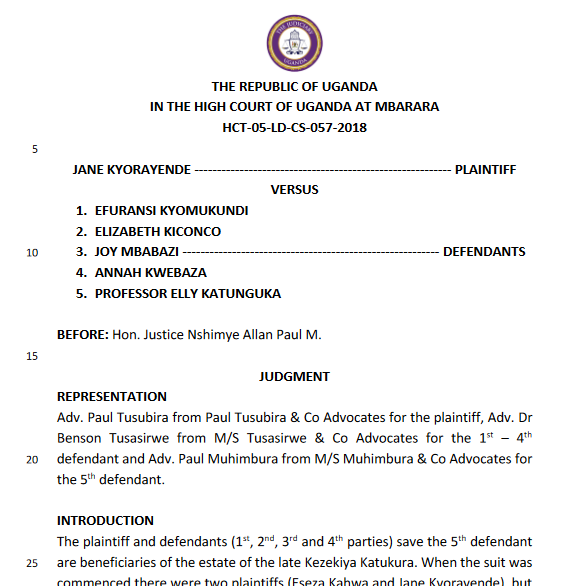
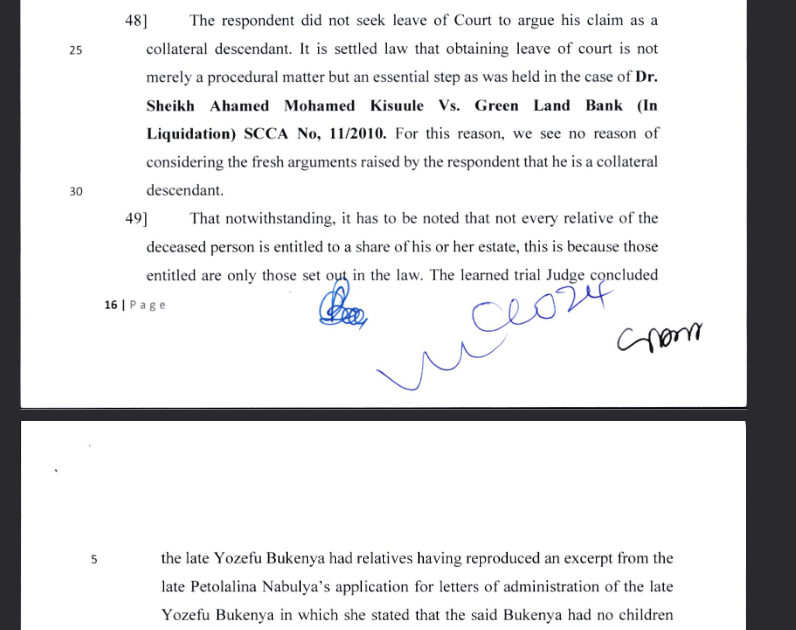
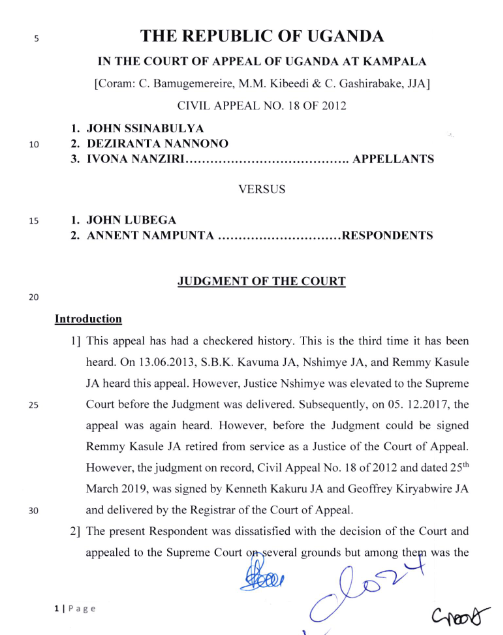
Nshimye, J., on 5th/04/2024 has affirmed that
Upon the death of a surviving spouse, the residential holding or any other residential holding shall devolve to the lineal descendants equally, who shall occupy it subject to terms and conditions set out in the 2nd Schedule to the Act
The court also held that
"The learned trial Judge was persuaded to hold that
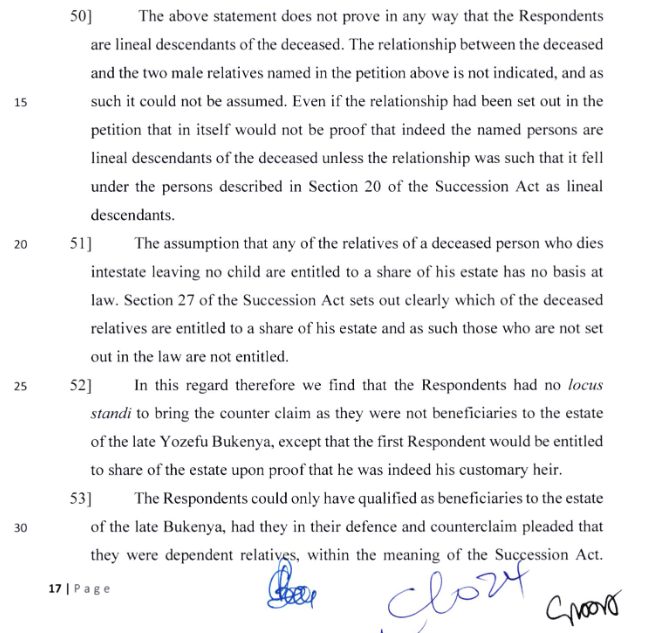
'blood relatives' have a claim to a deceased's estate under Kiganda customary law. But this has no basis in law, since there is written law on succession regardless of custom, see Section 15 of J.A
Section 27 of the Succession Act sets out clearly which of the deceased relatives are entitled to a share of his estate and as such those who are not set
out in the law are not entitled.
Court of Appeal in its landmark ruling has held that
"A sister is not considered a lineal descendant of her own brother as she does not descend from him. A son of a deceased nephew or deceased's nephew is not a lineal descendant, under section 20 of the Succession Act..."
Court of Appeal✍️Assumption that any relative of a deceased person who dies intestate leaving No child are entitled to a share of estate has no basis in law, S27 Succession Act sets out entitled deceased relatives✍️Not bearing children (fertility) is not synonymous with impotence
Tax statutes just like criminal penal provisions are a special class of law in the sense that if there are ambiguities in the law, then an adjudication tribunal is enjoined to resolve those ambiguities in favour of the tax payer.
In my commentary on the Income Tax(Amendment) bill 2024 which is currently before parliament, I have made the case for government to be careful not to upset the current structure of the Income Tax Act with this amendment, lest they creat ambiguities and loopholes in the law to be exploited by well advised businessmen to avoid tax altogether.
You can follow the link to read the article here. If you have commercial interests in real estate, I would advise you don't miss it. https://t.co/gLXCtZIz0W
“In a nutshell, @KiryowaKk is a useful idiot. He has not been appointed for his juridical opinion but, rather, for his obedience to the House of Kaguta. When the great questions of the day come (and they are coming pretty soon), we will surely see the glorified errand boy who suffers from hubris and mendacity completely exposed to the elements” 😅
https://t.co/bV1g16lhUs


![MarioNawfal's tweet photo. WHAT HAPPENED TO ALL THE EVIDENCE AGAINST EPSTEIN?
The FBI's chain of custody for evidence is a meticulously documented process designed to ensure the integrity, authenticity, and admissibility of physical or digital items from the moment they are collected until they are presented in court or disposed of.
It serves as a chronological record that tracks every interaction with the evidence, preventing tampering, contamination, loss, or unauthorized access.
This protocol is critical in criminal investigations, as any break in the chain can render evidence inadmissible or undermine a case.
The process is governed by strict guidelines outlined in resources like the FBI's Handbook of Forensic Services and aligns with broader federal standards from the Department of Justice and National Institute of Justice.
Evidence is collected at the scene using sterile tools and protective gear to avoid contamination.
Each item is immediately documented with details such as the date, time, location, collector's name, case number, and a unique evidence number.
For digital evidence like videos or lists, items are sealed in tamper-evident packaging to preserve their state. Photographs or videos of the evidence in situ are often taken for verification.
Items are packaged separately to prevent cross-contamination - in breathable paper bags for biological evidence or airtight containers for digital media. Seals use tamper-evident tape that shows if opened. Labels include chain-of-custody forms listing all handlers.
Every transfer (e.g, from field agent to lab, or between units) requires a signed log on the chain-of-custody form, noting the handler's name, date, time, purpose, and condition of the evidence.
Evidence is stored in secure facilities under controlled conditions - refrigerated for perishables, dark and cool for digital media to prevent degradation. Access is limited to authorized personnel, with audits and inventories conducted regularly.
Shipping uses trackable methods like registered mail or couriers, complying with regulations for hazardous or sensitive items.
During lab analysis, each step is logged. If evidence is returned or destroyed post-case, this is documented with approvals. Breaks in the chain trigger internal investigations, as they could indicate negligence or misconduct.
This system creates multiple redundancies: physical seals, digital logs, audits, and legal accountability.
In the context of Epstein's investigations, the FBI raided his properties and seized vast amounts of evidence, including hard drives, CDs, videos, documents, and other media potentially containing "blackmail" videos or client lists.
Official reviews, including a 2025 DOJ-FBI memo, confirm the seizure of over 300 gigabytes of data, including victim images/videos and over 10,000 downloaded child sexual abuse materials (CSAM) and pornography.
The FBI's chain-of-custody protocols make accidental loss virtually impossible without deliberate interference.
Every item would be logged at collection (e.g, during the 2019 NY raid, agents photographed contents of a safe containing hard drives, CDs labeled "Young [Name] + [Name]" or "Girl pics nude," diamonds, cash, and passports).
Transfers require signed forms, and digital evidence is cataloged in secure databases.
Losing an item would leave a glaring gap in records, triggering automatic audits or alerts.
Evidence is stored in locked, monitored facilities with limited access. For digital items like videos, backups and encryption are standard.
Accidental loss (e.g, misplacement) is improbable due to inventories and surveillance. If "lost," it would imply someone with access intentionally removed or deleted it - e.g, a 2025 whistleblower alleged FBI agents systematically deleted Epstein-linked files, and a 2021 court hearing revealed safe contents temporarily "went missing" after the raid.
High-profile evidence like Epstein's undergoes extra scrutiny, with DOJ oversight and potential Inspector General reviews.
The FBI's protocols create a near-impenetrable system where "loss" demands active subversion - such as falsifying logs, breaking seals, or deleting data - implying corruption or cover-up rather than oversight.
So what happenend to the mountain of evidence?](https://pbs.twimg.com/media/GwCtmwwXEAAEbW4.jpg)





![MarioNawfal's tweet photo. WHAT HAPPENED TO ALL THE EVIDENCE AGAINST EPSTEIN?
The FBI's chain of custody for evidence is a meticulously documented process designed to ensure the integrity, authenticity, and admissibility of physical or digital items from the moment they are collected until they are presented in court or disposed of.
It serves as a chronological record that tracks every interaction with the evidence, preventing tampering, contamination, loss, or unauthorized access.
This protocol is critical in criminal investigations, as any break in the chain can render evidence inadmissible or undermine a case.
The process is governed by strict guidelines outlined in resources like the FBI's Handbook of Forensic Services and aligns with broader federal standards from the Department of Justice and National Institute of Justice.
Evidence is collected at the scene using sterile tools and protective gear to avoid contamination.
Each item is immediately documented with details such as the date, time, location, collector's name, case number, and a unique evidence number.
For digital evidence like videos or lists, items are sealed in tamper-evident packaging to preserve their state. Photographs or videos of the evidence in situ are often taken for verification.
Items are packaged separately to prevent cross-contamination - in breathable paper bags for biological evidence or airtight containers for digital media. Seals use tamper-evident tape that shows if opened. Labels include chain-of-custody forms listing all handlers.
Every transfer (e.g, from field agent to lab, or between units) requires a signed log on the chain-of-custody form, noting the handler's name, date, time, purpose, and condition of the evidence.
Evidence is stored in secure facilities under controlled conditions - refrigerated for perishables, dark and cool for digital media to prevent degradation. Access is limited to authorized personnel, with audits and inventories conducted regularly.
Shipping uses trackable methods like registered mail or couriers, complying with regulations for hazardous or sensitive items.
During lab analysis, each step is logged. If evidence is returned or destroyed post-case, this is documented with approvals. Breaks in the chain trigger internal investigations, as they could indicate negligence or misconduct.
This system creates multiple redundancies: physical seals, digital logs, audits, and legal accountability.
In the context of Epstein's investigations, the FBI raided his properties and seized vast amounts of evidence, including hard drives, CDs, videos, documents, and other media potentially containing "blackmail" videos or client lists.
Official reviews, including a 2025 DOJ-FBI memo, confirm the seizure of over 300 gigabytes of data, including victim images/videos and over 10,000 downloaded child sexual abuse materials (CSAM) and pornography.
The FBI's chain-of-custody protocols make accidental loss virtually impossible without deliberate interference.
Every item would be logged at collection (e.g, during the 2019 NY raid, agents photographed contents of a safe containing hard drives, CDs labeled "Young [Name] + [Name]" or "Girl pics nude," diamonds, cash, and passports).
Transfers require signed forms, and digital evidence is cataloged in secure databases.
Losing an item would leave a glaring gap in records, triggering automatic audits or alerts.
Evidence is stored in locked, monitored facilities with limited access. For digital items like videos, backups and encryption are standard.
Accidental loss (e.g, misplacement) is improbable due to inventories and surveillance. If "lost," it would imply someone with access intentionally removed or deleted it - e.g, a 2025 whistleblower alleged FBI agents systematically deleted Epstein-linked files, and a 2021 court hearing revealed safe contents temporarily "went missing" after the raid.
High-profile evidence like Epstein's undergoes extra scrutiny, with DOJ oversight and potential Inspector General reviews.
The FBI's protocols create a near-impenetrable system where "loss" demands active subversion - such as falsifying logs, breaking seals, or deleting data - implying corruption or cover-up rather than oversight.
So what happenend to the mountain of evidence?](https://pbs.twimg.com/media/GwCtmwyWQAABywt.jpg)