SIP Stoppage Ratio 2026
Jan: 78%
Feb: 85%
Mar: 101%
Apr: 101%
May: 100%
NOTE: SIP Stoppage Ratio at or above 100% means that for every single fresh SIP account being opened, an equal or greater number of existing accounts are being closed. At 100%, the SIP pipeline is not broken, but it has stopped expanding. Equity MF Inflows
Category-Wise Breakdown
April vs. May (MoM)
Flexicap Funds: Down 49%
Midcap Funds: Down 33%
Smallcap Funds: Down 28%
Large Cap Funds: Down 37%
Thematic Funds: Down 67%
*Let me tell you in simple way - Why RBI measures is BIG news for financials: VB*
India needs dollars. Not rupees — actual US dollars. That's because India buys a lot of things from other countries (like oil and machines) and pays in dollars, and having a big pile of dollars saved up keeps our rupee steady and the country safe. Think of dollars as the "fuel tank" of the economy.
India's main bank — the RBI, which is like the "captain of all banks" — wants to fill that fuel tank quickly. So it has opened two special doors to let dollars flow in:
1.FCNR-B — Inviting Indians living abroad to keep their dollar savings in Indian banks.
2.ECB — Letting Indian banks and big government companies borrow dollars from foreign lenders.
To make people excited to bring their dollars, RBI sweetened the deal in two big ways. First, banks used to pay a kind of insurance cost (about 3.5% last time, in 2013) to protect against currency ups and downs — this time RBI says "don't worry, I'll cover that cost for you." So the deal is cheaper for everyone.
Second — and this is the clever part — RBI is allowing something called leverage. Here's the pocket-money way to picture it: imagine you put in ₹10 of your own money, and the bank lets you play the game with ₹100 (that's 10 times more). Even a tiny profit on ₹100 feels huge compared to your original ₹10. That's exactly why investors abroad will rush in — a small gain (1.5–2%) becomes a big-looking return (17–27%) once it's multiplied 7–10 times.
Why it's big news: India tried something similar in 2013 and pulled in about $34 billion, which really helped the country at a tough time. This time the deal is better, so the expectation is $50–70 billion — almost double. That much money pouring in helps keep the rupee stable, fills the dollar fuel tank, and gives banks more money to lend out (which helps the whole economy grow).
Banks benefit most, and most directly. Here's the plain reasoning:
The two doors RBI opened are mainly bank doors. FCNR-B is a bank-only product — only banks can collect these dollar deposits, so the spread and the funding land straight on bank balance sheets. The ECB window here is opened to banks and government companies (PSUs), again putting banks at the front of the queue. The 2013 playbook tells the same story — HDFC Bank pulled in the largest pool (about $3.4 billion), followed by ICICI, SBI and a few foreign banks. The banks that move fastest and have the strongest overseas customer networks tend to grab the biggest share.
NBFCs benefit too, but second-hand. They aren't allowed to collect FCNR-B deposits, so they don't sit at the door. Their gain is indirect: when banks suddenly have a flood of cheap dollars and rupee liquidity, the overall cost of money in the system tends to drift down. NBFCs borrow heavily from banks, so cheaper, more plentiful bank funding eventually makes life easier and margins better for them — especially the larger ones. (Some big NBFCs can also tap ECB directly under the general rules, but that's a smaller, separate channel from this special window.)
Hope this helps.
India’s fertility rate has fallen below replacement for the first time in the country’s history, declining from a TFR of 2.3 to 1.9 in just a decade.
Delhi’s fertility rate now sits at 1.2, lower than Finland’s.
Follow: @AFpost
India trains the engineer.
America files the patents.
Gurtej Sandhu was raised in Amritsar and trained at IIT Delhi.
He now holds 1,299 US patents at Micron, Edison topped out at 1,093.
Sandhu is the 7th most prolific inventor in American history.
His titanium nitride deposition work is why every DRAM cell in your phone and every GPU training a foundation model actually holds charge.
Micron, Samsung, and SK Hynix own 95% of global DRAM.
None of them are Indian.
We export the inventor.
We import the chip.
A Bengaluru startup just did something no one in the world has ever done, put a satellite in orbit that sees through clouds, through the night, with optical sensor and SAR fused into one.
Many many congratulations to the @Galaxeye team on the launch of Mission Drishti!
This is exactly why PM Sri @narendramodi opened up the space sector, so young Indians could build an audacious future for the nation.
JUST IN: The United States has fired 2,400 Patriot interceptors in 31 days. It manufactures 650 per year. Replenishment at current production takes three and a half years. It has consumed 40 percent of its global THAAD inventory. It produces fewer than 100 THAAD interceptors annually. Full replenishment takes four to five years. Each interceptor contains neodymium and samarium-cobalt magnets sourced from Chinese-controlled supply chains. The US defence rare earth stockpile has approximately two months remaining.
Read those numbers again. The US military has consumed more precision weapons in one month than it can manufacture in three years, using materials it can only source from the country it may need to fight next.
Every Patriot fired at an Iranian Fattah-2 over Riyadh is a Patriot that does not exist for a Chinese DF-21 over the Taiwan Strait. Every rare earth magnet consumed in Gulf interceptors is a magnet that cannot be installed in a replacement built for the Pacific. The Iran war is not just depleting American arsenals. It is depleting American deterrence against China. And the country counting the interceptors from both sides of the table, as supplier and as future adversary, is the same country hosting peace talks in Beijing right now.
China controls 90 percent of rare earth refining. China produces 90 percent of the world’s high-performance magnets. China buys 80 to 91 percent of Iran’s oil exports. China provides BeiDou navigation and ammonium perchlorate propellant to the Iranian missiles that are forcing the US to burn through its interceptor stockpile. China is simultaneously the supplier of the weapons America is using, the supplier of the weapons Iran is using, the primary customer of the oil the war is disrupting, and the only country with the leverage to end the disruption.
The arithmetic of the grand bargain is not complicated. The US needs Chinese rare earths to rebuild its interceptor inventory. China needs Hormuz open to receive Iranian oil. The US needs the war to end before its stockpiles hit zero. China needs tariff relief, semiconductor export control rollbacks, and Taiwan arms-sale restraint. Both sides need something only the other can provide. The question is not whether a deal happens. The question is how much of America’s strategic position in the Pacific gets traded for the minerals needed to survive the Gulf.
RAND estimated that 78 percent of US defence contractors would face production shutdowns within 90 days of a Chinese rare earth cutoff. The 2027 deadline to ban Chinese-sourced magnets from Pentagon procurement is nine months away with no domestic alternative at scale. MP Materials operates the only US rare earth mine and ships its concentrate to China for processing. The mine-to-magnet supply chain that the Pentagon needs to survive a Taiwan contingency runs through the country the Taiwan contingency is designed to deter.
This is not a supply chain problem. This is a civilisational dependency. The United States built the most advanced military in human history on materials processed by its principal strategic competitor. It is now fighting a war that burns through those materials at a rate that makes replenishment impossible without the competitor’s cooperation. And the competitor is sitting in a conference room in Beijing today, across the table from Pakistan’s foreign minister, calculating exactly how much of America’s future it can extract in exchange for the minerals America needs to have a future at all.
The deal of the century is not a choice. It is arithmetic. And the arithmetic leads to Beijing.
https://t.co/dAOBBMrIOk
🌍 Biggest Economy by Century (1 AD – Present)
1–100 AD – India 🇮🇳
100–200 – India 🇮🇳
200–300 – India 🇮🇳
300–400 – India 🇮🇳
400–500 – India 🇮🇳
500–600 – India 🇮🇳
600–700 – India 🇮🇳
700–800 – India 🇮🇳
800–900 – India 🇮🇳
900–1000 – India 🇮🇳
1000–1100 – India 🇮🇳
1100–1200 – China 🇨🇳
1200–1300 – China 🇨🇳
1300–1400 – China 🇨🇳
1400–1500 – China 🇨🇳
1500–1600 – India 🇮🇳
1600–1700 – India 🇮🇳
1700–1800 – China 🇨🇳
1800–1900 – China 🇨🇳
1900–2000 – United States 🇺🇸
2000–2100 – United States 🇺🇸
(PPP, based on Angus Maddison estimates)
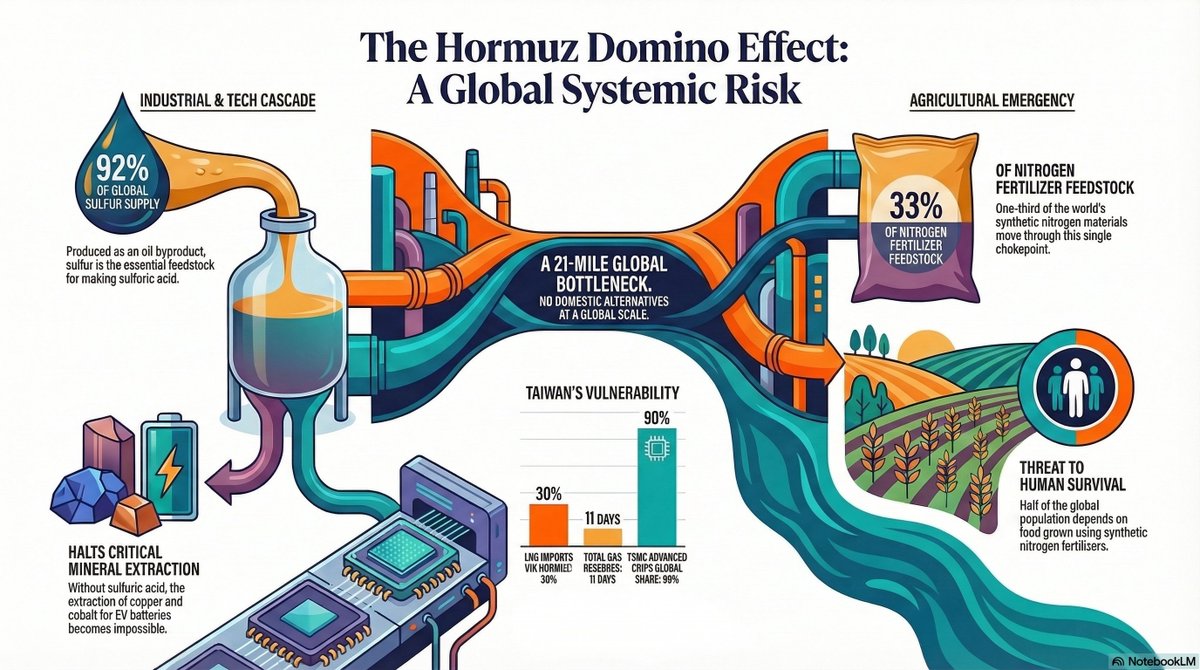
The Strait of Hormuz has been closed for 21 days.
Most people think this is about oil.
It isn’t.
It’s about what oil becomes.
Around 92% of the world’s sulfur is produced as a byproduct of refining oil and natural gas. When the Strait of Hormuz shuts down, the world doesn’t just lose 20 million barrels of crude per day.
It loses the feedstock for sulfuric acid — the most produced chemical on Earth.
Sulfuric acid is how we extract copper.
It’s how we extract cobalt.
Without it, you can’t manufacture transformers, EV batteries, or the electronic substrates inside every data center on the planet.
One chemical.
From one feedstock.
Moving through one chokepoint.
And the cascade doesn’t stop there.
About 30% of Taiwan’s liquefied natural gas from Qatar passes through the Strait of Hormuz. Taiwan reportedly holds about 11 days of reserves.
Now consider this:
Taiwan Semiconductor Manufacturing Company (TSMC) produces around 90% of the world’s advanced chips and consumes 8.9% of Taiwan’s total electricity.
No gas → no power → no chips.
Then comes food.
Roughly 33% of the world’s nitrogen fertilizer feedstock also moves through the Strait of Hormuz. Synthetic nitrogen fertilizers support the agriculture that feeds billions.
In fact, about half of all humans alive today depend on food made possible by synthetic nitrogen.
So this isn’t just about energy.
It’s about sulfur, semiconductors, and food.
Three critical supply chains.
One 21-nautical-mile chokepoint.
And no domestic alternatives at global scale.
🚨 BREAKING: China’s BAIC has unveiled a new sodium-ion battery that can go from 0 to full in just 11 minutes using 4C fast charging.
That alone is impressive, but here’s what makes it interesting 👀
It delivers around 170 Wh/kg energy density, putting it close to today’s LFP lithium batteries, meaning this isn’t just experimental tech, it’s already in the usable range.
Even more surprising, it handles extreme conditions extremely well, retaining over 92% capacity at −20°C, where most batteries start to struggle.
And instead of relying on scarce materials, this battery uses sodium, which is far more abundant and cheaper.
On top of that, it shows strong safety performance, surviving 200% overcharge and high temperature stress without catching fire.
This could make EVs cheaper, safer and significantly faster to charge.
I had dinner once with a top physicist and a top computer scientist and asked what they thought the probability was that we were in a simulation.
They answered simultaneously at 0% and 100% respectively. It was like a double-slit experiment, but with humans.
A lot of people may not like this.
But the way this govt has handled crisis whether Covid or Trump's tantrums or the energy issues now is beyond commendable.
One can always nitpick and find fault with some things but big picture the current team at the top led by PM Modi have done things for which they rarely get much credit.
I don't think India has seen such confident handling of dire situations since independence. The capability building, relationship building, the India first approach, the confidence and the execution has been next level. I can't think of any other previous govt handing things like this.
🚨 INDIA'S NEW RENT RULES 2026.
• Landlords cannot charge more than two months’ rent as a deposit.
• Tenants cannot be evicted without legal due process.
• Rental agreements must be digitally stamped and registered within 60 days.
• Rent can be increased only once in 12 months, with 90 days’ prior notice.
• Landlords must give 24 hours’ notice before entering the property.
• If essential repairs aren’t done within 30 days, tenants can fix them and deduct the cost from rent.
• Changing locks, cutting water/electricity, or threatening tenants is punishable.
Not every inspiring sporting story ends with a trophy. Over the last few days, Lakshya Sen has shown India what courage, resilience and belief truly look like. His run to another All England final, through extraordinary wins and immense physical pain, has been about far more than a result. He has reminded young India that greatness lies not only in winning, but in the honesty of effort, the dignity of the fight and the strength to keep believing. I am Proud of you, @lakshya_sen . Very, very proud.
JUST IN: BlackRock’s $26B private credit fund is limiting how much investors can pull out, capping withdrawals at 5% even though investors asked for 9.3%
Blackstone’s similar fund processed a record “7.9% OF SHARES” of withdrawal requests this week, with the firm and employees covering the rest.
Buying property in India?
Miss ONE document — regret lasts for decades.
Before you pay even ₹1 advance, verify these 8 non-negotiables 👇
1] Title Deed- Confirms the seller is the legal owner with full right to sell.
2] Mother Deed- Tracks ownership history — catches hidden defects early.
3] Encumbrance Certificate (EC)- Ensures no loan, mortgage, or court case is attached.
4] Possession Certificate- Verifies who actually controls the property on ground.
5] Property Tax Receipts-Shows taxes are paid — no surprise dues later.
6] Khata / Patta- Proof the property exists in municipal & govt records.
7] Conversion Certificate- Mandatory if land was agricultural — without this, construction can be illegal.
8] Location Sketch & Survey Map-Protects you from boundary disputes and land grabbing issues.
If any document is missing, walk away.
Another deal will come. Peace won’t.
🔖 Bookmark this
In today’s turbulent geopolitics, it is critically important for every large nation to secure energy independence. India is vulnerable because we import 90% of our oil and gas. We are surrounded by sea on three sides which can be blockaded in hostile times. There is no option but to raise our domestic production. We are the world’s fastest growing market for oil and gas. And our demand will keep growing for another 20 years at least.
Fortunately, we are blessed with tremendous resources, 300 billion barrels equivalent. More than 30 times Guyana’s potential. We also have amazing entrepreneurs - our businessmen, youngsters and startups. Across the world, in America, Middle East and Europe, 10% of experts in this industry are Indians. So, we have talent. What we need to do is exploration. That is the core of this business. Two decades ago, the US was dependent on hydrocarbon imports and vulnerable. They changed it by opening up exploration to entrepreneurs and making it lucrative for them. Even backyards of homes and farms were explored. Everyone benefited.
I have been in this business for the last 15 years and I can say with confidence that we can produce at half the cost of imports. At the same time, we have contributed $40 billion dollars to the exchequer. Over the years, Cairn has produced 1.3 billion barrels. This sector is among a few that has no government protection or incentive like PLI.
To unlock India’s full potential, we need more exploration. Today, there are hardly 200 active licences in India when there should be 2,000. The industry and potential investors fear processes, notices, court cases and taking away the licenses. Even one court case or notice in the public domain catches like fire in the world. I am reminded of what happened in the Ghana bird sanctuary in Bharatpur which, once upon a time, used to get birds from all over the world, some flying 5,000 miles. It would have been the world’s finest, until 10 or 15 years ago, a hunter shot a couple of birds. The other birds stopped coming. It is taking years to recreate a favourable environment.
The world doesn’t want India to produce. It only wants India to be a market. But only domestic production creates jobs, which is proven in other parts of the world. We must push back. We must fight to be self-sufficient. After all, this is a country which used to be import dependent on food. And then became self-sufficient. It all happened because the government created a movement to make the country self-sufficient.
Today, the world is rapidly securing its own energy and mineral resources. India must also move quickly to make full use of what lies below the ground. The Government has been encouraging growth, collaboration and investment. At Vedanta, our goal is to increase our production five times. For India, production must grow ten times to meet future needs. This will support economic growth and the vision of Viksit Bharat.
My vision is to see thousands of drilling rigs operating across the country. Even startups and small entrepreneurs can participate with an investment of around ₹5 crore through leasing of rigs. What we need most is stable and supportive environment. This is the right time to shift from heavy regulation to facilitation for exploration and production so the nation can move towards energy independence.
We have a long journey ahead but our potential is extraordinary.
That means you are effectively packing the equivalent of about 1,550 laptops’ worth of power consumption and heat density into a single AI rack
https://t.co/REyZcmxZCl
Mr. Rajesh bought a ₹60-lakh flat in Pune.
Now he’s fighting a legal case because he skipped just one document.
If you’re a homebuyer, save this thread 🧵👇