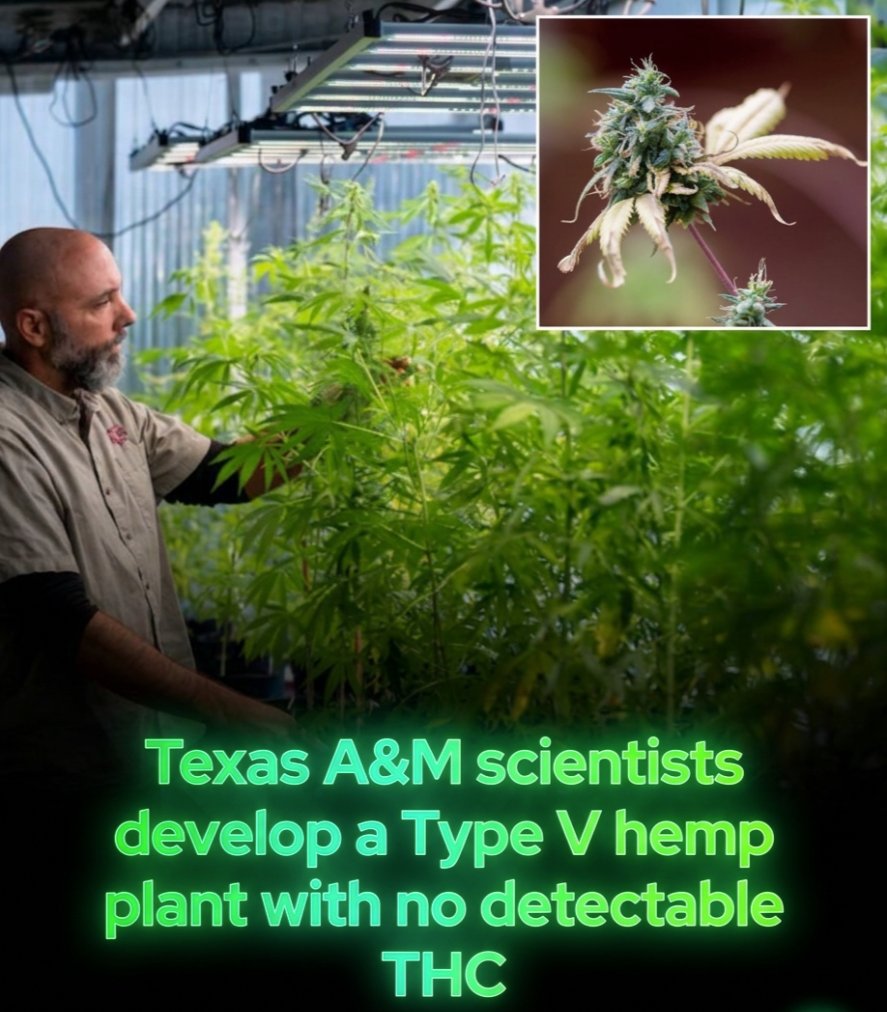
Hemp plants developed at Texas A&M have tested negative for THC and 17 other cannabinoids.
This breakthrough could make a major difference for farmers who cultivate hemp for its stalks and seeds. Even when a crop is grown strictly for fiber or grain, its flowers can still naturally produce THC. In Texas, growers risk having an entire harvest destroyed if it tests above the state's 0.3% THC limit.
The research began in 2022 when Teja Sri Vengala was a master's student at Texas A&M. She focused on trichomes, the microscopic, hairlike structures covering the surface of a hemp plant, some of which feature a gland at the tip where cannabinoids like THC and CBD are synthesized. Vengala screened thousands of plants looking for a rare physical combination: stalks where the tiny hairs remained intact, but the glands at their tips were completely absent.
After allowing those glandless plants to self-pollinate, she tested their offspring and confirmed that none of the 18 cannabinoids screened reached detectable levels. Scientists classify hemp exhibiting this cannabinoid-free profile as Type V.
By sequencing the plants' genomes, the research team identified two candidate genes that may explain why the glands fail to form. Scientists are now investigating the exact function of those genes and developing DNA markers that will help breeders easily identify plants carrying the trait, simplifying its introduction into existing commercial fiber and grain varieties. Texas A&M plans to conduct field trials with its new lines in 2027 and 2028, and if those tests succeed, commercial seed could reach farmers by 2029.
[Vengala, T. S., et al. (2026). Determination of the EMS Lethal Dose (LD50) and Characterization of Induced Mutations in Industrial Hemp (Cannabis sativa L.). Crops, 6(4), 78. DOI: 10.3390/crops6040078]
[Texas A&M AgriLife Research, "Texas A&M AgriLife Research creates a hemp plant with zero THC" (November 19, 2026)]