I am a SEBI Registered Fee-Only Investment Advisor (RIA). Details of the advisory services below:
Financial Planning:
https://t.co/W4K3xqyOKh
HNI Portfolio Advisory:
https://t.co/LtFNDvYLQx
Use the forms in these pages to contact for advisory/planning services
I love this story about what George Clooney learned from moving to Italy:
In the early-2000s he was a motorcycle trip to the Italian Alps and stopped by a small town on Lake Como to visit some friends. After he left his bike broke down so Clooney knocked on the door of the nearest house (which happened to be a beautiful estate on the water).
A member of the Heinz ketchup dynasty owned it. By the end of the day, Heinz asked the actor if he would like to buy the lakeside estate. Clooney balked which caused Heinz to lower the price.
Clooney said yes on a whim assuming he would sell the home within a year to turn a quick profit.
After moving in Clooney was sitting alone by the pool. In an interview with Esquire he described what happened next:
He looked out the window that first evening and saw a few construction workers walking home after work, orange vests, bellies sticking out, hard hats cocked on their heads. They pulled hunks off a loaf of bread and passed a bottle of wine as they walked, and they were singing.
Singing!
Clooney, who was making the leap from being pretty famous to being an international A-list actor–The Perfect Storm had been a hit, and Ocean’s Eleven was an even bigger one–thought to himself, Those guys are living their lives better than I am. Way better than I am.
He was always in such a hurry to be a success that he’d been eating dinner standing up for as long as he could remember. And then these guys–not much money, doing hard labor all day, and they’re celebrating another night walking home.
He thought, I’m never going to leave this house.
Clooney still has the house all these years later.
Some more thoughts about living a better life now:
https://t.co/nSEmgTywPH
In Sept. 2024, Indian markets were making new highs. The trailing returns for Nifty50 looked fantastic back then at 33.3% over 1 year, 24.1% over 2 years and 17.8% over 5 years. Many investors, especially those who had started recently, took these numbers as the new normal! They began expecting 18-25% every year from equity as their birthright, and some even planned their goals around it.
But that was never normal. It was just what the calculation showed at the peak.
Now fast forward to today and look at the same returns data (as of 30-Oct-2026). After more than two years of a sideways-to-down market, the 1-year CAGR is -10.4% and the 2-year is -2.4%. Even the 3, 4 and 5-year numbers have come down to 5.5-6.5%, which is at times lower than what a plain bank FD would have paid (a comparison being made a lot these days).
But the markets did not change their nature. Only the starting point of the calculation has changed.
Trailing returns measured at a high will always look great, and the same measure taken after a long flat patch will look poor. Impatient investors are troubled right now because they anchored on the first set of numbers. Their expectation was wrong to begin with, and the market is only correcting it.
Equity returns come in uneven lumps. Long dull stretches are the price you pay for the strong years, and no one gets one without the other.
Please don't join any WhatsApp/Telegram group which uses my name/photo/identity. I don't offer any stock tips/advisory of any kind on any platform.
There have been way too many cases of impersonation for many in recent times, where imposters/frauds create/use fake social media profiles/channels to dupe people. Be careful.
Note - I only offer financial planning and investment advisory services. No stock tips/advisory.
Let me be blunt. Those who are afraid of AI feel deep down that they are impostors & have no edge. If you have a 1) clear mind, 2) a deep, not just cosmetic, undertanding of your specialty, 3) and/or are original enough to reinvent yourself when needed, AI will be your friend.
Current State of Indian Markets (6-Nov-2026)
The table shows the % Fall of Indices (closing values) from their respective All-Time-Highs (intraday).
Note - Investments in the securities market are subject to market risks. Read all the related documents carefully before investing.
Disclaimer - The indices shown are for illustration only. It is not a recommendation to buy/sell/hold. Please get in touch with your investment advisor to get customised investment advice based on your risk profile and unique requirements.
Current State of Indian Markets (6-Nov-2026)
The table shows the % Fall of Indices (closing values) from their respective All-Time-Highs (intraday).
Note - Investments in the securities market are subject to market risks. Read all the related documents carefully before investing.
Disclaimer - The indices shown are for illustration only. It is not a recommendation to buy/sell/hold. Please get in touch with your investment advisor to get customised investment advice based on your risk profile and unique requirements.
The Home Ministry has warned NBFCs and fintechs about AI-assisted cyber fraud. Ordinary people like us are at risk too. A familiar voice or a polished message is no longer proof of anything. Set payment limits, verify every beneficiary, and switch off apps you don’t use. Be cautious.
INDIA'S HOME MINISTRY: ISSUES ADVISORY TO NBFCS AND FINTECH FIRMS ON AI-ASSISTED CYBER FRAUD; RECOMMENDS PAYMENT LIMITS, BENEFICIARY VERIFICATION AND DISABLING UNUSED PAYMENT INTERFACES
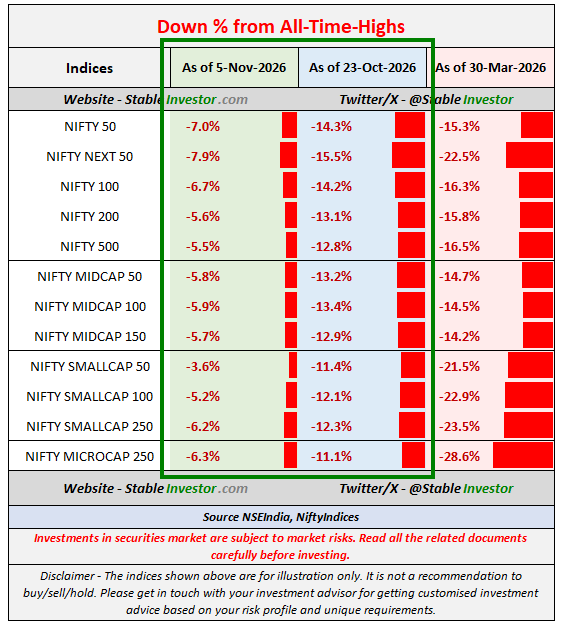
Sentiment changes faster than most investors expect and can flip in days. Two weeks ago, the mood was fear. Drawdowns were 12-15% across indices. Today, they are about half of that.
The table below compares drawdowns for indices as of today (5-Nov-2026) vs about two weeks ago and the start of the FY.
Note - Investments in the securities market are subject to market risks. Read all the related documents carefully before investing.
Disclaimer - The indices shown are for illustration only. It is not a recommendation to buy/sell/hold. Please get in touch with your investment advisor to get customised investment advice based on your risk profile and unique requirements.
Excellent move, and one that was long overdue. There has always been a real need to bring personal finance into our Indian education. And this is a solid first step that can trigger better financial awareness among the next generation.
More importantly, if done well, it could save many of them from learning the hard (and expensive) money lessons later in life.
The economics segment of the recently introduced NCERT textbooks for Social Science (Grade 9, Part 2) now has a chapter on personal finance. Students are taught basics about fixed deposits, mutual funds, EMI, taxes, risk-return and so on. The idea is to provide them with useful life skills. 1/2
SEBI has reportedly proposed that switching from one mutual fund to another shouldn’t trigger LTCG tax if the units have been held for over a year (the time required to qualify as long-term). If this proposal becomes law (fingers crossed!), it would be one of the most investor-friendly changes in years.
As of today, many investors are stuck in underperforming funds because they face a simple calculation: Exit and pay 12.5% on whatever gains they have now, or stay and hope fund performance improves soon. Many stay. Not because the fund is good, but because leaving is expensive tax-wise.
It also makes logical sense in my view. Moving from one fund to another isn’t exactly cashing out. You aren’t taking the money home. So why tax it?
This also helps in periodic rebalancing. Reviewing and rebalancing/adjusting a portfolio after 12 months without a tax penalty means more people will actually start doing it instead of avoiding it for tax reasons.
Then there is the Direct Vs Regular Plans decision. A lot of legacy AUM in regular plans hasn’t moved to direct plans because the switch itself creates a tax event, and most investors don’t want to pay tax unnecessarily. But if this proposal removes tax in fund-switches, then many would switch to direct plans (for higher returns given lower expense ratio).
But a few operational aspects remain to be seen. Like what happens when someone switches from an equity fund to a debt fund? Does the holding period carry over? Is the gain exempt, or just deferred with the cost carried forward, etc., etc…
And there’s a possible unintended consequence. If switching after a year is tax-free, then many would be encouraged to start switching unnecessarily, running after previous year’s table toppers. So the churn in fund space may increase a lot more than what many would anticipate now.
But let’s remember, this is still just a proposal (reportedly). Let’s see if it really sees the light of day.
SEBI has reportedly proposed that switching from one mutual fund to another shouldn’t trigger LTCG tax if the units have been held for over a year (the time required to qualify as long-term). If this proposal becomes law (fingers crossed!), it would be one of the most investor-friendly changes in years.
As of today, many investors are stuck in underperforming funds because they face a simple calculation: Exit and pay 12.5% on whatever gains they have now, or stay and hope fund performance improves soon. Many stay. Not because the fund is good, but because leaving is expensive tax-wise.
It also makes logical sense in my view. Moving from one fund to another isn’t exactly cashing out. You aren’t taking the money home. So why tax it?
This also helps in periodic rebalancing. Reviewing and rebalancing/adjusting a portfolio after 12 months without a tax penalty means more people will actually start doing it instead of avoiding it for tax reasons.
Then there is the Direct Vs Regular Plans decision. A lot of legacy AUM in regular plans hasn’t moved to direct plans because the switch itself creates a tax event, and most investors don’t want to pay tax unnecessarily. But if this proposal removes tax in fund-switches, then many would switch to direct plans (for higher returns given lower expense ratio).
But a few operational aspects remain to be seen. Like what happens when someone switches from an equity fund to a debt fund? Does the holding period carry over? Is the gain exempt, or just deferred with the cost carried forward, etc., etc…
And there’s a possible unintended consequence. If switching after a year is tax-free, then many would be encouraged to start switching unnecessarily, running after previous year’s table toppers. So the churn in fund space may increase a lot more than what many would anticipate now.
But let’s remember, this is still just a proposal (reportedly). Let’s see if it really sees the light of day.
In Sept. 2024, Indian markets were making new highs. The trailing returns for Nifty50 looked fantastic back then at 33.3% over 1 year, 24.1% over 2 years and 17.8% over 5 years. Many investors, especially those who had started recently, took these numbers as the new normal! They began expecting 18-25% every year from equity as their birthright, and some even planned their goals around it.
But that was never normal. It was just what the calculation showed at the peak.
Now fast forward to today and look at the same returns data (as of 30-Oct-2026). After more than two years of a sideways-to-down market, the 1-year CAGR is -10.4% and the 2-year is -2.4%. Even the 3, 4 and 5-year numbers have come down to 5.5-6.5%, which is at times lower than what a plain bank FD would have paid (a comparison being made a lot these days).
But the markets did not change their nature. Only the starting point of the calculation has changed.
Trailing returns measured at a high will always look great, and the same measure taken after a long flat patch will look poor. Impatient investors are troubled right now because they anchored on the first set of numbers. Their expectation was wrong to begin with, and the market is only correcting it.
Equity returns come in uneven lumps. Long dull stretches are the price you pay for the strong years, and no one gets one without the other.
In Sept. 2024, Indian markets were making new highs. The trailing returns for Nifty50 looked fantastic back then at 33.3% over 1 year, 24.1% over 2 years and 17.8% over 5 years. Many investors, especially those who had started recently, took these numbers as the new normal! They began expecting 18-25% every year from equity as their birthright, and some even planned their goals around it.
But that was never normal. It was just what the calculation showed at the peak.
Now fast forward to today and look at the same returns data (as of 30-Oct-2026). After more than two years of a sideways-to-down market, the 1-year CAGR is -10.4% and the 2-year is -2.4%. Even the 3, 4 and 5-year numbers have come down to 5.5-6.5%, which is at times lower than what a plain bank FD would have paid (a comparison being made a lot these days).
But the markets did not change their nature. Only the starting point of the calculation has changed.
Trailing returns measured at a high will always look great, and the same measure taken after a long flat patch will look poor. Impatient investors are troubled right now because they anchored on the first set of numbers. Their expectation was wrong to begin with, and the market is only correcting it.
Equity returns come in uneven lumps. Long dull stretches are the price you pay for the strong years, and no one gets one without the other.