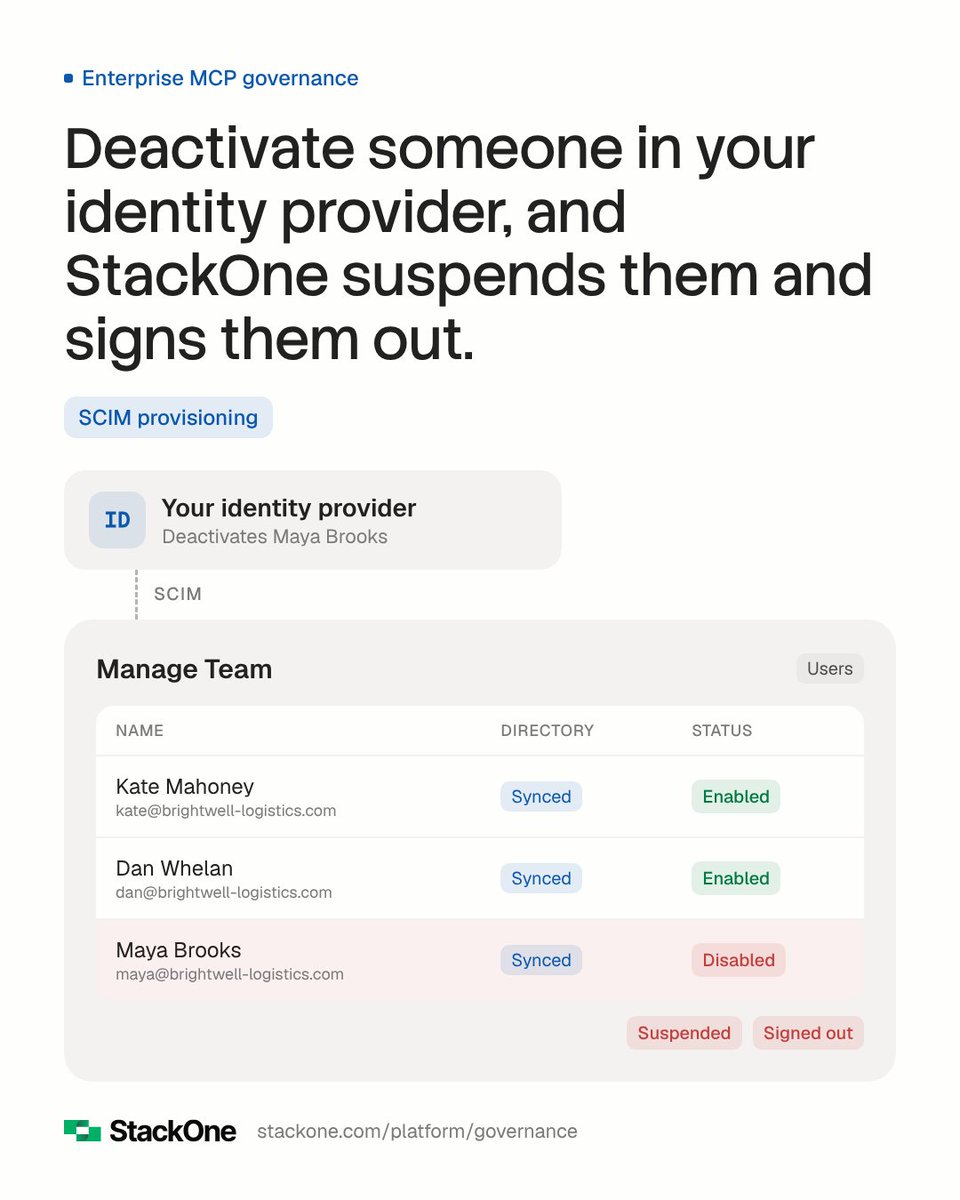
New in StackOne: govern MCP across your whole organization. SSO and SCIM run membership, connector profiles set read or write access per team, and every tool call can go to your SIEM. https://t.co/v3FicipdQw
@OpenAI How OpenAI splits Daybreak into Blue and Red: https://t.co/ZcFgxH1IMi
Our prompt injection research so far, with a benchmark across frontier models and an open challenge to get past Defender: https://t.co/aOKw6jz3zt
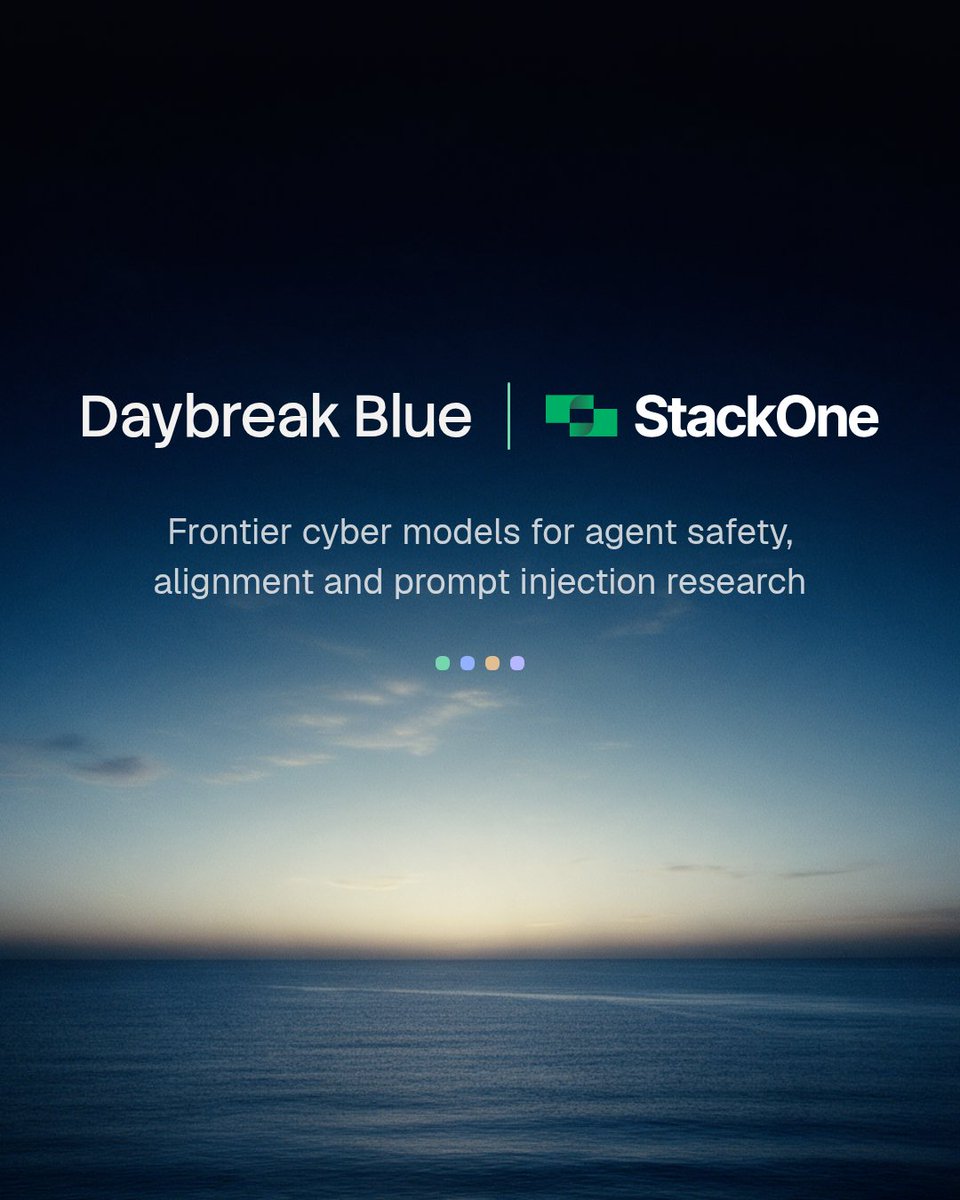
We're approved for Daybreak Blue from @OpenAI.
It goes into the research behind our agent policies, PII redaction, prompt injection defense, misalignment work and on-device agent control, so enterprises can let AI use every tool safely.
Daybreak Red application is next.
Customer emails and phone numbers stay out of the model. Tool Policies redact personal data in support tickets before your agent reads them, using StackOne's own PII model. https://t.co/L3ypKoHXha
Contractors get AI too. With Tool Policies, one rule blocks every tool matching *delete* for your Contractors group, across every connector, including ones you add later. https://t.co/L3ypKoHXha
One HR system calls it salary, another base_pay, a third pay_rate. A Tool Policies semantic rule asks "Is this compensation?" and hides all three from every agent, including in systems you connect later. https://t.co/L3ypKoHXha
Today we're launching StackOne Tool Policies.
With Tool Policies, IT can let Claude, Copilot, Gemini Enterprise and Glean update records, send messages and make payments in Workday, Salesforce, NetSuite and the rest of your stack, inside limits you set for each team.
Block every delete tool for contractors.
Hide salary and bank details from every agent.
Allow payments only between $25 and $500.
Stop agents from posting unreleased financial results to Slack.
Every rule can run in Monitor first, so you see who it would affect before it blocks anything. Every decision is logged with the user, connector and rule.
Available today in early access on Gateway Team and Gateway Enterprise.
See how Tool Policies work: https://t.co/f8sSZXSZ4w
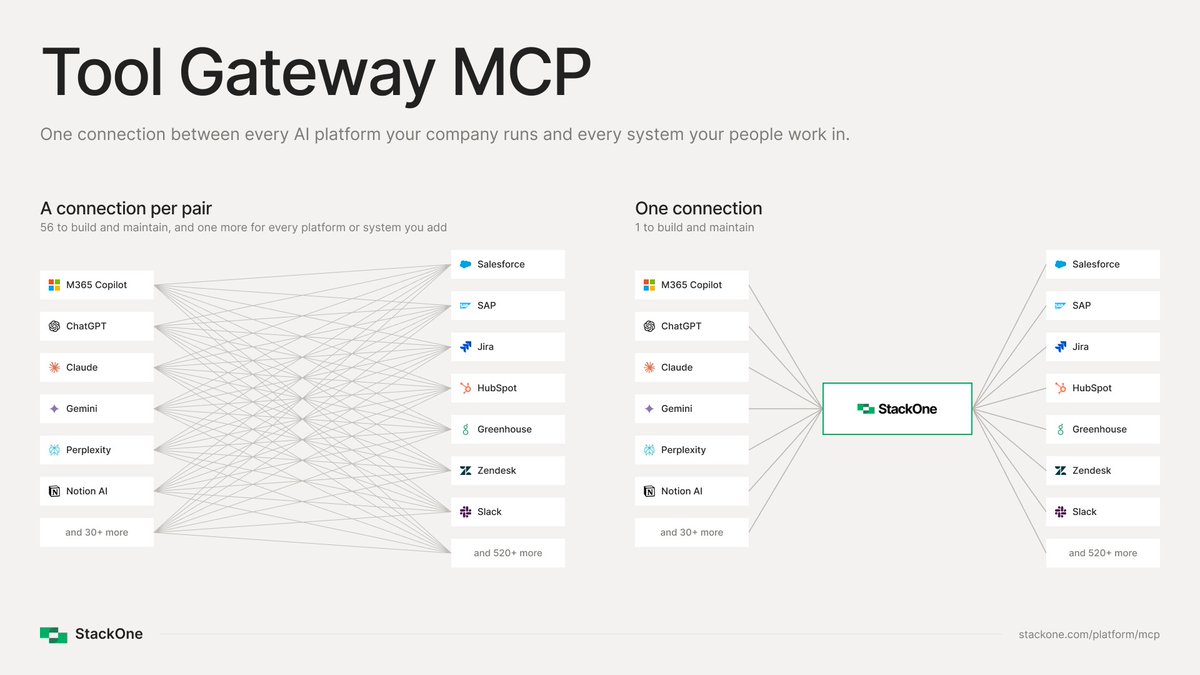
Every AI platform your company runs, connected to every system your people use, through one URL.
One integration to build and maintain, however many AI platforms and systems you connect.
https://t.co/Tp5qf4F1EZ
We built an agent on Glean that closes them. Marked hired in the ATS → employee record, directory account, equipment ticket, and a 9-month onboarding plan. StackOne reads the ATS and writes the other four.
At Glean GO? Book time with us: https://t.co/ezc8XsXJxd
Onboarding measured in days isn't a capacity problem.
The days come from the gaps — HR's work is done, IT's hasn't started, and the new hire is stuck in between.
An LLM's reasoning is only as useful as what it can reach. Ask one about your hiring funnel and it has nothing to work with, because that data sits in your ATS.
So our Head of People connected Claude to Ashby directly. Four steps, no code. Then they asked how many candidates withdrew at our take-home stage and what reasons they gave.
The connection is the part worth thinking about, because an ATS holds candidate records, compensation and personal data. Which comes down to two questions: what can it see, and where does the data end up.
You decide what each connection is allowed to reach, and nothing is stored by default, so records pass through and get acted on rather than kept. SOC 2 Type II, HIPAA and GDPR sit underneath it.
See how it was set up: https://t.co/xHdvB5v5Ll
An agent that receives a raw webhook payload has to figure out what just happened, whether it matters, and what to do — often across two or three additional calls.
StackOne Native Webhooks shapes the payload before it reaches the agent. One ingest URL per connector. Enrichment, filtering, and transformation in flight. The agent acts. It doesn't investigate.
How StackOne handles the notification layer: https://t.co/5WXETIDLct
Want AI agents that actually execute workflows like a human? 🤖⚙️
@StackOneHQ is building the integration layer that turns agentic intent into real-world action.
✨ Built using the latest Gemini models
⏱️ New connectors up and running in minutes
🛡️ Solves complex security and token challenges
What agents have you built to take action? Tell us in the comments 👇
At 50+ connected tools, most agents start making the wrong call.
The context window fills with tool definitions before the agent reads the task. It’s not the model — it’s the catalog size.
Tool Discovery fixes this. 54.4% nDCG@10 across 44,453 tools vs. 30.0% for Anthropic Tool Use.
Available today. https://t.co/FHo5xmYR9K
Your AI agent can't distinguish emails from instructions to leak your data. Our CTO breaks down how indirect prompt injection hits 100% success in mixed attacks — and the two-tier defense we built to stop it in ~11ms.
https://t.co/JtQiji0DiX
#PromptInjection#AIAgents
Connecting your AI agent to @googleanalytics shouldn't take an afternoon.
Jacob's <5-min OAuth flow:
→ App in Google Dev Console
→ StackOne's callback URL
→ Client ID + secret in the MCP gateway
→ Scope actions
Works for any OAuth Google API.
🎬 https://t.co/tTkr5CeUQt
Gartner says 60% of AI agent deployments will fail — because the integration layer isn't fit for purpose. Richard South breaks down the report and what it means for your architecture. 👇
https://t.co/ExipP3K7EL
#AgentIntegration#AIIntegration