Stackers Discord is now open!
You will need to verify NFT's for holders chat don't forget!
Will be adding more stuff over time 🫡
https://t.co/X224GYH9TU
Since yesterday, I've been digging into Stackers.
After reading the website, the whitepaper, following the team's updates on X, and watching what happened on OpenSea over the past 24 hours, I think I finally understand what they're building.
At first glance, it looks like another voxel NFT collection.
It isn't.
The easiest way to understand it is this:
Stackers is building NFTs that can accumulate tokenized real-world assets inside themselves.
There are 3,000 Stackers.
But each one is much more than a collectible.
Once activated, a Stacker can begin accumulating tokenized stocks like Apple, Nvidia, Tesla, Google, Microsoft, or simply USDG.
The interesting part isn't that you receive rewards.
It's where those rewards end up.
The assets aren't sent directly to your wallet.
They are stored inside the NFT itself.
And if the NFT changes hands...
...the entire vault moves with it.
This is where $STACK comes in.
The token wasn't designed to reward holders directly.
Its primary purpose is to activate, upgrade, and fuse Stackers.
Each of those actions permanently burns $STACK.
So the basic loop starts to look like this:
Buy a Stacker
↓
Burn $STACK to activate it
↓
Choose which assets you want to accumulate
↓
Protocol fees purchase those assets
↓
The assets are stored inside the NFT
↓
The NFT's value no longer depends only on its rarity.
It also depends on everything it has accumulated over time.
Now here's the part I found most interesting.
Most NFT projects follow a model that looks something like this:
NFT → stake → print token → sell token.
Stackers proposes something different.
NFT → trading fees → tokenized assets → NFT vault.
That changes how the NFT can ultimately be valued.
The artwork still matters.
But so does the portfolio the NFT has accumulated.
The protocol also adds another interesting mechanic.
Stackers can be fused together.
When you fuse two or three NFTs, the originals are permanently destroyed, the surviving Stacker receives a higher earning multiplier, and it inherits both the assets and visual traits of the absorbed Stackers.
So over time, supply decreases while some NFTs become increasingly more valuable.
And Stackers isn't just an NFT collection.
The project also includes a leveraged trading platform for the same tokenized stocks that Stackers can accumulate automatically.
So the NFT becomes more than a PFP.
It becomes an investment vault that can grow over time and transfer its entire history to the next owner.
The flywheel looks something like this:
More trading activity
↓
More protocol fees
↓
More purchases of tokenized assets
↓
More value stored inside Stackers
↓
More incentive to activate and upgrade them
↓
More $STACK burned
↓
Lower token supply
Of course, none of this guarantees success.
The entire model still depends on sustained trading activity generating real fees over time.
But conceptually, I think Stackers is another example of how some builders are pushing NFTs beyond simple collectibles.
If StonkBrokers turns an NFT into a financial account...
Stackers is trying to turn an NFT into an investment vault that grows over time.
Do you think NFTs that can accumulate real-world assets inside themselves could become the next evolution of NFTFi?
14% supply gone forever
$500 floor price
$30k in stocks/pons paid out to holders
2000+ holders
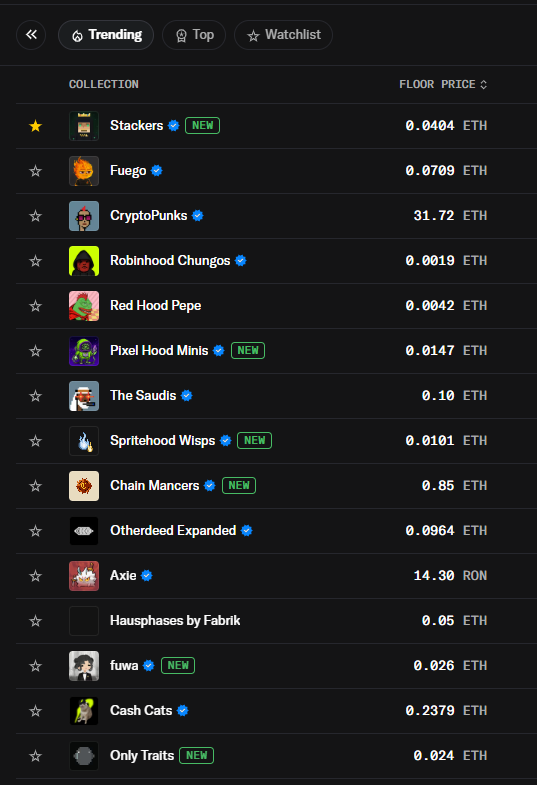
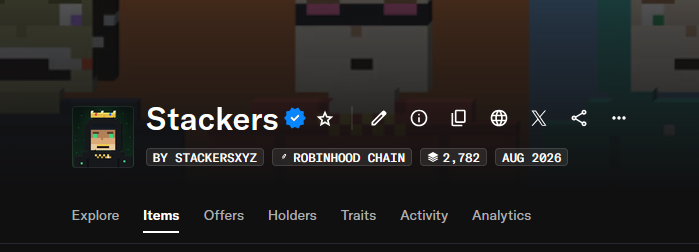
opensea verification
all in 24 hours
proud owner of this bad boy
GM Stacker!
38 hours In
Paid out: $34,230
Stackers paid: 1,560
NFTs burned: 216 (7.20%)
$STACK burned: 141,375,000 (14.14%)
Few things lined up later 🫡
Small update
A few of you flagged that changing your split didn't seem to stick.
It was saving to one Stacker at a time, and nothing on the site showed you that. Both fixed. Your dashboard now shows what each Stacker is buying.
Hard refresh and have a look.
Everything runs automatically. If a cycle is ever delayed nothing is lost, it catches itself up and pays out with the next one.
I've been going nearly 40 hours so I need a few hours of proper sleep and then back at it when I'm up 🫡
24 hours in and we've paid out $20k
205 NFTs burned along the way. 12% of the supply gone.
Every hour, activated Stackers get paid
Opensea verification up next
https://t.co/pbhIWNJ8Ii